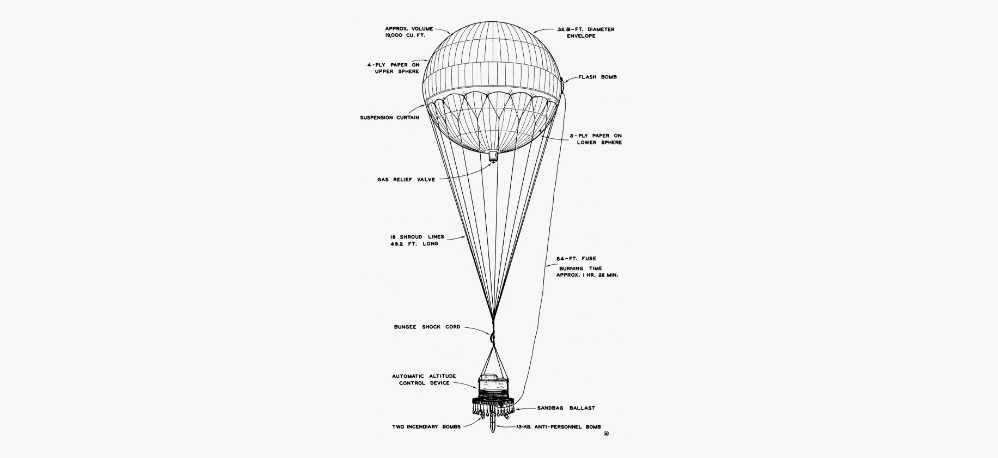

In 1944, Japan, which was at the end of its rope, was overwhelmed by the strategic bombing of the US military. The military called for revenge on the US mainland, but had no good plan. Meteorologist Hidetoshi Arakawa discovered that in winter, a strong atmospheric circulation at an altitude of about 10,000 meters in Japan blew through the Pacific Ocean to the US mainland, with a speed of up to 300,000 meters per hour. It only took 3 days to reach the US mainland from Japan. The military formulated the "Flying Elephant Plan" (FU-GO) to use hydrogen balloons to carry bombs across the ocean to bomb the United States. In early November 1944, the first batch of "windboat bombs" carried the hatred of the Japanese to the other side of the ocean. They hoped that these "devil’s gifts" could cause forest fires, destroy buildings, kill people, and cause panic in the United States. However, the height of this high-speed airflow was not stable, and it would also shift laterally. The control device with only 24 sandbags could not ensure the height. The women and students who were responsible for the manufacturing task had no relevant experience, and many balloons leaked and crashed just after taking off. According to postwar statistics from the United States, Japan mobilized millions of people and spent half a year to manufacture more than 9,000 balloons, of which at most 900 flew to the American continent.
The American press was prohibited from reporting related news in order to confuse the Japanese while avoiding causing panic among the people. If the frenzied Japanese knew that the "Sailboat Bomb" could attack the U.S. mainland, they would certainly increase their investment to manufacture and release more balloons. The Japanese Kwantung Army Unit 731 conducted inhumane live experiments in China, and the large number of biological weapons it manufactured had long been used in actual combat. Americans were worried about being attacked by biological weapons. The strict news blockade made the Japanese military believe that few balloons could fly to the United States. The "Sailboat Bomb" neither effectively attacked the U.S. mainland nor played a role in boosting morale at the time of the collapse of the empire. The Japanese, who had completely lost confidence, stopped the plan at the end of April 1945.

Material issues
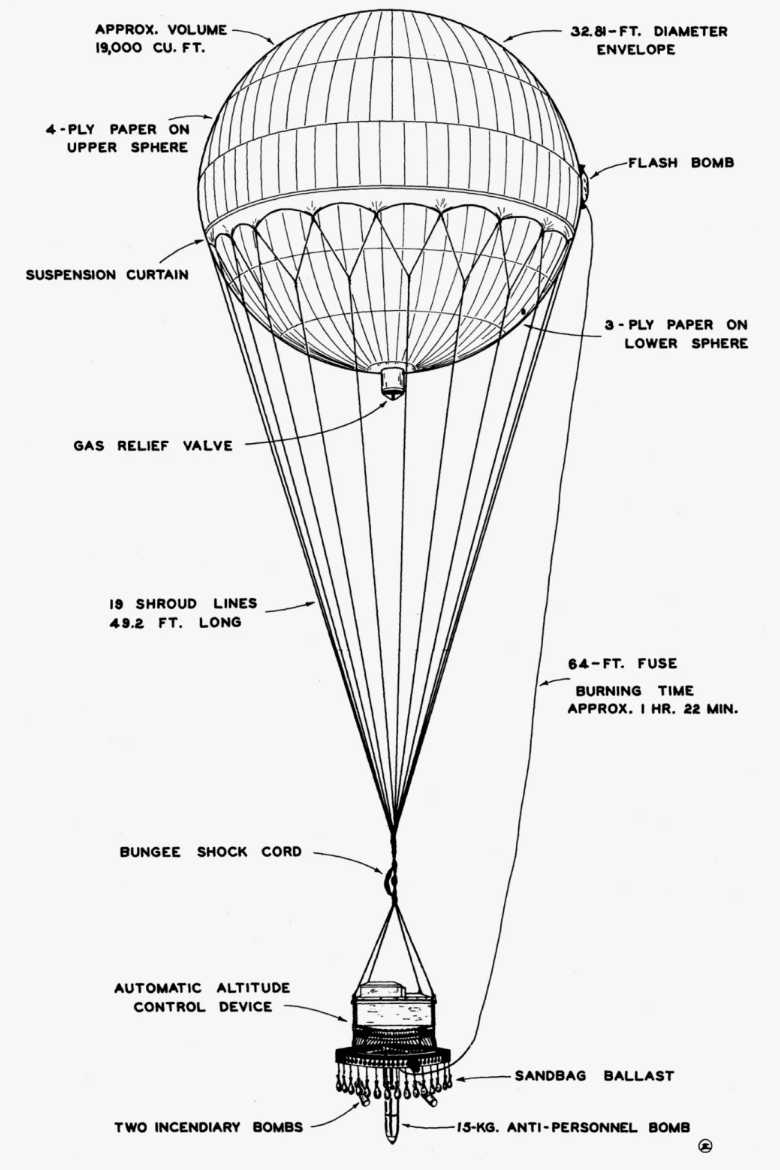
The special materials needed to make hydrogen balloons were already scarce strategic resources in Japan at that time. The Japanese explored the solution of using Ogawa paper as a substitute. This paper has high toughness, does not need to be coated with rubber, and is low in cost. It does not consume strategic materials and is very suitable for production in Japanese workshops. A large number of people participated in the production.
How the balloon maintains its altitude in the circulation
In order to maintain the flying altitude of the balloon, the Japanese army designed a mechanical height-limiting device consisting of a barometric altimeter, sandbags, and balloon deflation valves. When the barometric altimeter finds that the balloon’s flying altitude is lower than 9,000 meters, it will trigger the mechanism to throw away the two sandbags on the disc in opposite positions to reduce the weight, allowing the balloon to rise; and when the altimeter finds that the balloon is higher than 12,000 meters, it will open the valve to release some hydrogen to reduce lift and let the balloon descend.
Bomb dropping problem
The Japanese installed a timer on the balloon. The balloon should have reached the North American continent after three days of flight, and the ballast should have been consumed. The timer released the bomb and the incendiary bomb, and ignited the fuse to burn the balloon after 84 minutes, thereby destroying the evidence and keeping the secret.
In 1942, Arakawa Toshihide discovered "high-speed airflow", but his "balloon bomb" idea was not taken seriously.
In 1944, Arakawa’s idea was recognized by the military, and the Flying Elephant Project began to be implemented.
In November 1944, the first batch of "windboat bombs" departed from Japan and flew to the United States.
In April 1945, the Flying Elephant Project was terminated.
On May 5, 1945, a balloon crashed in Oregon and killed 6 civilians. This was the only casualty caused by a balloon bomb in the United States, and the only public war casualty in the United States during World War II.
The balloon bomb was the only weapon that Japan successfully used to bomb the North American continent during World War II, and it was also the first weapon with intercontinental strike capability. However, no matter how "brain-opening" the weapon was, it could not change the outcome of the demise of Japanese fascism.