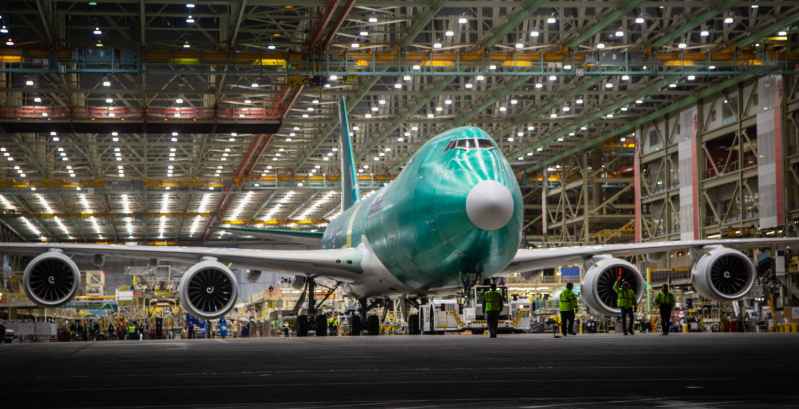

On December 6, 2022, the last Boeing 747 rolled off the production line. After that, the production line of Boeing 747 will be closed. There will be no new "Swan Head" launched in Everett. The curtain call of Boeing 747 is due to the trend of changes in the shipping market. Its emergence and prosperity in the past were also the result of market demand. To this day, the development of Boeing 747 is still likened by many people to "a big gamble", and this metaphor actually makes sense. Boeing Company keenly captured the new trend of market demand through the communication with Pan American Airways and the conversation with Pan American boss Juan Tripp: a "big plane" that can carry 366 passengers for long-distance flights is needed. Going forward in this direction, the wide-body four-engine 747 was finally born.
The development of Boeing 747 is difficult because it is too big. On the one hand, the project leader Joe Sutter had to solve a large number of unprecedented technical difficulties and convince customers to accept a single-deck wide-body aircraft that subverted their dream of "double-deck cabins throughout the body". On the other hand, he had to constantly entangle with the company’s senior management in multiple parallel major projects to fight for limited resources. When the Boeing 747 entered the market, it unfortunately ran into Boeing’s dark age. The higher priority supersonic passenger aircraft 2707 was cancelled, and high-investment large projects such as the "Apollo" project and the 747 project almost drained the company’s cash flow, and the Boeing 737 had not yet become a cash cow. Boeing was forced to lay off nearly 60% of its employees and even reached the brink of seeking bankruptcy protection. Just a few years ago, with the success of the Boeing 707 and 727, the total number of Boeing employees surged to 100,000 in the 1960s. But the recession in 1969-1970 caused many airlines to choose to cancel orders. The Boeing 747 project was implicated, with no new orders for several consecutive years, and a serious backlog of aircraft. After layoffs, Seattle’s unemployment rate soared to an astonishing 13.8%, far exceeding the national level of 4.5%.
The difficult times did not completely change until the mid-to-late 1970s.
The Boeing 747 gradually won market recognition through continuous improvement and perfection, and began to show strong market vitality against the background of the improvement of the commercial aviation situation. The Boeing 747 is the pinnacle product of the hub-and-spoke shipping era. It is a large wide-body passenger aircraft that was born out of the rapid expansion of people’s demand for air travel. It meets the urgent requirements of the expansion of the large passenger flow long-distance shipping market.
The Boeing 747, known as the Queen of the Sky, is a myth in half a century. It can transport 500 passengers at a time, and its unique round head has impressed countless people. The Boeing 747 has been associated with the flight footprints of countless celebrities. It is also the "Air Force One" of the US President. It has even been transformed into a carrier platform for space shuttles. Today, it still bears the heavy responsibility of launching rockets in the air. However, the market is always changing, sometimes fast, sometimes slow, sometimes obvious, sometimes obscure. Over the past few decades, with the advancement of aviation technology, the face of air travel has been quietly changing. The business model of commercial aviation has also evolved from a hub-spoke shipping system to a smaller fragmented point-to-point direct flight system, rather than the original starting point-hub-end point. At the beginning of the 21st century, passengers no longer expect to fly to the final destination via a hub city as a transit point, but hope to be able to continuously bypass the traditional transit hub to achieve convenient direct flights.
In response to this change, aviation manufacturers have launched new aircraft that are slightly smaller, more fuel-efficient and have longer range. In recent years, the Boeing 747 has had many competitors and successors, such as the more economical Boeing 777. The large passenger capacity and long-range advantages of the Boeing 747 are no longer irreplaceable. If measured by operating economy, the Boeing 747 is the last-ranked wide-body aircraft in service. Aviation analysts believe that as early as 2004, Boeing considered the retirement of the 747. The Boeing 777-300ER has begun service, and the company believes that the service of the 777-300ER is the beginning of the end of the 747. The new crown epidemic has also changed the business model of commercial aviation. In 2020, British Airways, which was under heavy pressure from operating costs, announced that it would retire its Boeing 747 fleet four years ahead of schedule. According to statistics, there are only 44 747 passenger planes still flying, and more than 300 747 cargo planes are busy running. A set of figures can illustrate the problem: in 1990, the proportion of Boeing 747 in wide-body passenger aircraft and cargo aircraft reached 28% and 71% respectively. By 2022, these two figures have become 2% and 21% respectively. As the most uneconomical old-school wide-body aircraft, the Boeing 747 finally announced its curtain call after experiencing glory. In its resume, the total production of 1,574 aircraft is a very good performance.
All legends have an end. The legendary end of the Queen of the Sky is a conclusion of her retirement.