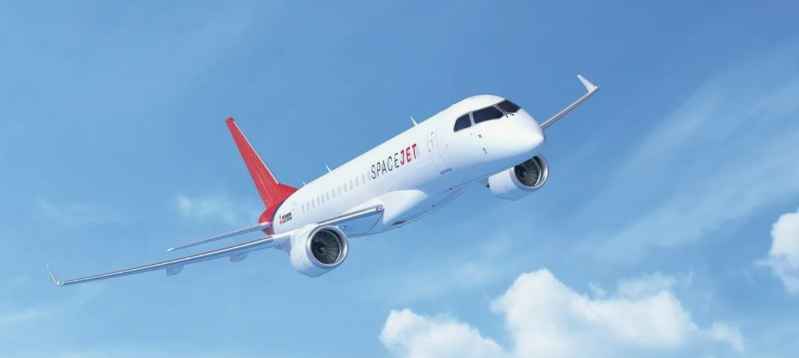

February 7, 2023 is a bleak day in the history of Japan’s civil aircraft industry. After years of delays, Japan’s Mitsubishi Heavy Industries announced the cancellation of the SpaceJet project, admitting that "it is too difficult to manufacture domestic jet airliners and may not be possible."
This statement is equivalent to declaring that Japan’s dream of impacting domestic jet commercial aircraft has finally come to nothing. When it comes to determination and perseverance, I have always admired the Japanese. Strictly speaking, there is nothing wrong with Japan’s formulation of a strategic goal for the development of domestic jet commercial aircraft. The Japanese government hopes to use Mitsubishi Heavy Industries to lead the development of domestic regional jet airliners as a starting point to integrate and forge relatively scattered but not low-level domestic aviation manufacturing companies into a powerful industrial system and move strongly towards the upstream of the global aviation manufacturing industry. The ideal is beautiful, but Japan obviously underestimated the cost of realizing this ideal, and it is seriously insufficient.
First of all, in terms of time, Japan started the development in 2008 and planned to complete the project in five years and deliver it in 2013. Even for established companies like Boeing and Airbus, it is not so fast to develop a new model. It took China’s ARJ21 12 years from the beginning to the airworthiness certification, and C919 took 14 years. From this, Japan’s urgent mentality can be seen. Secondly, in terms of budget, Japan estimates that it can be completed with 150 billion yen, which is a little more than 1 billion US dollars. However, if you do some statistical investigation, you will find that from scratch to build a civil jet branch line and complete the airworthiness certification, this amount of money is just a small amount. The excessive optimism in progress and budget reflects a cruel fact, that is, Japan does not fully understand the technical difficulties in the development of large commercial aircraft and the "combat effectiveness" of its own aviation research and manufacturing system. As a result, the first flight was completed from 2008 to 2015, and the project progress was postponed six times. To this day, the type certificate has not been obtained. The 450 orders that were hard to accumulate were cancelled one after another, and only 270 are left, and they are still shaky. The business prospects of Spacevet also changed from sunny to cloudy, and finally to bleak. As for the budget, the plan was 150 billion yen, but it was overspent and overspent again. Now more than 1 trillion yen (7.6 billion US dollars) has been invested, but there is still no way forward. It is not impossible to continue to move forward. Mitsubishi Heavy Industries estimates that it will burn at least 100 billion yen every year and it may take several years. Even if Japan is determined to burn it, the existing software problems and air conditioning system problems of the aircraft (this is just the exposed problem) may not be solved smoothly. The airworthiness test exposed that the original design changes and other big troubles are as difficult as ghosts, which makes Mitsubishi Heavy Industries gradually lose confidence.
Mitsubishi Heavy Industries was quite frank about the direct reasons for the project’s suspension. President Shoji Iwasawa directly stated that there were two major difficulties:
First, Japan lacked technical experience in the development of advanced regional jetliners, especially in the airworthiness certification procedures;
The second is that Japan lacks sufficient resources to continue to advance the project.
Speaking of these two major difficulties, Japan’s neighbor China needs to face the same difficulties as Japan. The two countries launched commercial aircraft projects almost at the same time, but China has a full understanding of the degree of difficulty. Under the integration of national strategies, it has gathered the most powerful resources of its aviation industry, made scientific and careful deployment, and unswervingly fought a protracted battle.
Let alone, the six years of airworthiness test flight work of ARJ21 and the five years of certification work of C919 can show the patience and tenacity of China’s aviation industry. What is the difference between Japan and China? It may be in the integrity and health of the aviation industry. Since China established its aviation industry in the 1950s, it has maintained the integrity and health of the industry for more than half a century. Although there have been twists and turns, it has basically maintained its confidence. For decades, China’s aviation industry has always maintained the research and development, testing, mass production and test flight capabilities of large aircraft. Although it lacks experience in the field of commercial aircraft, it has a technical population and cognitive ability foundation. In particular, the long-term accumulation of a large number of basic technologies has always allowed China’s aviation industry to contain a "small universe" that can be stimulated.
These are the real foundations that support the country’s strategic ambitions. It is good to have determination, have ideals in your heart, have clear eyes, be rational in planning, act in an orderly manner, be reserved in good times, and be tenacious when encountering setbacks, only then can you see the dawn of success.