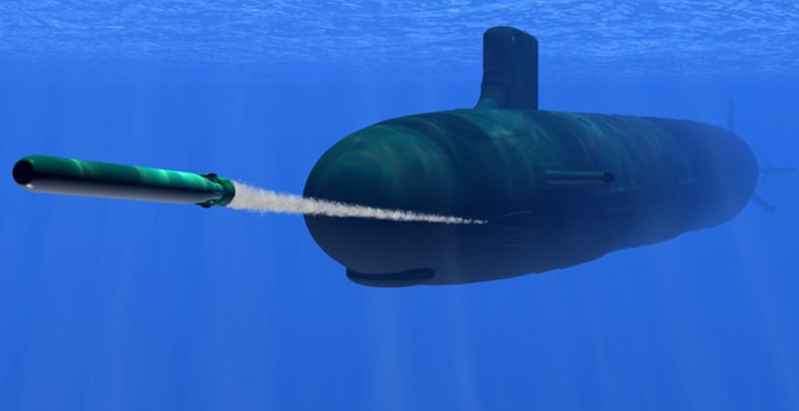

Electromagnetic launch technology can not only be applied to the catapult takeoff of aircraft carriers, but may also be applied to the field of submarine torpedo launch in the future. At present, there are two main ways to launch torpedoes: relying on the torpedo’s own power device and using external force to push. Electromagnetic launch technology belongs to the latter. The picture shows the imaginary picture of the launch of the US MK48 Mod7 torpedo. The new nuclear submarines of the US Navy now mainly use air turbine pumps to launch torpedoes.
Submarine torpedo launch technology
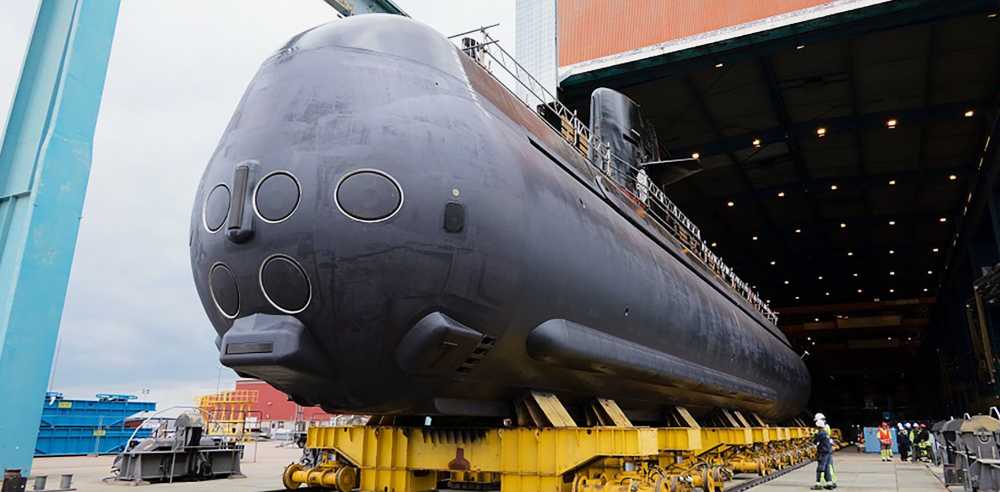
The torpedo launch device is an important part of the submarine weapon launch control system and is an indispensable and reliable guarantee to ensure that the torpedo completes the offensive and defensive combat missions. At present, the torpedo launch devices equipped by naval submarines in various countries in the world mainly include self-propelled, pneumatic unbalanced, pneumatic ramjet, hydraulic balance, and air-filled turbine pump. These devices have different characteristics and different combat needs and values. Self-propelled launch device The self-propelled torpedo launch device opens the front cover of the launch tube in advance according to the torpedo attack instructions and procedures, and is propelled out of the launch tube by the torpedo’s own power system. The torpedo then enters the water, sails in the direction of the target according to the guidance instructions, and completes the attack. The advantages of this device are simple structure and operation, and low launch noise; the disadvantages are low initial launch velocity of the torpedo. After the torpedo leaves the tube, it will first fall deep to form a larger bag depth under the action of negative buoyancy, and then return to the set depth to sail. This device is suitable for small and medium-sized submarines to launch torpedoes, but the water depth of the launching sea area must be considered to prevent the torpedo from forming a large bag depth and sinking to the seabed after leaving the tube. There are two conditions that must be met to achieve self-propelled torpedo launch: First, the torpedo must start the power system in the launch tube to ensure that it leaves the launch tube at a higher initial velocity. Therefore, self-propelled launch is only suitable for electric-powered torpedoes with higher initial velocity, but not for thermal-powered torpedoes; Second, during the self-propelled launch process, seawater can freely and quickly enter the launch tube to fill the space vacated by the torpedo exit tube, which requires the inner diameter of the launch tube to be larger than the diameter of the torpedo to reduce the impact of water flow on the rapid exit of the torpedo from the launch tube. Therefore, self-propelled launch is more suitable for use at depths above 50 to 60 meters.
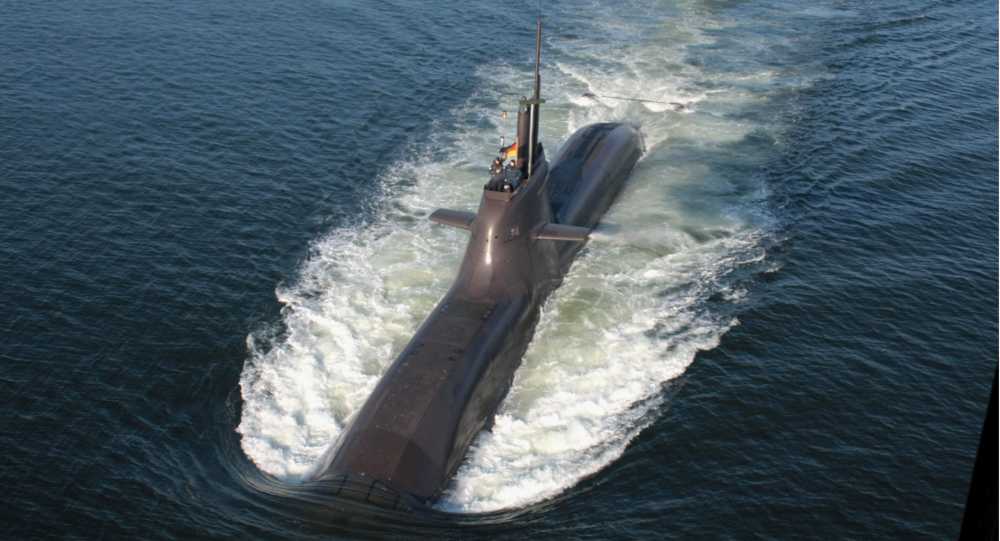
In contrast, European countries are more inclined to use self-propelled launch tubes on conventional-powered submarines, such as the German Type 214 and the Italian Sauro class. These two types of submarines are also equipped with a water pressure balance launch system, which is mainly used for emergency launch, that is, the torpedo cannot self-propelled out of the tube for some reason and needs to be ejected out of the tube, or for launching unpowered mines and thermal-powered torpedoes with low initial velocity, etc.
Pneumatic unbalanced launcher
Pneumatic unbalanced launcher relies on high-pressure gas to blow the torpedo out of the launch tube, so that it can be away from the submarine as soon as possible and give it a higher initial velocity. Before launching a torpedo, first fill the gap between the launch tube and the torpedo with water through the water tank, then balance the pressure in the launch tube with the seawater depth, and then open the front cover of the launch tube. When the torpedo is launched, high-pressure gas is injected into the launch tube from the launch gas cylinder, and the high-pressure gas pushes the torpedo out from the tail of the launch tube. With this launch method, the torpedo has a high initial velocity and a wide range of applications. It can launch weapons such as unpowered mines, torpedoes or missiles. Pneumatic unbalanced torpedo launchers are widely used on modern conventional submarines due to their simple structure, small size, light weight, low manufacturing cost, good working reliability and maintainability. Most conventional submarines of various countries during World War II and the Cold War used this type of launcher. However, the unbalanced launcher is deeply affected by the launch depth. At great depths, a large amount of high-pressure gas needs to be carried; launcher. However, the unbalanced launcher is deeply affected by the launch depth. At great depths, it needs to carry a large amount of high-pressure gas. The launch noise is large, and after launch, the high-pressure gas rushes out of the boat to form a large number of bubbles, which easily exposes the submarine’s position. For this reason, a bubble recovery device must be designed to recover the high-pressure air and discharge it into the submarine when the torpedo travels to 3/4 of the launch tube. The greater the water depth, the greater the pressure, and the greater the pressure difference between the inside and outside of the launch tube, so it cannot be used at great depths and is generally suitable for use at a depth of 80 to 100 meters.
Pneumatic ramjet launcher
Pneumatic ramjet torpedo launcher, which pushes the sleeve-shaped ramjet through high-pressure gas to push the torpedo out of the launch tube. This device was first successfully developed by France and is mainly equipped on the Augusta-class conventional submarines and Rubis-class attack nuclear submarines. This device is small in size and light in weight, but requires the torpedo structure to be strong and able to withstand greater impact force.
Hydraulic pressure balance launcher
This method uses high-pressure water flow to launch torpedoes, and introduces seawater outside the boat into the water cylinder. There is a piston in the cylinder, and the other end of the piston is connected to the air valve. Before launching, seawater is injected into the launch tube from the torpedo gap water tank, and then the launch tube is pressed through the launch cylinder to make the launch tube consistent with the external pressure, and then the front sealing cover of the launch tube is opened. During launch, the launch cylinder valve is opened, and the high-pressure air pushes the piston to press the water in the water cylinder into the launch tube, pushing the torpedo forward. Because the pressure of the torpedo is the same before and after, the launch is not affected by the depth of the water and can be launched underwater at a depth of 300 to 600 meters, so it became the mainstream launch method of nuclear submarines in the 1970s and 1980s. The United States’ Los Angeles-class, Soviet/Russian Akula-class attack nuclear submarines, Typhoon-class ballistic missile nuclear submarines, etc., all use this launch method. Its advantages are low launch noise, good concealment, and high initial velocity; its disadvantages are complex equipment and difficult maintenance.
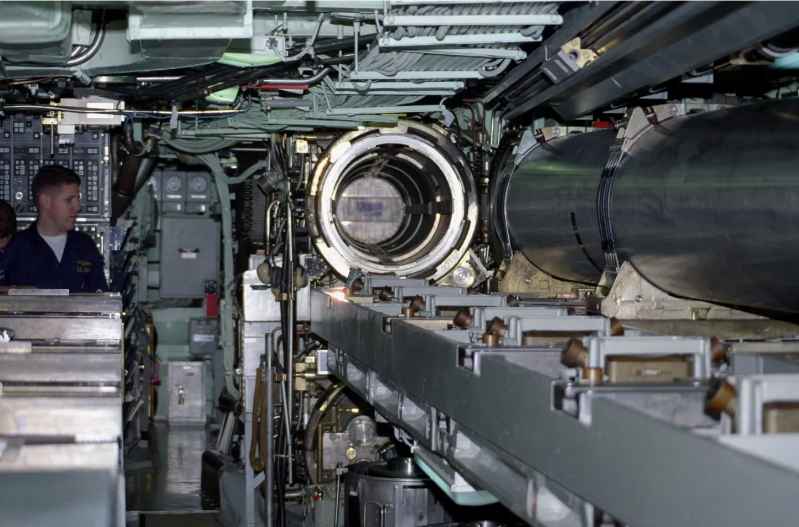
Air turbine pump launch device
This is a popular launch technology for modern nuclear submarines. The principle is similar to the water pressure balance launch. The air turbine first pushes seawater into the launch tube to push the torpedo to launch. Its advantage is that the reciprocating water cylinder piston is replaced by a rotating air turbine, which greatly reduces the volume and can be used by small and medium-sized submarines. The air turbine is not affected by the external water depth and can be launched from tens of meters to thousands of meters deep. It is an excellent, mature and stable launch technology. The Seawolf and Virginia classes of the United States, the Astute class of the United Kingdom, and the Yasen and Borei classes of Russia all use this launch device. It can be seen that most advanced submarines currently use air turbine pumps to launch torpedoes/missiles underwater. Compared with the previous linear propulsion method (such as hydraulic pistons), this method is smaller in size, lighter in weight, and has higher energy utilization. However, due to the need to arrange mechanical pumps, turbines, gearbox launch cylinders and other equipment, the launch system still needs to be improved in terms of maintenance costs. Based on this background, foreign countries have proposed a technical solution for submarine underwater horizontal electromagnetic launch of torpedoes/missiles, but it is still in the design stage and no relevant reports on engineering development have been seen.
Development of submarine electromagnetic launch technology
From the invention patent application published this time, the fully submerged multi-unit electromagnetic launch device may have been in the technical development stage, and at least there is a prototype that can realize the principle of underwater electromagnetic launch technology, but there is no relevant report on whether it is suitable for equipment on new submarines or whether it has been installed on a certain type of submarine for testing.
Concept and characteristics
Compared with the traditional launch method that relies on the expansion of the working fluid to drive the load movement, the electromagnetic launch technology can accelerate the load to an extremely high speed, the acceleration process is smoother, the speed and acceleration can be arbitrarily controlled, and it also has the characteristics of high energy conversion efficiency, simple structure, low noise, high safety, etc., and has strong military application potential. The traditional submarine torpedo launcher uses a launch tube as a launch channel for different weapons such as torpedoes, missiles, and mines. On the one hand, it needs to penetrate the submarine pressure hull, so the number of launch tubes is limited, which limits the number of weapons launched in each wave; on the other hand, before launching, it is necessary to inject water into the launch tube, equalize the pressure, open the front cover, etc. The long combat preparation time limits the rapid response capability of the confrontation. These operations will also generate a lot of noise, which is easy to expose the position of the submarine and affect the sonar detection of the target.

The fully submerged multiple electromagnetic launcher adopts a fully submerged design as a whole, which can work in seawater for a long time. The equipment adopts wet storage, and the launch frame body adopts a frame structure: the equipment and the mover are in open and connected waters for balanced launch. The launch process is independent of the diving depth, and deep launch can be achieved. It has the characteristics of fast and continuous launch, deep diving, full immersion, multiple installations, high integration, high power density, fast preparation, fast switching, flexible adjustment of equipment tube speed, and low launch noise.
Basic composition
The device consists of 4 basic parts: base assembly, linear launch motor assembly, integrated launch frame assembly and rotation drive assembly. The linear launch motor assembly includes: a stator, a mover, a rear support barrel seat, a front buffer cavity, a pull-rope sensor and guide rods symmetrically arranged on both sides of the stator. The rear end of the stator passes through the front end of the rear support barrel seat and the front buffer cavity. The front end of each guide rod is installed on the front buffer and the rear end is installed on the rear support barrel seat. The two guide rods cooperate with the guide blocks on both sides of the middle of the mover to realize the linear guidance of the mover movement. The pull ropes of the two pull-rope sensors are respectively installed on the guide blocks on both sides of the mover. A mover push block is provided at the top of the middle of the mover.
Launch principle
The electromagnetic catapult is a device that uses the electromagnetic force generated by a linear induction motor to accelerate the torpedo to a speed that meets the specified exit speed. The linear induction motor consists of an outer secondary cylindrical mover and an inner primary cylindrical stator. The mover moves linearly along the stator under the action of the electromagnetic force to realize the conversion of electricity and power and provide power for the weapon launch. The pull-rope displacement sensor is used to measure the motion parameters of the mover to realize real-time closed-loop control of the launch process. The linear launch motor brake adopts position open-loop control, and when the motor starts braking, the mover is separated from the weapon, and the coupling surface between the mover and the water is very small, so the influence of water resistance can be ignored during the braking stage.
Before launching, the motor is controlled to drive the launch frame body to rotate, and the torpedo is rotated to the top launch position, and the equipment adapter at this position is automatically connected with the mover push block. During launching, the mover generates thrust under the action of electromagnetic force, the push block pushes the equipment adapter, the equipment adapter pushes the equipment, breaks free from the brake lock, and accelerates forward along the stator together; when the mover moves to the end of the acceleration stroke, it decelerates under the action of the reverse electromagnetic force, and the equipment adapter decelerates with the mover, and the torpedo separated from the torpedo continues to move out of the tube under the action of inertia; the mover and the equipment adapter decelerate to stop, and then move to the starting end under the action of the reverse electromagnetic force. If the next torpedo needs to be launched, the motor is controlled to drive the launch frame to rotate, and the next torpedo is rotated to the launch position, so that the conditions for launching again are met.
In 2013, the United Kingdom proposed the "integrated electric launch tube" scheme, which is a typical underwater electromagnetic launch technology scheme in recent years. It launches the load through the torpedo tube and adopts the principle of linear induction motor, which is similar to the electromagnetic catapult. The stator of the linear induction motor is arranged along the wall of the torpedo tube, and the mover is located at the tail of the load to push the load forward.
Technical difficulties
The main technical difficulties of submarine underwater electromagnetic launch are as follows:
First, the driving force of electromagnetic launch is proportional to the magnitude of the current. In order to accelerate the torpedo/missile weapon to a higher speed in a short time, a lot of power support is required. The peak output power of the electromagnetic launcher is required to exceed tens of megawatts and the thrust is tens of tons, which requires the linear motor to have a large enough power. Such a high-power motor is difficult to meet for diesel-electric submarines and submarines equipped with AIP power systems. In addition, due to the power loss of the linear motor, the heat dissipation problem must be considered, and an active cooling system is required to cool it. This is difficult to meet for a closed submarine cabin, and a feasible solution is to install it outside the submarine cabin.
The second is the storage and release of electrical energy. In order to store enough electrical energy, a large capacitor is required, but due to the limited space in the submarine cabin, this requires the energy storage capacitor to be small in size, with a large amount of electrical energy storage, and also needs to be installed outside the cabin.
The third is that the linear motor is an important device for electromagnetic launch. It converts electrical energy into kinetic energy by making the rotor move linearly in the electric field. The rotor of the linear motor drives the torpedo/missile to move, and changes the size of the driving force through the change of the size of the electrical energy to achieve the purpose of controlling the launch force. The control system continuously monitors the operating status of the entire system during the entire ejection process, regulates according to the changes in the submarine environment and the parameters of the launch system, changes the terminal speed as required, and also undertakes the alarm task of the entire electromagnetic launch system. The key to the control system lies in improving the control accuracy and reliability, as well as the relevant technologies for precise control of large amounts of pulse power.
The fourth is the limitation of electromagnetic shielding technology. The electromagnetic field of the electromagnetic catapult cannot interfere with other electronic equipment of the submarine.
The fifth is that the electromagnetic launch device is arranged outside the cabin, and it is necessary to consider the corrosion resistance, collision resistance and underwater reloading of the launch device and torpedo weapons, the integration of the launch device and the load, and the contradiction with the layout of the integrated sonar array at the bow. In addition, the existing attack submarines can carry more than 20 to 50 torpedoes/missiles. The launch device must consider the matching of the spare rack storage weapons and the reloading system.
Application prospects
Underwater electromagnetic launch technology is an emerging development direction for submarines to launch torpedoes/missiles/mines underwater horizontally in the future, and its application prospects are broad. However, it must be noted that the current underwater electromagnetic launch technology at home and abroad is not mature enough, especially the conventional submarine battery or AIP power system is difficult to provide the high-power power demand of the launch motor; although the power supply system of nuclear submarines is not a big problem, it is limited by the cabin space and the layout of the integrated sonar array at the bow. The fully submerged multi-unit electromagnetic launch device must be arranged outside the pressure-resistant shell to be feasible.
At present, nuclear submarines of the United States, Britain, Russia and other countries still use relatively mature and reliable air turbine pumps or water pressure balance torpedo launch technologies, but with the continuous development and improvement of technology, it is believed that submarine electromagnetic launch technology will soon be applied and promoted, especially for underwater launch of submarine-launched ballistic missiles and cruise missiles. In particular, in terms of launch efficiency, this technology can launch several or even dozens of missiles in a very short time, and the strike effect will be greatly improved.