
Request for foreign aid
Since formally joining NATO in 1952, Turkey, which controls the only passage between the Black Sea and the Mediterranean Sea - the Turkish Straits, faces the threat of the Soviet Union, is close to the powder keg of the Middle East, and has long-standing territorial and maritime disputes with its neighbor Greece, has almost never relaxed its efforts to enhance its military capabilities. Given that its land is mainly mountainous and plateau, and that both its land and sea borders face a high level of threats, Turkey has long begun to equip its armed forces by purchasing helicopters from abroad to effectively meet the possible military operations of Turkey and NATO in multiple directions.
Since the 1980s, Turkey has begun to seek to purchase powerful equipment from the United States in addition to the various types of general-purpose helicopters it has equipped, and eventually purchased 32 second-hand AH-1P and AH-1S "Cobra" helicopters in 5 years. The performance of these "Cobras" in many operations has made the Turkish army very satisfied. The Turks are not willing to fall into the military trade cycle of "buy from abroad, use, upgrade and buy from abroad". In view of the painful experience of the US arms embargo after sending troops to Cyprus in 1975, Turkey cannot ignore the risk of being cut off from weapons and equipment again. The establishment of the Turkish Aerospace Corporation in 1973 is considered an important measure to achieve self-sufficiency in Turkish helicopters. Since the mid-1980s, Turkey has been conducting anti-guerrilla operations against anti-government organizations such as the Kurdistan Workers’ Party in the southeast and along the border, and urgently needs helicopters that can adapt to the combat environment to participate; at the same time, the threat from the Soviet Union and the Warsaw Pact countries is still real. The Turkish Defense Industry Development and Support Administration (SAGEB, established in 1985), which is responsible for the planning of military equipment, proposed the largest package procurement and development plan in Turkey’s history in 1987, purchasing and developing helicopters of various models and purposes for Turkish government departments and the military in the next ten years, with a total of 700-800 helicopters. Among them, about 600 general-purpose helicopters were purchased and developed for government departments, and about 150 general-purpose helicopters and armed reconnaissance and armed attack helicopters were purchased and developed for the military.
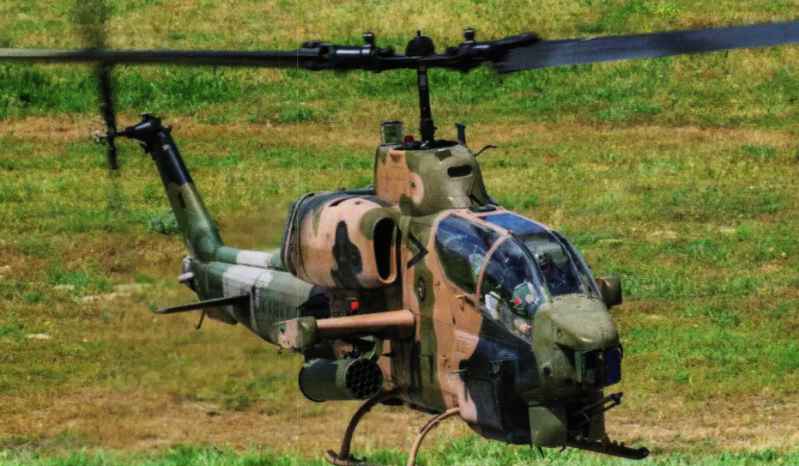
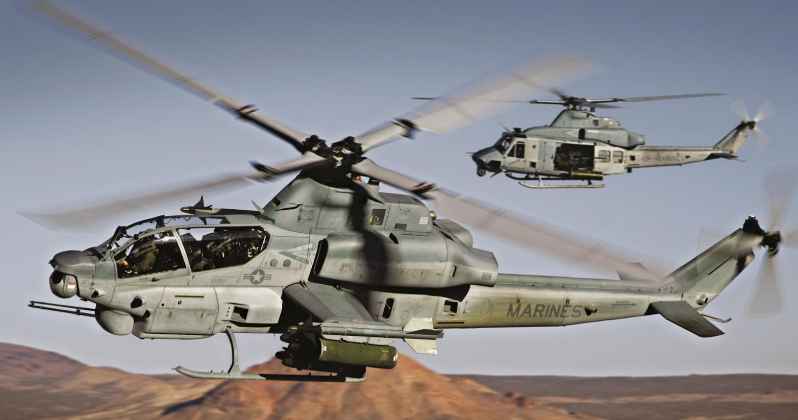
However, at that time, the Turkish Aerospace Industries was weak and the work it could carry out was limited to the development of light piston trainers and the maintenance and improvement of existing aircraft models. As for the helicopter industry, it had almost no achievements. Not only did it not have the ability to develop new models of helicopters, but even the overhaul and upgrade of the AH-1 series helicopters equipped by the Turkish Army had to rely on Israel Aerospace Industries (IAI). In view of the increasing shortage of available second-hand "Cobras", Turkey had to purchase 10 new AH-1W "Super Cobras" and 36 second-hand upgraded AH-1S/Ps as a match for the AH-1 series of armed helicopters in the early 1990s. The Turkish Army tested the OH-58 "Kiowa Warrior light reconnaissance helicopter around 1995, but the test results disappointed the Turkish side and the plan to purchase 50 aircraft was shelved.
The Turkish Defense Industry Secretariat (SSM, reorganized from SAGEB in 1992), which had lost patience with the purchase of existing models of helicopters, then formulated a Turkish armed/reconnaissance helicopter plan and named it the ATAK plan, which means "attack" and "brave" in Turkish. The SSM planned to purchase 145 armed reconnaissance and attack helicopters, but then cancelled the requirement for reconnaissance functions and instead purchased professional armed attack helicopters. Due to the expected sharp increase in costs, the purchase quantity was reduced to 50. The Turkish Defense Industry Secretariat approved the plan and officially launched the procurement bidding. Only two companies participated in the bidding, one was the American Bell Helicopter Company, the manufacturer of the AH-1 series, and the other was the Russian Kamov Company and Israel Aerospace Industries, which jointly bid. The former used the ultimate model of the AH-1 series, the AH-1Z, to participate in the competition, while the latter launched a radical modernized upgraded version of the Ka-50 "Black Shark", the Ka-50-2, and named it "Erdogan", which means "born warrior" in Turkish. The aircraft uses a tandem two-seat cockpit and uses a large number of Western avionics and weapon systems. In the end, Turkey chose the more mature AH-1Z and conducted further negotiations with Bell, but the project did not go to the end. The US government believed at the time that the two mission computers in the integrated avionics system on board involved core defense secrets, so it restricted exports. In addition, the purchase cost of the aircraft continued to rise, and the purchase plan ended hastily.
Twists and turns
Continuously hitting a wall on the issue of purchasing helicopters has strengthened Turkey’s determination to develop its own armed helicopters, but the Turkish aviation industry does not have the ability to independently develop new helicopters at this time, so it can only return to the purchase plan. However, Turkey has put localization in the first place this time. The second procurement case of "loading as many Turkish equipment as possible on the helicopter" was named ATAKI, which not only means inheriting the ATAK plan, but also shows Turkey’s persistence in localizing helicopters. In order to prepare for the localization of armed helicopters, the first meeting of the ATAKII plan authorized the Defense Industry Secretariat to formulate new indicators and requirements and formed a main contractor group. The main contractors in Turkey are Turkish Aerospace Industries (TAI) and Turkish Military Electronics Industries (ASELSAN), of which TA! was just formed by the merger of several Turkish aviation industry companies in 2005. In March 2007, Turkey chose the AgustaWestland AW729 (A129 improved version) over the South African Daniel AH-2 "Stone Tea Falcon" and signed a contract in July to purchase one prototype and 50 production models. The contract also reserved the right to continue to purchase 40 domestically, with a total project amount of up to 3 billion US dollars. This is the origin of the now well-known Turkish T129 attack helicopter.
Compared with the current stagnation due to the embargo sanctions, Turkey was in full swing when it just launched the T129 project fifteen years ago. According to the project contract, Turkey will fully obtain the intellectual property rights of the T129 attack helicopter and have the full right to decide whether to export it. The largest main contractor of the T129 helicopter, the Turkish Aerospace Industries, has complete technical data of the AW729 helicopter and also attaches great importance to solving the technical difficulties that were previously "stuck" by the United States. According to the Turkish side, the T129 The first batch of production TUC-1 (Turkish special configuration batch 1), the first model T129B with full combat capability in the project, will be equipped with Turkish domestically produced mission computers. To this end, Turkey launched the ArGE 2004 research program as early as 2004, led by the Turkish Scientific and Technological Research Council, Turkish Rocket Industries (ROKETSAN) and Turkish Military Electronics Industries, using the AH-1S flight test bench provided by the Army to develop key systems and technologies for advanced armed helicopters, and finally successfully developed Turkey’s domestically produced armed helicopter integrated avionics system and UMTAS long-range anti-tank missile system. However, such results are obviously not enough for Turkey to be able to independently develop and produce T129. In fact, the first three prototypes of the T129 project were modified and produced by AgustaWestland. Although the fourth prototype was produced by TAI, its localization rate was less than 50%, far from the expected level.
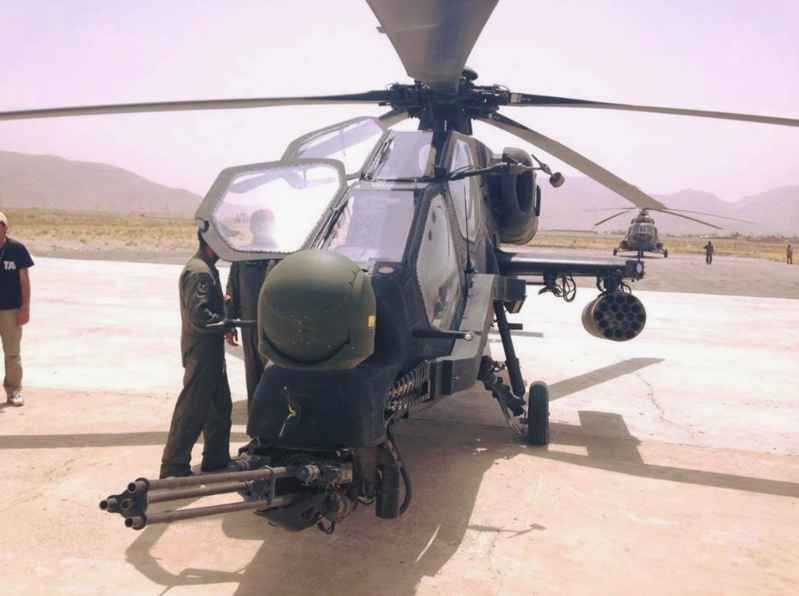
Because the AH-1 in service is too old, more than half of the helicopters in the fleet will run out of flight life. The urgent need for new attack helicopters forced the Turkish Army to urgently purchase 9 early T129s, also known as T129A, in 2010. Compared with the B type, the A type does not have a complete avionics fire control system at all, and the weapon aiming equipment is only the Turkish domestic infrared aiming and navigation system. Compared with the A129, the T129A is equipped with the CTS800-4A turboshaft engine of the LHTEC joint venture, and the rated and emergency power are greatly increased. Due to incomplete equipment, the available weapons of the T129A are only 20mm cannons and 70mm unguided rockets, which are not even as good as the old AH-1P upgraded model. Despite this, the delivery of this batch of "simple version" T129A was delayed, which shows the true strength of Turkey’s helicopter industry.
In 2013, the first two T129As were delivered to the Turkish Army for acceptance testing. The test of such "beggar’s edition equipment" should have been relatively smooth. However, after the test, the Turkish Army raised more than 30 unqualified opinions to TAI. The most serious problem is that the equipment layout of the T129A armed helicopter is unreasonable, and several subsystems placed in the front fuselage are obviously overweight, which causes the helicopter to have a significant downward trend in almost all flight phases. The "top-heavy" characteristics have a serious impact on flight safety and handling quality. In addition, the main rotor system of the T129A, which is almost copied from the A129, also experienced unexpected violent vibrations, which may even make the weapon system unusable in severe cases. The T129A with serious defects was returned to the factory, and TAI had to start urgently improving the problems raised by the military at the end of 2013. However, the technical means of the Turkish side’s improvement seemed quite primitive. When solving the problem of the front fuselage being too heavy, it did not modify the equipment layout or carry out weight reduction design, but simply added a 137 kg counterweight to the tail. It should be noted that the T129 Both the A129 and the original model are light armed helicopters with a maximum take-off weight of only 4 tons. Such unnecessary weight gain has a great impact on performance. It is true that the ceiling of the T129A is limited to less than 5,000 meters, which is far from the design target of 6,100 meters. For the Turkish aviation industry, which has only a short and shallow history of helicopter development, there seems to be no other way to solve such problems.
Where is the way forward
In May 2014, TAI delayed the delivery of 9 T129As for nearly three years. At this time, it had been seven years since the launch of the T129 project, and the AH-1S, which had been seriously overdue in service, was finally retired. The following year, In June, the first T129B was delivered to the Turkish Army, which was more than two years later than originally planned. Turkey was very satisfied with this result. Before the Army could receive the T129 in sufficient quantity on time, it began to attack everywhere and try to get a share of the international arms sales market.
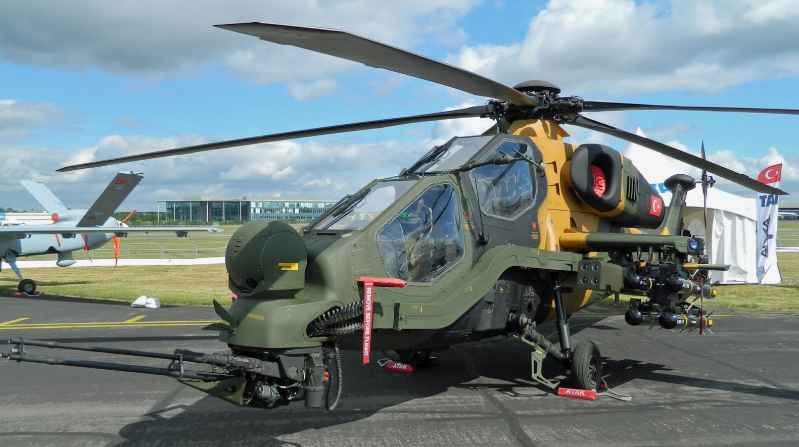
Missile system. Limited by the maximum take-off weight and space, the T129 can carry up to 8 UMTAS missiles at a time
After years of unremitting efforts, Turkey announced in 2018 that it had won a large order for Pakistani armed helicopters from China, the United States and Russia. However, they probably never dreamed of the changing international situation and geopolitics, did not predict the determination of the West to take decisive measures in the face of ideological and interest conflicts, and did not assess how heavy a blow this would cause to their military industry, which claimed to have achieved domestic production. Since the rise of ISIS and the involvement of many countries in anti-terrorism operations, Turkey’s relations with various foreign powers have changed rapidly, but its close relationship with the United States has unexpectedly ended in a rupture. In July 2019, as Turkey insisted on purchasing the Russian S-400 air defense system despite opposition from NATO allies, especially the United States, the relationship between Turkey and the Western world also reached a freezing point. Within a few days, the Turkish Aerospace Industries was cut off from the supply of many Western parts, including the core CTS800-4A turboshaft engine, and the production and sales of the T129 project were also in trouble. Although Turkey has told Pakistan that it has the ability to solve the power problem of the T129, everyone now understands how difficult it will be to build an advanced turboshaft engine from scratch. In the end, Pakistan gave up the T129, which had many preferential but distant prospects, and chose China’s Z-10ME instead. The taste of this is probably only known to the Turks themselves.
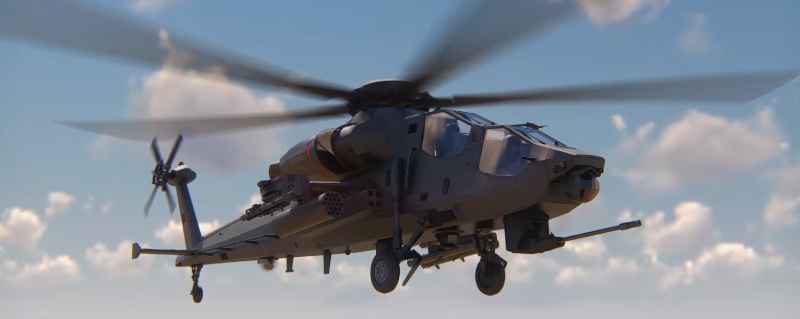
What is even more puzzling is that when the development and production of the T129 project encountered many obstacles, the Turkish Ministry of Defense actually proposed the ATAK I plan in 2017, wanting to directly achieve a two-step jump and develop domestic advanced heavy armed helicopters. In February 2019, the development and procurement contract was officially signed. However, to this day! ATAKⅡ has made almost no breakthrough progress. After all, there is no water without source and no tree without root in the world. Even the Turks, who are full of self-confidence, have to accept this truth.
In September 2018, the T625, which is known as Turkey’s first domestically developed and produced helicopter, made its first successful flight. However, in fact, the aircraft is almost a proportional replica of the AgustaWestland AW139. The engine, transmission system, hydraulic system and other key components used in this aircraft are basically all imported from the West. Although the development of this model can help Turkey to open up the entire process of helicopter design and manufacturing, its Western origins naturally make it, like the T129, lose the power to take off due to the Western embargo. It is difficult to predict whether this simple prototype, which did not even have a door or engine cowling installed during its first flight, can have a bright future.
One wrong move, and the whole game is lost. No one knows where the Turkish helicopter industry will go in the future, but judging from the recent achievements of the Turkish aviation industry and the overall development direction of the Turkish military industry, it is unlikely to see an explosion in the Turkish helicopter industry in the short term. Although we can still see sporadic news such as "Turkey’s domestically produced TS1400 turboshaft engine is being tested", can Turkey seize the opportunity to lead the whole and give its helicopter industry a chance to emerge? The answer can only be left to time.