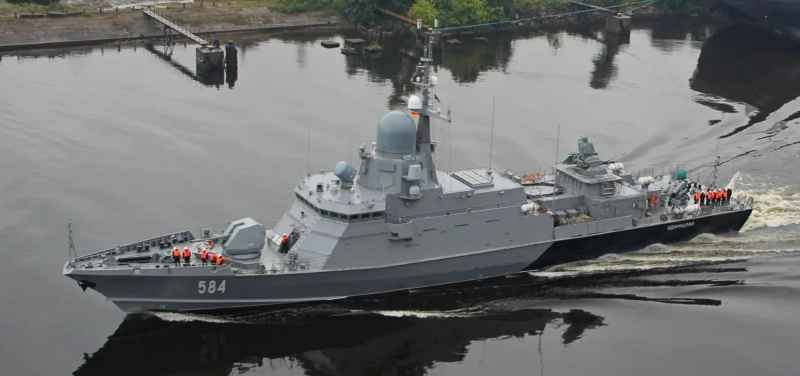

This article will tell about the contemporary Russian small missile ships and the process of forming the "two heroes" of Type 21631 and Type 22800. Although the "Thug" brought the Zelenodolsk Design Bureau (abbreviated as Ze Bureau) into a new world of small missile ships, it also made the "Diamond" Design Bureau covetous. A secretly brewing technological innovation was launched shortly after the birth of the "Thug" M, and soon formed today’s small boat upstart--Type 22800 small missile ship.
Supplement to the limitations of the "Thug"
The overly "river and sea" design of the 21631 type not only restricts the combat application of the ship, but also the shallow draft, small and deep ship layout space is already crowded with various equipment. When the fully armed "Thug" was "drunk" and swayed left and right in the small waves, the troops felt that this fully armed small boat was indeed difficult to use.
There is also an obvious defect in the configuration of the weapon system-air defense. The short-range air defense network composed of the 3M47 "bend" point air defense missile system and the AK-630M2 naval gun system seems to have a decent firepower density, but the long-range distance is only 6,000 meters, just enough to reach the distance of airborne guided bombs. To defend against "professional players" such as "Hellfire" and "Sulfur Stone" that specialize in small surface targets, they can only rely on soft kill means such as electronic warfare. If you can’t hit, what’s the point of arranging the front and rear firing ranges? When the near-range air defense operation is launched in a high-threat environment, the guided ammunition is already approaching. The "thugs" can only rely on the cover of other ships with regional air defense capabilities and aviation forces in the formation to perform their tasks, which deviates from the original intention of small missile ships to be light and concealed.
Of course, in the Caspian Sea, the Black Sea and even the Baltic Sea offshore areas, the "thugs" can still play a role. The ability to pass through inland waterways and mobilize across sea areas is also a unique advantage of this type of ship. The 21631 type that has been ordered can be built slowly. So, what should the several ocean-going fleets that are eager for new ships do?
The "Diamond" Design Bureau, which has already noticed it, has been gearing up for a long time.
22800 taking advantage of the situation
The story starts in the late 1990s, when the 1241-type "Lightning" series orders left over from the Cold War were still being built, and the military trade market orders were impressive. "The Almaz Design Bureau designed a follow-up small missile ship based on this type of ship, and named it the 12300 "Scorpio", ready to be launched in domestic and foreign markets.
The 12300 type retains the overall layout of the 1241 type, and changes the superstructure to a fully enclosed multi-slope configuration, adopts a diesel-fuel combined power form, and plans to replace the "Gem" supersonic missile system and the "Kashtan" close defense system. It is said that one ship was built at the "Flag" Shipyard in Rybinsk Oblast, but it was not built due to lack of funds.
2001 "Thug" project plan bidding: The "Almaz" Design Bureau used the 12300 type as the basis, cancelled the anti-ship missile system according to the requirements at the time, and replaced it with the A-1909 naval gun system. The difference from the A-190-01 type is that it is equipped with a 5P-10 fire control radar dedicated to the main gun, which is more adaptable to the combat environment.
But as mentioned above, simple modifications could not meet the requirements for inland river use environment and fire support at that time. After the "Diamond" design bureau’s proposal was defeated, it could only turn to the foreign market. The 12300 type foreign trade proposal is still on the product page of the Russian Defense Export Company, but it has added options such as the 3C249 "Uranus" 9 missile system. This is closer to the modernization status of the 12341 and 1241 types under the jurisdiction of some missile ship units in recent years.
In early 2014, Ukraine cut off the supply of gas turbines for the Russian 11356 frigates, and the construction and replacement process of mature models of medium-sized surface ships was temporarily interrupted. In the absence of suitable medium-sized ships, the Russian Navy Shipbuilding Administration considered using small combat ships (i.e. Class III ships) to supplement the equipment in urgent need.
As mentioned above, the Zelenodolsk Design Bureau had basically completed the development task of the 21631 type at this time, and also launched an improved and enlarged version, which later evolved into the 21635 series, taking the safe route of improving the models under construction. The "Diamond" Design Bureau, which was full of energy, learned the lesson of the last failed bid and decided to seriously judge and understand the needs of the Russian Navy during this period and locate the design ideas on a feasible basis. The details are as follows:
Make full use of the expertise of offshore ships, while ensuring the seakeeping performance of offshore navigation, taking into account certain mid- and long-distance mission capabilities;
Grasp two key points, fully digest the design ideas of the power system and weapon system that have been practiced in the 21631 type, use domestic supporting conditions, determine to use the M-507Д diesel engine power system and the "caliber" HK as the core weapon system, and at the same time optimize the defects of the original 21631 type weapon system configuration,
Reserve enough design margin, and the space layout is more reasonable.
In short, make up for what the 21631 type lacks.
The Diamond Design Bureau first considered the ship type selection, and adopted a deep V-shaped rounded bilge planing ship type with a folded angle. From the 1234 type, 1241 type to the 12300 type, a large amount of model test and actual ship data has been accumulated, which can better control the overall performance. In order to sail in inland waterways, the beam of this ship type is 11 meters, the same as the 21631 type, but the length is only 67 meters. This is because the planing ship type generally has a small length-to-width ratio in order to control the length of the immersion when starting to slide. The length-to-width ratio of this ship type is 6.09, which is lower than the 6.8 of the 21631 type and higher than the 5.1 of the 1241/12300 type, which is at an intermediate level.
Although the ship length is short, this type of ship type is fuller in the middle and rear, and the folded angle at the tail also increases the displacement volume of the tail, making the restoring moment ratio The 21631-type ship has a shallow draft and a large rounded bilge. In consideration of improving the sea navigation performance, the design draft is also increased by 300 mm compared with the 21631-type, reaching 2.8 meters: at this time the displacement reaches about 800 tons; at the same time, two pairs of inclined anti-roll fins are also set on the bilge of the hull. These measures are essentially improved compared with the former method of locally exceeding the baseline in terms of reducing roll and improving wave resistance.
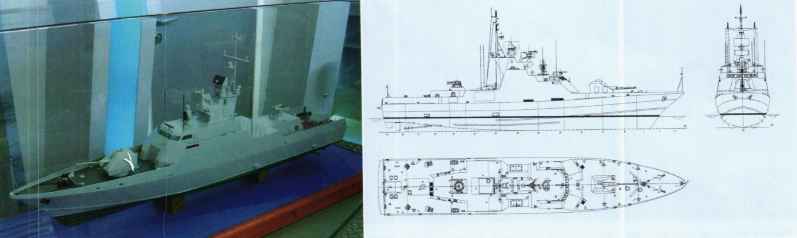
In addition to the ship type, the "Diamond" Design Bureau also tried to improve stability in other aspects, so that this small warship can still perform tasks in sea conditions of level 5. The entire ship structure adopts a steel-aluminum hybrid form, and the superstructure is made of all-aluminum alloy, which saves more upper weight and lowers the center of gravity than the 21631 type structure with only the mast made of aluminum alloy. The main gun is replaced with a lighter AK-176MA naval gun system-after all, near-shore fire support is no longer the primary mission.
Increase speed, increase range, and maintain a certain low-speed maneuverability. Due to the increase in the hull space, a set of M-507Д diesel engine units can be added, and fixed-pitch propeller shafts can be used to improve transmission and propulsion efficiency, increasing the speed to 30 knots; increasing the volume of fuel tanks and fresh water tanks to increase the self-sustaining power to 15 days; Although it is not as maneuverable as the water jet propulsion system of the 21631 type - most operating conditions do not require such good maneuverability, a side thruster is still retained under the bow, which is very practical when docking and leaving the dock.
2014 At the end of the year, the proposals of the two design bureaus were put to bid. The Ze Bureau, which was still thinking at the same level as four years ago, was unsurprisingly won by the Diamond Design Bureau, and the new ship took advantage of the situation.
The Shipbuilding Administration gave the new missile ship model 22800, and the engineering code was transliterated as "Karakut", which is a Turkic compound word meaning "poisonous spider" or "black wolf". The author thinks it is closer to "poisonous spider", which is a tribute to the previous generation of small missile ships.
This side forward
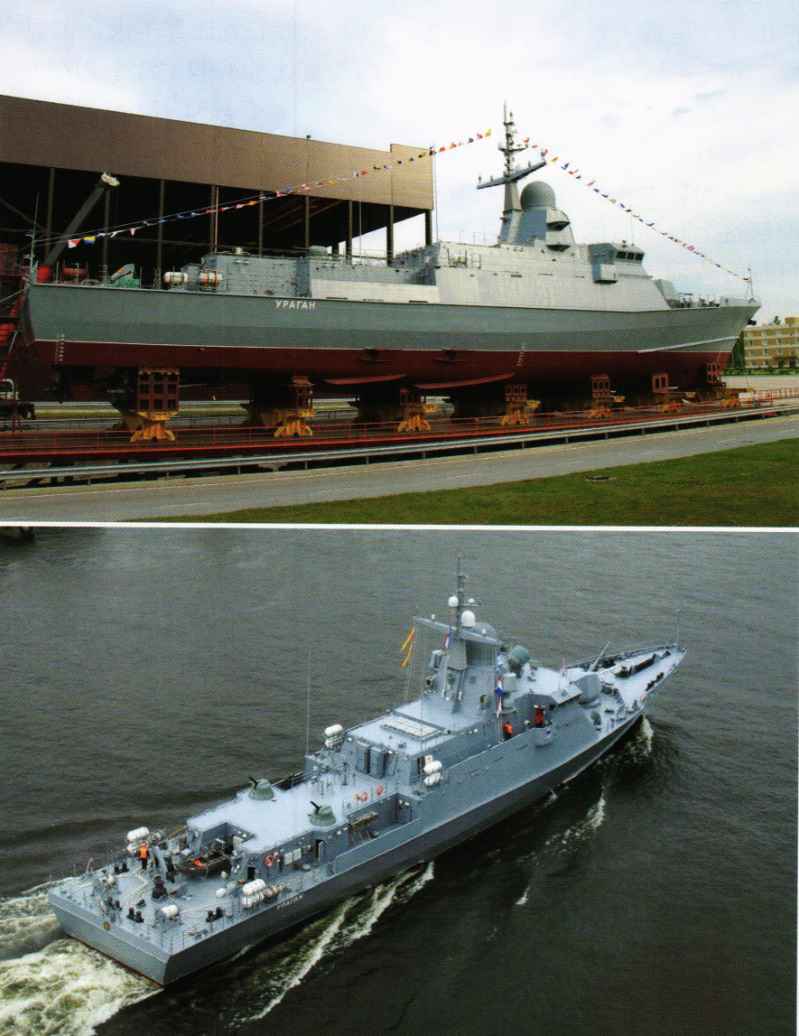
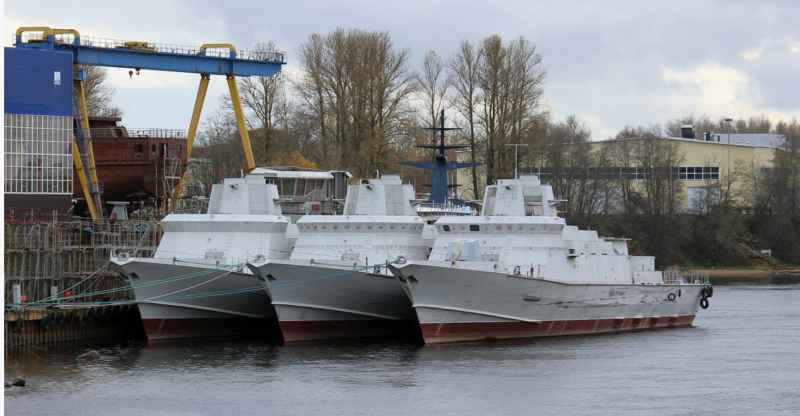
Due to the previous accumulation, the design progress of the 22800 type was quite fast. "The Diamond Design Bureau formed a design team in April 2015 to start technical design, and turned to detailed design in December 2015 and some drawings were sent to the factory. Earlier, the Navy held a tender for the construction of the first batch of two ships. The "Pella" Shipbuilding Co., Ltd. in St. Petersburg won the bid (hereinafter referred to as the "Pella" factory). On December 24, 2015, the construction ceremony of the two ships was held at the same time. The factory numbers were 251 and 252, and they were initially named "Hurricane" and "Typhoon".
The deepening process of the plan
The first public release of the 22800 type was at the first "Army-2015" International Military Technology Forum held on "Patriot Day" in June 2015. The "Diamond" Design Bureau exhibited the renderings at the booth, which should be the technical design status.
In addition to the overall parameters, most weapon systems such as the main gun and yKCK launch module are shown. In order to strengthen the air defense capability mentioned above, the "Armor" M system is configured, and two small-caliber missile vertical launch devices are arranged in front and behind the system. The model was not specified at the time.
The 22800 model exhibited at the "Army-2016" forum has more technical details. The small-caliber vertical launch device has been cancelled, and rectangular phased array radar antenna arrays have been added to the front walls (and only the front walls) on both sides of the composite mast structure.
The design status disclosed by the 22800 model and published data exhibited in 2017 is more detailed and should be close to the expected design: This is a small missile ship with distinctive "Diamond" design bureau characteristics. In addition to the overall characteristics of the ship type, the arc-shaped wave strips extending from the bow to the waterline, the tail wave strips and the freeboard angle lines have all appeared in the 1234 and 1241 series.
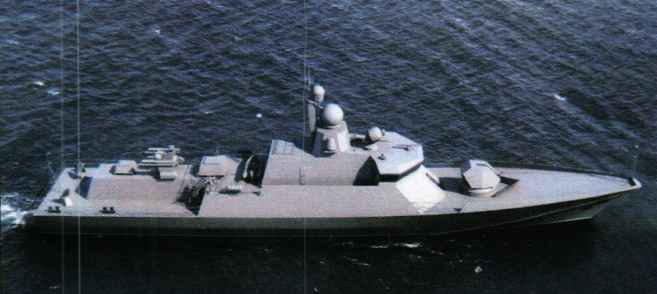
The design status rendering.
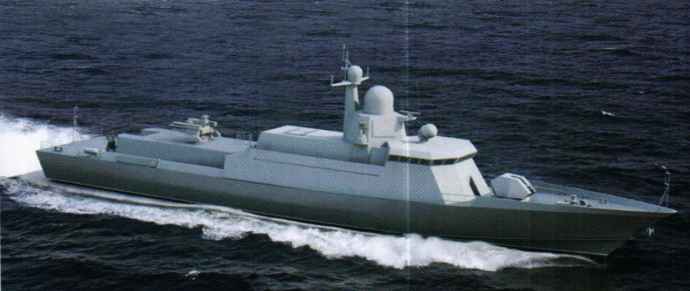
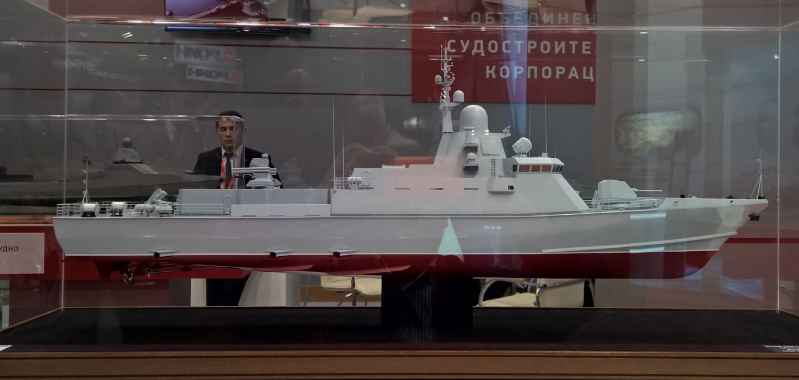
Actual ship technical status
In order to achieve three-machine propulsion, the three M-507Д units are arranged horizontally in a "品" shape with 2 in front and 1 in the back, and extend at different shaft angles as the tail line is lifted. Among them, the shaft angles on both sides are 5° and the middle shaft angle is 10° (this angle requires a universal joint transfer). Each shaft drives a large-disc 4-blade fixed-pitch propeller. The three propeller positions are separated by two balanced rudders. The two side propellers extend to the front of the rudder and the middle propeller extends to the middle and rear of the two rudders. The use of an odd number of propeller shafts will bring about the problem of torque imbalance. For this reason, the rotation directions of the three propeller shafts are different. The middle propeller shaft and the right propeller shaft are counterclockwise, and the left propeller shaft is clockwise.
In order to increase the potential for subsequent modification and upgrading, the generator set uses 3 ДПAЫ3150. For concealment considerations, the 6 diesel generator sets of power + electricity all use independent underwater exhaust ports, 4 on the port side and 2 on the starboard side, which is more beautiful and does not need to paint the rear hull plate black like the 21630/21631 type.
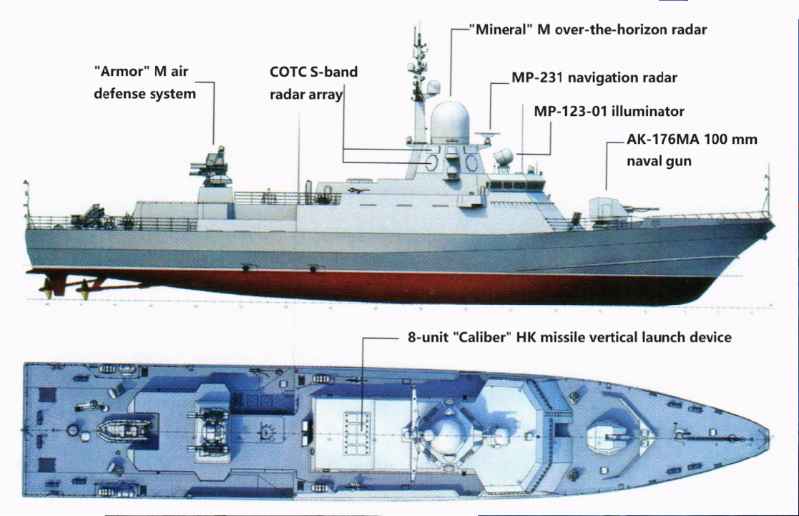
The superstructure and deck layout are relatively simple. Behind a small section of the bow wall is a AK176MA main gun of the Russian Armament Machinery Manufacturing Company, with a maximum rate of fire of 150 rounds/min and a maximum range of 15 kilometers. The total weight of the gun is only 11 tons, which saves 7 tons of weight compared to the A-190 type. Due to the high rate of fire, it can also play a certain role in air defense.
Behind the main gun is an integral superstructure, two decks high, with a fully enclosed cab extending to both sides, and a pair of observation platforms are reserved for open-air use on the outer walkway. Above the cab is an MP-123-01 illuminator and a CII-520M-2 photoelectric detection device. Behind is the integrated deckhouse of radar electronic equipment, with TK-25 electronic warfare system antennas on both sides, an MP-231 navigation radar in front, and a 5Π-26M1.2 "positive phase" M1.2 multi-function radar installed above. Behind the radar is a tower mast, which is centrally installed with the "Centaur" ИM data link antenna, satellite communication antenna, navigation identification antenna, etc., eliminating the space for another mast. Behind the cab is an 8-unit yKCK launcher, which also has a small section of sinking like the 21631 type, but the difference is that the 22800 type is horizontal, reducing the longitudinal layout length. After that, the superstructure was reduced to one deck, which was mainly used for ventilation equipment room and close-in weapon system equipment room. The rear deck was mainly used for small boats and anchor lifesaving equipment. Four IK-10 passive jammers were distributed on the front and rear decks. If machine guns were needed, they would also be placed nearby. As for the mine tracks, they were finally not seen this time.
On July 29, 2017, when the first ship was launched, the first batch of ships was finally fixed, with some differences in some parts. Since the Tula Instrument Factory needed to give priority to the production of the land-based "Armor" S1 to be sent to Syria, the "Armor" M system could not be delivered in time. The first two 22800 ships could only install the AK-630M in stock first. One set of two turrets were arranged on both sides of the tail superstructure where the "Armor" M was to be installed; the draft mark showed that its standard draft depth at the bow should reach 3.2 meters, and the tail mark line reached 3.4 meters, which was larger than the nominal data; the two phased array radar arrays were not installed, but were closed with steel plates.
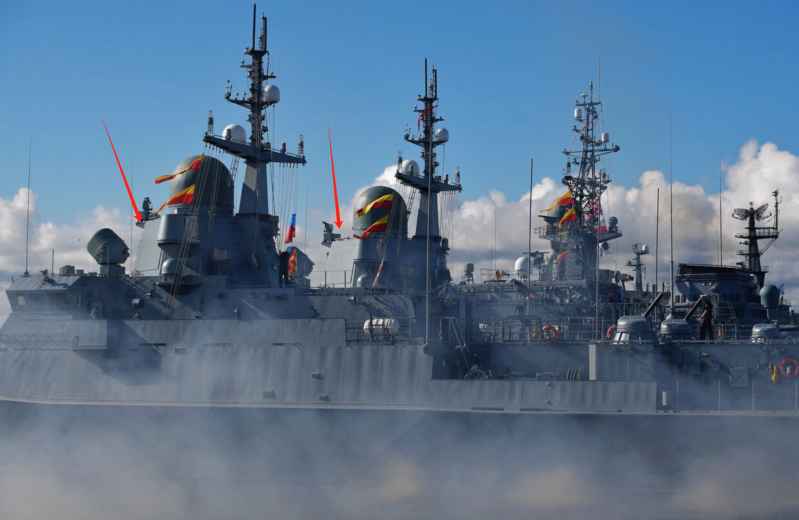
"This side is forward" speculation
In the first batch of configurations, these two phased array antennas have always confused me, and various materials have different statements about their models. Judging from the appearance of the model and concept map, one theory is that it is a scaled-down version of the 50N6E "Orbit" multi-function radar in the S-350 air defense system or the 5П20K "gold-coated rubber" radar on the 22350 frigate. Both radars have search and guidance capabilities and are mainly used for air defense missions. However, except for the main gun, the combat system configuration of the first batch of 22800 is similar to that of the 21631 type, and there is no place for this high-end radar; another theory is that it is the array antenna of the "Mineral" M over-the-horizon radar. Since this type of ship can carry the anti-ship types of three missiles, "Caliber", "Gem" and "Zircon", this statement makes sense - forward search, binding and launching, and then turning and withdrawing, it will not be used later, but as the configuration of subsequent batches becomes clear, "this side forward" seems to be a transitional attempt. Until now, both sides are just steel plates.
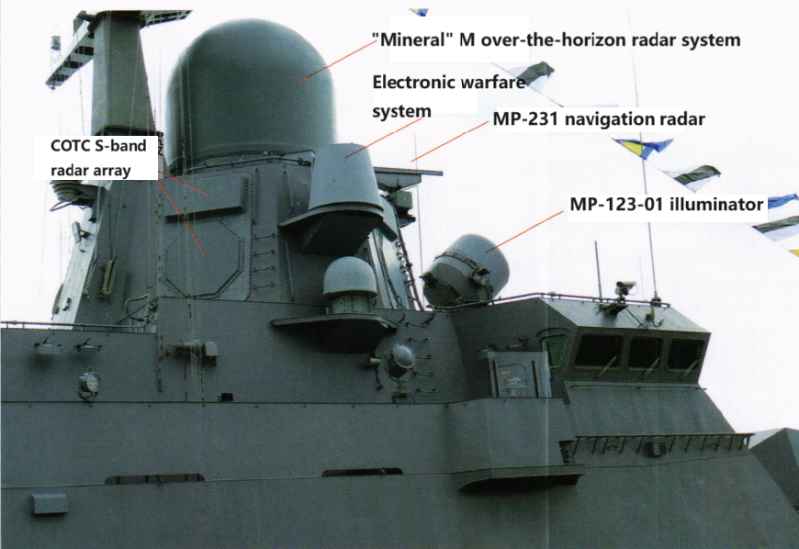
The array surface (including search array and identification array).
From rivers and seas to offshore areas
The second batch of gradual improvement
While the construction of the first batch started, the "Diamond" Design Bureau continued to promote the "complete version of the 22800 design. The Russian Ministry of Defense authorized the Shipbuilding Administration to conduct construction bidding, and built a total of 16 new missile ships for the Baltic Fleet, the Black Sea Fleet and the Pacific Fleet on the principle of regional allocation, called the second batch of 22800. Among them, the "Pella" plant and its holding "Ocean" shipyard mainly supply the Baltic Fleet, winning 5 ships; the Zelenodolsk plant (referred to as the Ze plant) and its holding "Gulf" shipyard mainly supply the Black Sea Fleet, winning 5 ships; the Far East Amur Shipyard and the "Eastern" Shipyard mainly supply the Pacific Fleet, winning 6 ships.
The second batch The 22800 model can be seen as a further adjustment of the original design in its complete state. While the overall layout remains basically unchanged, the latest version of the "Armor" M system is installed, which is equivalent to the status of the "Armor" S2. At the same time, the COTCS band radar array (including search array and identification array) that matches the "Armor" S2 is installed in the superstructure deckhouse in a four-sided symmetrical shape, replacing the "positive phase" M, and giving this position to the real "Mineral" M over-the-horizon radar system. The changes brought about by these changes are obvious:
First, the short-range air defense firepower of small missile ships has finally been supplemented. The 57E6 missiles carried by the "Armor" M have expanded the effective air defense distance to 20 kilometers with the cooperation of the complex and ship-borne sensors; and the four-sided fixed array also has a more comprehensive field of view and faster response speed than the "this side forward" or rotating scanning array.
Second, the over-the-horizon strike capability of a single ship has been enhanced, and the active radar detection distance of the "Mineral" M can reach 250 km: The passive radar sensing distance reaches 80 ~ 450 km. Considering the low height of the 22800 type, the sensing distance can reach about 100 km. Even without data link support, the 22800 type has a stronger attack capability than the 21631 type.
Gradually becoming a trend
Unlike the 21631 type, which was built by one shipyard, the second batch of the 22800 type was built simultaneously by 6 shipyards in 3 directions. Among them, No. 254 (shipyard number) built by the "Ocean" shipyard was the first to start construction, but No. 253 (shipyard number) should be the first ship built by the "Pella" factory and the earliest to serve in this batch. The service status of subsequent ships is not clear due to data problems. Interestingly, both the "Ocean" and "Gulf" shipyards were built in 2014. In 2000, the Crimean Shipyard was merged into the Russian-owned enterprise for well-known reasons. The "Ocean" Shipyard also formed an assembly line relationship with the "Pella" plant. The three 22800-type ships built by the shipyard only completed the platform part, and then were towed by tugboats along the Volga River route to St. Petersburg to complete the subsequent engineering.
In 2018, several Type 22800 ships under construction encountered the problem of insufficient M-507 million production capacity, just like the previous Type 21631 construction delays. Fortunately, it has been alleviated recently.
Compared with Type 21631, Type 22800 performs much better at sea. During the national test of the first ship No. 567, the speed quickly reached more than 30 knots, and the stability in sailing attitude and wind and wave conditions was good. With the first batch of two ships entering service, Type 22800 will gradually become popular in the 2020s, allowing Russia’s new generation of small missile ships to move from rivers and seas to offshore.
Subsequent development
The Russian Navy’s regular deployment in the Middle East continues, and Type 22800 may have a chance to show its strength. In the future, the 22800 and 21631 types will be in mixed use for a long time, and will also undertake near-shore strike and support missions together with the in-service 1241 type and even a small number of improved 1234 types.
While developing the Russian self-use model, the Almaz Design Bureau also simultaneously launched the export version of the 22800 model, called the "Karakut" 9. The main engine uses the MTU 4000 series and adopts a relatively normal 4-engine 4-propeller propulsion form.
During the "Army-2019" exhibition, the "Almaz" Design Bureau also launched an upgraded version of the "Karakut", which was vividly called the "Super 22800" by the media. Its scale is obviously larger. Judging from the added chimney configuration, the power system should have added a gas turbine and changed to a diesel-fuel combined power unit; added a yKCK universal vertical launch device; cancelled the "Armor" M, and installed two 16-unit 9M100 "Fortress" air defense missile system, the rear deck has added two 4-unit "Paper Bag" NK anti-submarine weapon launchers. Interestingly, the two radar arrays are back. Considering the 9M100 on board, it is finally understandable that the designer wants the 22800 type to take on the "forward" formation area air defense. The "Super 22800" launched by the "Diamond" Design Bureau is close to the level of light frigates. Will this "poisonous spider" continue to grow? How much new things can small ships bring to the Russian Navy? .