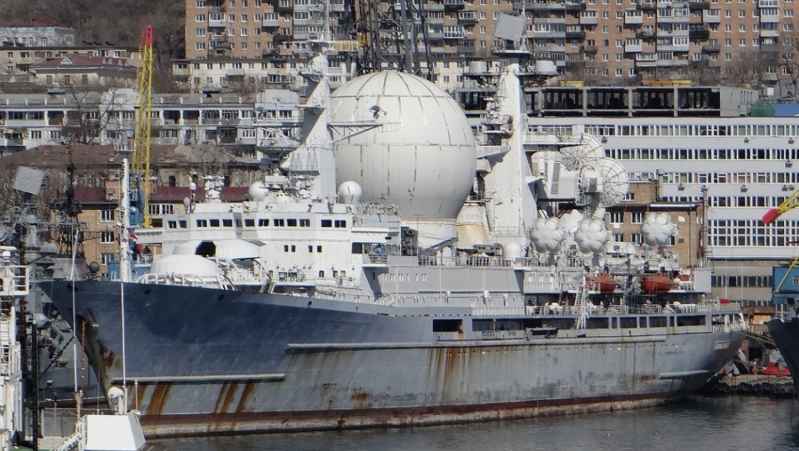

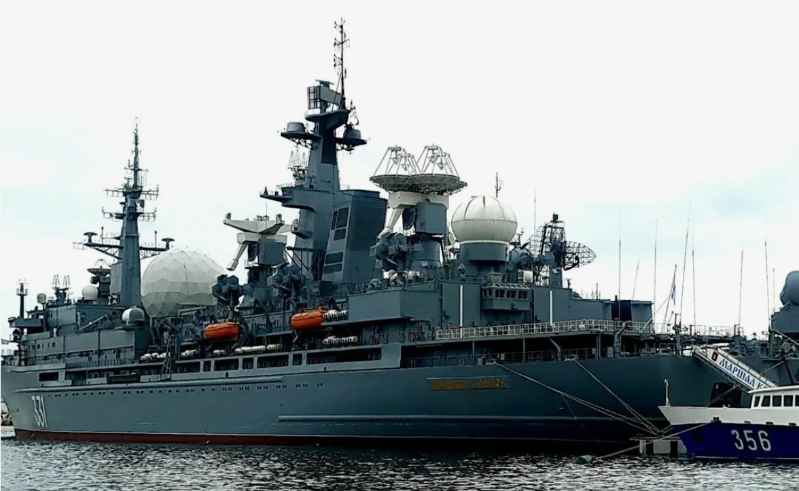
Before the outbreak of the Russian-Ukrainian conflict in February 2022, the Russian Navy has conducted large-scale joint exercises in the Mediterranean, the North Sea, the Sea of Okhotsk, the Northeast Atlantic and the Pacific, and dispatched the Pacific Fleet flagship "Varyag" cruiser and the "Admiral Tributs" large anti-submarine ship formation to the Mediterranean to participate in the exercise. As the trend of the long-term evolution of the Russian-Ukrainian conflict becomes clearer, it is expected that the Pacific Fleet ships will be deployed in the Mediterranean for a long time. In this case, the heavy responsibility of the command ship of the Russian Pacific Fleet has historically fallen on the "Marshal Krylov" (hull number 331) aerospace measurement ship.
In late June, the Japanese Ministry of Defense announced that the "Marshal Krylov" led the "Marshal Shaposhnikov", "Admiral Panteleyev", "Grumpy", "Perfect", "Loud" and "Zydenzapov" a total of 7 ships, arrived at the waters about 280 kilometers southeast of Cape Erimo, Hokkaido, and then sailed to the waters about 180 kilometers southeast of Inubosaki, Chiba Prefecture, and appeared in the waters between Sumisushi Island and Torishima Island in the Izu Islands. Finally, the formation passed through the Miyako Sea and entered the East China Sea all the way north, returning to Vladivostok (Sea Cucumber). During the voyage around the eastern waters of Japan, the formation practiced air defense, submarine search and other subjects, and conducted coordinated maneuvering exercises with the Pacific Fleet Naval Aviation.
In fact, it is not the first time that the "Marshal Krylov" has served as a command ship. In the 2021 joint military exercise between the Chinese and Russian navies, the "Marshal Krylov" replaced the "Varyag" as the command ship for the first time, and its appearance once attracted great attention from the outside world.
Missile support mission
The "Marshal Krylov" is the only Marshal Nedrin-class survey ship (1914 type) in the Russian Navy fleet. In addition to some civil aviation support tasks, it is mainly responsible for flight design tests and testing of new aerospace equipment (such as spacecraft, cruise missiles, ballistic missile launch vehicles, etc.). It has repeatedly supported the test launch of the "Bulava" submarine-launched intercontinental missile by the Borei-class ballistic missile nuclear submarine to the Kamchatka Peninsula.
According to public reports, between 2004 and 2011, the "Topol" M During the test firing of the "Bulava" missile, the "Marshal Krylov" was responsible for monitoring the warhead parameters of the missile at the extreme range many times. On August 27, 2011, when the "Yuri Dolgoruky" nuclear submarine conducted the "maximum range test firing of the Bulava missile" in the designated waters of the Pacific Ocean, the "Marshal Krylov" was responsible for monitoring the arrival of the missile warhead in the designated area. In November 2012, the "Marshal Krylov" sailed 2,000 nautical miles in 2 weeks, not only recording in detail the telemetry information of the Pacific Fleet’s nuclear submarines launching ballistic missiles and cruise missiles, but also recording the live-fire shooting of the Russian small missile ship strike group. In 2013, the "Marshal Krylov", led by Lieutenant Colonel B. Kulik, ensured the arrival of the 667BDR The strategic nuclear submarine "Saint George Dragon Slayer" was tasked with launching a ballistic missile test mission.
Refitting to achieve multi-functionality
Since the 21st century, military technology has advanced rapidly. Under information conditions, combat has expanded from traditional three-dimensional space to multi-dimensional space. As the Russian Pacific Fleet’s ships are aging as a whole, the "Marshal Krylov", which was commissioned in 1990, is also facing problems such as backward equipment and shortage of parts, and its role is difficult to adapt to the needs of the new situation. Admiral C. Avakyantz, then commander of the Pacific Fleet, discussed with ship officers and military experts and finally decided to modernize the "Marshal Krylov" based on the evaluation report.
In early October 2014, the "Marshal Krylov" sailed from the Kamchatka Peninsula to the Far East Shipyard in Vladivostok (Vladivostok) to overhaul the main engine and auxiliary engine, and significantly upgraded the full set of measurement and control equipment. The four-year-long The modernization process has begun since then.
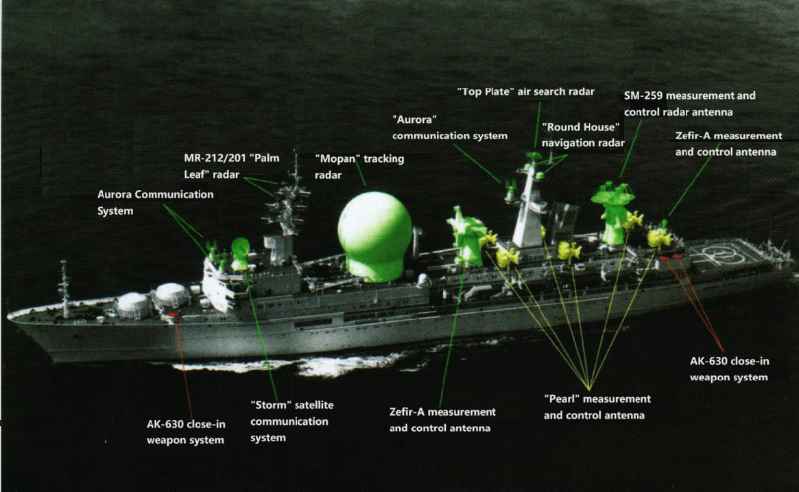
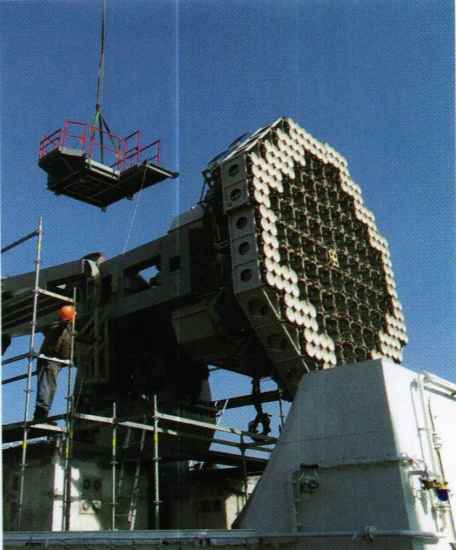
According to the modification plan, the "Marshal Krylov" added a spherical antenna cover in front of the helicopter deck at the stern and installed a more advanced new integrated radar system; modified the radio technical equipment and applied modern process technology; re-arranged the ship’s command post. During the mooring test, the modified "Marshal Krylov" re-debugged and calibrated the radio technical integrated system (used to accept the telemetry equipment and a full set of radar equipment that can measure the track of aerodynamic targets and ballistic targets), instrument measurement and control system, and optoelectronic ballistic measurement and control system.
Modernization empowers efficiency
The "Marshal Krylov" learned the lessons of the "Ural", solved the electromagnetic compatibility problem, and inherited the advantages of the "Ural" electronic reconnaissance. Through radar measurement, it can not only ensure the test launch of its own strategic missiles, but also obtain the core parameters of other countries’ ballistic missiles such as range, accuracy, trajectory characteristics and warhead characteristics. On the one hand, these functions can evaluate the testing, delivery, projection and strike capabilities of other countries’ strategic weapons, and provide a basis for the country to formulate corresponding national security strategies; on the other hand, the ballistic missile target characteristic data obtained is a fleeting strategic intelligence, which can be used for the country’s ballistic missile defense system to improve combat effectiveness.
The detection data of the "Marshal Krylov" long-range radar can support the construction of the space situational awareness system, and its capabilities are manifested in the following aspects: First, it can respond to targets in the launch ascending phase in real time, which is conducive to timely determining the target orbit parameters and then distinguishing the target type. This information is very beneficial to the classification and management of space targets; second, it uses the mobile characteristics of the platform to achieve full orbit coverage. The longitude and latitude of the radar deployment location have a certain impact on the space surveillance effect. The coverage of low-angle targets will be severely limited if the deployment latitude is high, and the longitude position will limit the radar’s coverage of high-orbit and synchronous orbit targets. The "Marshal Krylov" has the advantage of working at any longitude and latitude, and can achieve system coverage of space surveillance capabilities.
The modernization modification has immediate results.
In the fall of 2018, the "Marshal Krylov" conducted sea trials after modification. It is no longer used as a dedicated space measurement ship. During the "Vostok 2018" military exercise, the "Marshal Krylov" equipped with a new communication and command system was designated as the fleet command ship, and its capabilities were also well demonstrated. During the exercise, the command post on the ship effectively coordinated, organized and commanded the actions of the fleet, shore-based missile forces, naval aviation and the Eastern Military District Aviation. In October 2019, the "Thunderbolt" 2019" strategic nuclear force exercise, the simulated strike aircraft carrier formation exercise of the Russian Pacific Fleet in the central Pacific in June 2021, and the Sino-Russian "Maritime Joint 2021" joint exercise in October, all effectively fulfilled the missions of measurement and control support, combat command and electronic reconnaissance.
Responding to maritime threats
In the series of Pacific Fleet exercises in the first half of 2022, the "Marshal Krylov" experienced complex sea conditions, near-shore training and long-distance navigation tests, fully exerted its own expertise and excellently completed the various tasks assigned by the Russian Navy.
Command support under complex sea conditions
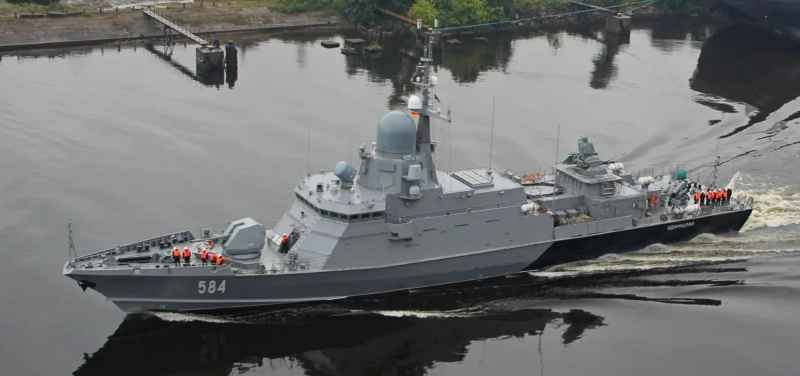
In February and March, due to the large amount of floating ice in the Sea of Okhotsk and the waters of the Kamchatka Peninsula, the navigation of ships was restricted, and the Russian Pacific Fleet usually conducted small-scale exercises in the waters of Vladivostok (Vladivostok). However, since February: a formation consisting of more than 10 ships of the Russian Pacific Fleet, under the unified command of the "Marshal Krylov", conducted joint tactical operations, destroyed imaginary targets, searched for imaginary enemy submarines, and jointly repelled air strikes in the waters of Avacha Bay near the coast of the Kamchatka Peninsula (near Petropavlovsk). During the exercise, the ship attack group composed of the "Perfect", "Roar" and "Zydenzapov" light frigates completed joint artillery shooting and missile launches on the surface target group of simulated imaginary enemy ship formations at the sea range. The tactical group consisting of the anti-submarine ship "Marshal Shaposhnikov" and the light frigate "Voice" fired artillery fire at the sea target - the imaginary enemy landing force. Since the disintegration of the Soviet Union, it is extremely rare for the Russian Navy to conduct exercises like this in the waters east of the Kuril Islands.
On February 19, Russia held a strategic deterrence force exercise, launching the "Yars" intercontinental ballistic missile from the Plesetsk Cosmodrome to the Kura test site on the Kamchatka Peninsula; the Tu-95MS strategic bomber launched an air-based cruise missile, destroying targets at the Pianboy and Kura test sites. The Northern Fleet’s "Karelia" strategic nuclear submarine launched the "Deep Blue" submarine-launched ballistic missile from the Barents Sea to the Kura test site, and the Pacific Fleet’s nuclear submarine launched an intercontinental ballistic missile at the Chiza test site in Arkhangelsk Oblast in northern Russia. The "Marshal Krylov" provided missile measurement and control support for the above exercises. Some analysts believe that on the eve of the Russian-Ukrainian conflict and during the conflict, Russia’s move was intended to show the outside world that Russia was also ready for battle in the Pacific direction, in order to deter the United States and Japan from acting rashly.
Afterwards, according to the Japanese Ministry of Defense, at 23:00 on March 13, the Marshal Krylov, three Kilo-class submarines, the large anti-submarine ship Marshal Shaposhnikov, and an ocean-going tugboat sailed through the Soya Strait into the Sea of Japan and returned to Vladivostok (Vladivostok).
Near-sea exercise communication damage control and air defense
On March 31, the Marshal Krylov held an exercise in Peter the Great Bay, taking on the communication organization tasks of surface ships, submarines, naval aviation, Il-38N anti-submarine aircraft and the fleet’s land command post. When the command ship exercises to transmit command signals over long distances, a stable encrypted communication network is built at sea to forward signals, including the use of satellite communication channels. In addition, damage control and air defense training are also conducted.
Hardening combat command and coordination capabilities in the far sea
The Russian Ministry of Defense reported on June 3 that the Pacific Fleet organized an exercise, with the Marshal Krylov as the command ship, including the Marshal Shaposhnikov and the Admiral Panteleyev anti-submarine ships. 40 warships and support ships, as well as up to 20 aircraft participated in the exercise, studying air defense organization methods and maritime material support issues for troops, and conducting live-fire shooting at surface and air targets.