
At 4:30 a.m. local time on October 29, 2022, some ships of the Russian Black Sea Fleet docked at the port of Sevastopol in Crimea were attacked by a cluster of unknown drones and unmanned self-destructing boats. Subsequently, the Russian Ministry of Defense stated that the attack was carried out by personnel from the 73rd Maritime Special Operations Center of Ukraine with the assistance of the British Navy. The attack tools were 9 drones and 7 unmanned self-destructing boats. In addition, the high-altitude US RQ-4C "Global Hawk" unmanned reconnaissance aircraft provided intelligence. The Russian army only lost 1 minesweeper, and according to relevant videos on social media, the attack tool was indeed an unmanned self-destructing boat.
Since the start of the Russian-Ukrainian war, the Russian military bases and the Black Sea Fleet in Crimea have been unlucky. First, the flagship of the Black Sea Fleet, the missile cruiser "Moscow", sank (the Ukrainian side claimed that it was sunk by the Ukrainian army, and the Russian side claimed that it was caused by a fire and explosion); then in the port of Berdyansk, the Black Sea Fleet was sunk and one landing ship was damaged; then the Crimean Saki Air Force Base was attacked and several military aircraft were destroyed; now the port of Sevastopol has been attacked by a cluster of drones and unmanned suicide boats, and the new flagship "Admiral Makarov" frigate is likely to be severely damaged by the unmanned suicide boat.
Review of the surprise attack, the unmanned suicide boat is revealed
In the history of naval battles, surprise attacks by suicide boats are not uncommon, and they seem to have become the trump card for the weak side to launch an asymmetric counterattack against the strong side. During World War II, Italy used three 7.5-ton manned torpedoes to sink two battleships of the British Royal Navy’s Mediterranean Fleet, which once reversed the Axis’s military disadvantage in the Mediterranean theater. Of course, it was the old Imperial Japanese Navy that finally pushed the record of the self-destructing boat to the peak. It developed two "jade-breaking artifacts" - the "Kaiten" manned torpedo and the "Zhenyang" self-destructing boat, which once caused headaches for the US military preparing to attack the Japanese mainland. On October 12, 2000, al-Qaeda used a self-destructing rubber boat to attack the USS Cole, a US Navy destroyer refueling in the port of Aden, Yemen, killing 17 US military personnel and injuring 39 people. The 9,000-ton destroyer, which had just been in service for four years, was also severely damaged.
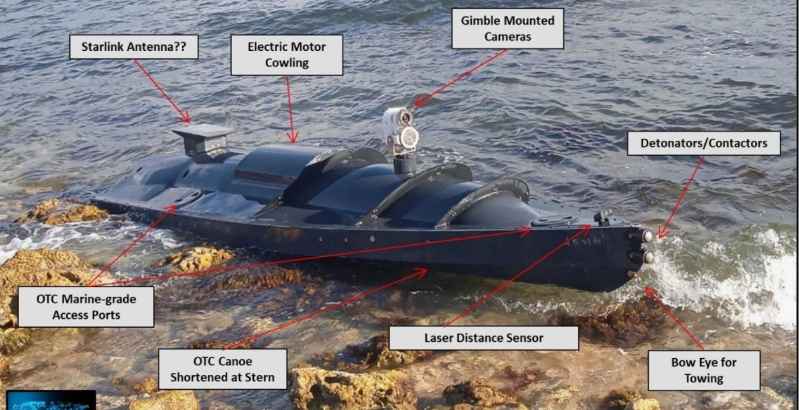
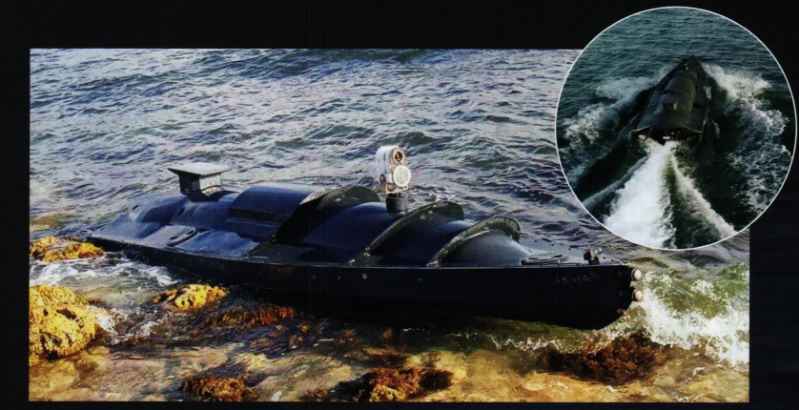
Different from previous suicide boats, the suicide boat in this surprise attack was controlled by an unmanned system. The same type of boat was stranded on the Sevastopol beach in September and is not an active standard equipment of any country’s navy. In terms of appearance, it is all black and has a very compact shape. The main body of the speedboat is a common Xidu (a motorboat brand under Canada’s Bombardier) motorboat in civilian marine sports, but the top deck is closed by a special "turtle back:" wave-proof cover. There is also a rod for day and night monitoring equipment in the center of the top. The power unit is a built-in water jet propulsion with good concealment. There is also a protruding satellite antenna box at the stern of the boat. The bow of the boat is suspected to be equipped with an impact detonation sensor.
It can be imagined that when this self-destructing boat is sailing on the sea, due to its low freeboard, the draft will increase after loading heavy explosives, and the part exposed above the sea surface is very small, which basically belongs to the category of semi-submarine. On a windy and turbulent night, this semi-submarine is difficult to be discovered by the naked eye and radar. How the Russian army discovered these self-destructing boats in advance is a mystery. In addition to the fact that the Russian army usually equips the guards on military ports and ships with some anti-frogman weapons, perhaps the Black Sea Fleet has long established a normal mechanism for anti-sabotage operations at its doorstep.
Another feature of this surprise attack is that the attackers used a combination of drones and unmanned boats to carry out cluster attacks, opening a new chapter in the history of naval warfare. It is unknown how they coordinated the attack. Since there is little public information at present, we can only make a rough guess about the process of the surprise attack. The Russian side claimed that the departure point of the unmanned suicide boats was Ochakov, Ukraine, a port city about 100 kilometers west of Kherson, but the straight-line distance from Ochakov to Sevastopol is at least 200 kilometers. It is also a mystery how far these seven suicide boats have traveled and how they arrived at their destination. Perhaps they were towed by other ships.
After the unmanned suicide boats arrived at the periphery of the target, the drones may launch the first wave of feints to attract firepower. The Russian side announced that one of the drones took off from a nearby grain transport ship, which means it may be a multi-rotor drone or a small fixed-wing drone. This level of drones cannot carry heavy bombs, usually only a few grenades or mortar-sized bombs, which are not a big threat to sturdy warships. It is estimated that drones are mainly used to attack vulnerable facilities such as fuel and ammunition depots on the shore, and the task of attacking ships is handed over to unmanned self-destructing boats.
Frankly speaking, if the Black Sea Fleet is to be "annihilated", the number of equipment used by the surprise attack planners this time is still too small. For a medium-sized country like Ukraine, it should be economically affordable to deploy 100 to 80 unmanned platforms at a time. Therefore, the purpose of this surprise attack should be more to send a signal to the Russian national leadership that Crimea and the Black Sea Fleet are within my strike range.
Unmanned ships are the basis of the US military’s decision-making center war
This surprise attack has pioneered the use of unmanned ships in actual combat and achieved results, but the value of unmanned ships is by no means limited to low-level applications such as self-destructing boats. According to some cutting-edge technology research and development in the world, unmanned ships are about to take on some of the combat missions of manned ships and become an important supplement to large and medium-sized manned ships. Unmanned ships can not only reduce casualties after the offshore platform is damaged or sunk, but also have much lower construction standards and costs than manned ships. Unlike manned ships, unmanned ships do not occupy personnel establishment, can be stored in docks or warehouses at ordinary times, and can be quickly activated in wartime, so their combat readiness is higher than that of manned ships.
In January 2021, the U.S. military successfully launched the "Standard-6" air defense missile on the "Ranger" experimental unmanned boat using the modular vertical launch system carried by it, which means that in the future, when the U.S. Navy does not have an "Aegis" ship in a certain sea area, it can also rely on unmanned ships to support the "air defense umbrella" for friendly forces in the war zone. Of course, due to the use of universal missile launch units, unmanned ships can also easily launch other types of anti-ship, anti-submarine and land attack missiles, and the guidance of the missiles can be handed over to the data link and cloud control center.
There are signs that the US Navy not only wants to develop unmanned ships on its own, but also wants to form alliances and make a big fanfare to develop multinational unmanned fleets. On October 12, 2022, Vice Admiral Brad Cooper, commander of the US Fifth Fleet, said that the United States and its allies hope to form a large fleet of 100 unmanned ships in the waters near the Arabian Peninsula by the summer of 2023, patrolling the waters from the Red Sea to the Persian Gulf, of which about 20% will be controlled by the United States and the remaining 80% will be controlled by countries in the Middle East. Since last year, the US Central Command has taken the lead in piloting the combat capabilities of US unmanned ships, and has established the 59th Task Force, which is mainly composed of unmanned ship forces. This year, 50 unmanned ships have been sent to participate in multinational exercises.
Unlike some high-end unmanned weapons used by the US military, each platform of the 100 unmanned ship force in the Cooper Plan uses unclassified sensors and sends unclassified information. These unmanned devices will output information and transmit it back to the maritime operation center. When the artificial intelligence system detects an abnormal situation, humans will make a decision. Each sensor of each participating country can provide new information, which can be integrated into the so-called database of the US military. All unmanned ships are controlled by satellites, and each platform is equipped with 360-degree high-definition cameras, search radars and automatic identification systems, which can conduct persistent maritime surveillance and display of strength in large areas of sea.
From this, it can be seen that the unmanned ships coveted by the US military are by no means ordinary. They are not isolated platforms with simple point-to-point remote control, but part of a larger architecture-decision-centered warfare. The concept of decision-centered warfare has great theoretical and practical value. It focuses on the operational needs of great power confrontation and promotes the US military to transform from "information-centered warfare" to "decision-centered warfare" and from "controlling information advantages" to "controlling decision advantages." If the concept of network-centric warfare has opened the way for the U.S. military to transform into an information-based army, the concept of decision-centric warfare marks that the U.S. military’s information construction has entered a higher stage and will also become an important driving force for the U.S. military’s intelligent transformation.
The winning mechanism of decision-centric warfare is to put the enemy into a "decision-making dilemma". The U.S. military believes that in a local area of the war zone, when the enemy has an advantage in the number and quality of missiles and it is difficult for the U.S. side to deal with the enemy’s salvo attack, it should maneuver more efficiently in a wider sea area, so that even if the enemy has the situation information of the U.S. side, it is difficult to judge the combat intention, and then it is difficult to determine the focus of the attack and the direction of defense. The combat purpose of decision-centric warfare is to maintain the decision-making advantage of the U.S. side while putting the enemy at a decision-making disadvantage. Network-centric warfare shows that if there is a lack of information, there is no way to make a decision, and the combat advantage will be lost; decision-centric warfare shows that even if there is information, if the correct decision cannot be made, the combat advantage will be lost.
In fact, decision-centric warfare is a higher form of command and control warfare. Whether it is a manned platform or an unmanned platform, it should improve its own decision-making ability and reduce the enemy’s decision-making ability. The basis of decision-making is command and control. Therefore, the operating efficiency of the command and control chain of the own side and the enemy should be accelerated. David Goldfein, former Chief of Staff of the US Air Force, said, "By creating a variety of situations that make the enemy embarrassed in multiple combat fields such as land, sea, air, space, and network, the enemy’s command and control can be made ineffective."
Unmanned autonomous systems and intelligent command and control are the key support for decision-making center warfare. Only by adopting unmanned autonomous systems and relying on intelligent command and control can the effect of more accurate and faster decision-making relative to the enemy be achieved in decision-making center warfare. The information obtained by unmanned autonomous systems, platforms, weapons, and personnel is processed by the combat cloud through a wide-area battlefield information network with large bandwidth, high timeliness and low latency, and a common battlefield situation map is jointly built and shared. Based on this, intelligent command and control and auxiliary decision-making are carried out. Simultaneously carry out counterintelligence reconnaissance, surveillance and counter-target indication operations, either by depriving the enemy of its information advantage and thus its decision-making advantage, or by causing the enemy to make wrong, ineffective or paralyzed decisions and thus achieve the combat objectives.
Currently, the U.S. Navy Force Structure Plan 2045 has proposed a new surface ship force composition plan based on the decision-making center war concept. This plan includes not only 373 manned ships, but also 150 large surface unmanned ships and underwater unmanned ships, which is less than the 200 unmanned ships in the previous version, but it will save tens of billions of dollars compared to building the same number of manned ships. The increase in the number of unmanned ships will also greatly increase the missile launch units of the entire fleet and have stronger anti-strike resilience.
Crimea Defense War 3.0?
On November 2, 2022, Ukrainian President Zelensky said in an interview with Czech TV that after defeating Russia, the first thing he planned to do was to visit Crimea, which means that Ukraine has regarded Crimea as a goal after the Battle of Kherson. Currently, the Russian and Ukrainian armies are fighting fiercely in Kherson Oblast. Russia’s 300,000 mobilized soldiers will be eliminated in the next few months. Ukraine has also mobilized again and assembled 100,000 troops on the southern front. For the Russian side, Crimea is behind Kherson Oblast. If it is defeated again, the control of Crimea and the survival of the Black Sea Fleet will face severe challenges again. Historically, the British and French coalition forces and Nazi Germany have broken through the Sevastopol Fortress. If it is broken by Ukraine again in the future, Russia’s authority as a world military power will be shaken.
For Russia, Crimea is nominally a peninsula, but in fact it is an isolated island with only one land passage. The reason is that the land part of the northern part of Crimea is far away from the Russian mainland, and the supply transfer stations such as Milerovo and Rostov on the Russian border are all more than 500 kilometers away, and road and rail transportation is inconvenient. Because of this, Russia spent a huge amount of money to build the Crimean Bridge in eastern Crimea and the Kerch Strait for transportation. The bridge is a two-way highway and railway bridge. Most of the military and civilian supplies needed by Crimea and the Black Sea Fleet basically rely on the Crimean Bridge. Therefore, the bombing of the Crimean Bridge on October 8, 2022 shocked the whole country of Russia, not only because of the symbolic significance of the bridge, but also because it is the guarantee of military and civilian supplies for Crimea and the Black Sea Fleet.
Once the Kherson Oblast is lost, the Russian army can only fight a desperate battle in Crimea, and the situation of the Black Sea Fleet will become more difficult. It is not ruled out that the Russian army will evacuate the Black Sea Fleet to Novorossiysk, which was also the headquarters of the Black Sea Fleet in history. It is said that when the unmanned self-destructing boat was discovered in September, the Black Sea Fleet evacuated the seven "Kilo" class submarines in the port of Sevastopol to Novorossiysk. Of course, since the Black Sea Fleet actually controls the maritime lifeline of Ukraine’s grain exports, Russia and Ukraine will still reach a compromise on the issue of whether the Black Sea Fleet should stay or go in the short term.
After tasting the sweetness of the "high leverage return" of unmanned ships, Ukrainian President Zelensky said on November 6, 2022 that he would raise funds to build an unmanned fleet, which would undoubtedly pose a great threat to the port security of the Black Sea Fleet. If the United States takes over the actual command and control of the Ukrainian unmanned fleet, then the Black Sea will inevitably set off a naval battle between manned and unmanned ships.