
For years, the Indian Army’s urgent need for artillery has increased pressure on the Modi government’s adherence to the "self-sufficiency" policy. In the past few months, the Indian Ministry of Defense and the military industry have been arguing over the purchase of 400 towed artillery pieces at a cost of 40 billion rupees. In September 2019, the Indian Army’s proposal to purchase 400 howitzers from Israel entered the (procurement) approval stage of the Minister of Defense, but the proposal was shelved after the domestic artillery project showed promise. Earlier in 2022, the Indian Army re-proposed the proposal to import artillery, saying that there was an urgent defense need on the northern border and it was reasonable to import 20 regiments (20 guns each) of howitzers. In addition, India’s domestic The delivery of the "Longbow", a derivative of the FH77B Bofors howitzer manufactured according to Swedish technology, has also slowed down, which has increased the sense of urgency of the Indian Army. Once the minister approves the proposal, it can be submitted to the Cabinet Committee on Security (CCS) for final approval. However, the Indian Ministry of Defense hopes that the Army will cancel the import of towed artillery, believing that any current artillery imports will seriously affect the development of domestic artillery. It should be noted that the Ministry of Defense’s Department of Defense Production (DoDP) supports the "Advanced Towed Artillery System" (ATAGS), which was designed by the Defense Research and Development Organization (DRDO) and developed by private industrial partners Tata Power (TataPowerSED) and Bharat Forge (Bharat Forge). Forge), the Ministry of Defense Production believes that ATAGS is a test of India’s defense capabilities and advocates the purchase of more artillery. In fact, the 155/52 caliber howitzer is on the "negative list" (hereinafter referred to as the "active localization list") of 101 types of weapons that were banned from import in August 2020 issued by the Indian Ministry of Defense, which aims to prevent the import of weapons that the local industry can be self-sufficient. What is the game in the middle? This article will explain the inside story for you.
Domestic or imported?
As early as 2007, India did not have a domestic suppression artillery development project for the Army. Faced with the ever-changing Chinese artillery (especially along the Line of Actual Control along the Sino-Indian border), the Ministry of Defense in New Delhi approved a military proposal to import and assemble 158 at a cost of 126.4 billion rupees. 0 foreign howitzers, of which 400 were imported finished products and 1,180 were produced domestically through technology transfer. Since then, three types of barreled artillery have been slowly provided to the Indian Army - the "Longbow" ATAGS and the M46-S kit of the Ordnance Board (OFB). The M46-S kit is an upgrade of the Indian Army’s existing Soviet-made 130mm M46 cannon to the 155mm caliber M46-S "Sharang" howitzer by the OFB Arsenal with the assistance of the Israeli Soltam Company. An OFB official worried that the import of 400 howitzers would stifle local enterprises. He said: "At a time when domestic artillery is about to mature, such an order will allow foreign manufacturers to monopolize the Indian market, make the localization of foreign artillery possible in the future, and stifle local industry and innovation. As a result, the import capacity was put on hold.
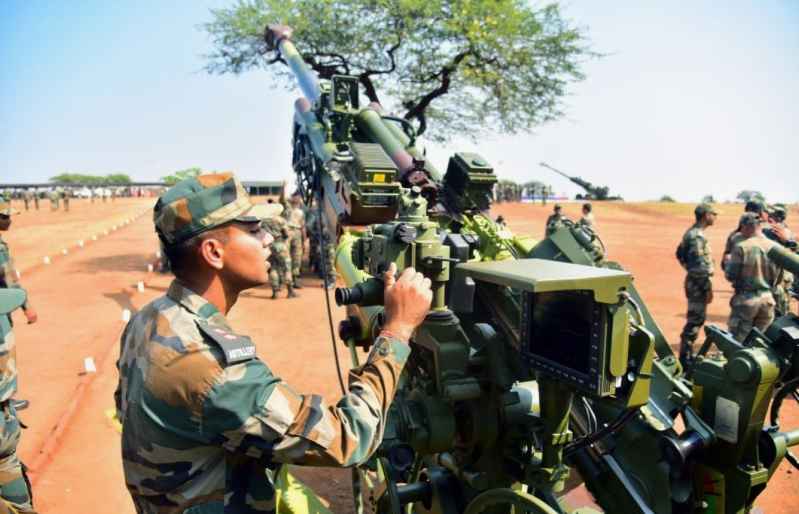
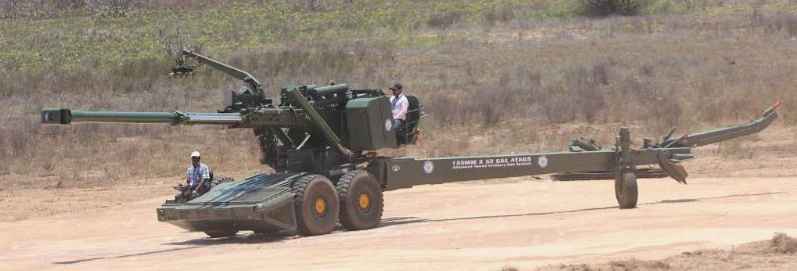
Earlier in 2021, two ATAGS prototype guns (one each built by two private companies) were sent to the Sikkim Plateau for winter testing. Tests have proven that the gun can be deployed and fired at temperatures close to freezing, and can make wide turns on mountain roads. The research team said that the combat technical index requirements (SOR) proposed by the Indian military are very high. In fact, it is to make a leap in the performance of active artillery. The range target of the new gun is close to 60 kilometers, almost twice that of the active Bofors FH77B howitzer. At the same time, the mobility requirements greatly reduce the delivery burden of mountain infantry. To this end, ATAGS uses an all-electric drive instead of the bulky hydraulic drive of the FH77B, which means that it can work at high altitudes without worrying about the freezing of hydraulic oil. In August 2022, in the abandoned Kolar gold mining area in Karnataka, echoing with the low "buzz" of diesel engines, Tata executives watched the G1 prototype gun of ATAGS galloping like a precious thoroughbred horse. The gun with its own auxiliary propulsion unit (APU) rotated along its axis, drawing a circle of black tracks on the ground, and then it switched to electric drive-the 95-kilowatt on-board electric motor pushed the gun into the firing position, put the big frame, and raised the barrel to a 45-degree firing angle. "This gun is a true reflection of India’s scientific research capabilities," said Rahul Chaudhry, CEO of Tata Power and Chairman of the Defense Innovation and Industry Association. ATAGS is a project that truly embodies the spirit of public-private partnership. It is jointly tackled by a young team composed of ARDE, DRDO’s armament research and development agency, Tata Power, and Bharat Forge. In 2013, ATAGS was just a concept in a computer at the ARDE laboratory in Pune. In September 2016, the Tata-made G1 and Bharat-made G2 prototypes were unveiled. Both prototypes fired shells at a range of 47 kilometers at the Pokhran Desert Range in Rajasthan, the distance between New Delhi and Gurugram, setting a world record for similar howitzers (the range of such howitzers is usually around 40 kilometers).
The designers said that if used in the thin air of the plateau, the range of these shells could easily be extended by another 25%. ATAGS cost only 2.82 billion rupees to develop, compared to 3.86 billion rupees for India’s failed lunar mission "Chandrayaan-1". For DRDO, public-private partnership is an opportunity to deliver world-leading weapons within a reasonable time. It has been severely criticized by the Ministry of Defense for delays in weapon development. Japan’s ATAGS is also a touchstone for the Modi government’s "Make in India" plan, and why then Defense Minister Nirmala Sitharaman enthusiastically supported it.

In terms of design, the basic principles and structures of various howitzers are actually similar. The shells rotate out of the rifled barrel at high speed and fall on the target, but because of the integration of modern electronic equipment and ballistic computers, the artillery calibration and positioning are automatically realized, and combined with laser rangefinders and shells equipped with global positioning systems, it has become the most cost-effective strike method within a range of 50 kilometers. For example, the Indian Strategic Forces Command (SFC) has mastered the "Earth" tactical ground-to-ground missile, which costs 100 million rupees. A 50-kilogram 155mm grenade only costs 10,000 rupees. The project is expected to create large-scale industrial clusters and employment opportunities. In the project, Tata alone has more than 40 major partners and more than 220 downstream suppliers, and more than 80% of the G1 prototype gun parts are purchased locally (both prototype guns use Bharat Forge’s precision high-strength gun blanks using self-tightening technology). In addition, there are two weapon systems that meet the "Indian Design, Development and Manufacturing" (IDDM) principle, namely the "Pinaka" rocket launcher produced by Larsen & Toubro (L&rT) and Tata, and the "Blue Sky" surface-to-air missile produced by DRDO, Bharat Forge and Bharat Electronics (BEL).
However, the Indian Army has its own views. Since the Galwan Valley incident in June 2020, the Indian Army has implemented at least three rounds of plans to increase troops along the Line of Actual Control between China and India, but what they have always been worried about is the "crushing advantage" of the Chinese army in artillery firepower, especially the power of the PCL-181 wheeled vehicle-mounted gun, which makes the Indian army worried. An Indian officer told the Asian News Agency (ANI) that artillery is an important part of the "rebalancing" of military power on the Sino-Indian border. The PCL-181 vehicle-mounted gun can fire 155mm steel shells (weighing more than 30 kg) loaded with more than 6 kg of high explosives. When it explodes, it will shoot steel fragments at the target at supersonic speed, crushing concrete fortifications and armored vehicles. "It is the key to the PLA’s mountain warfare, relying on the so-called "indirect firepower" to support the front-line infantry in offensive and defensive operations." You know, in the Kargil War in 1999, the Indian Army’s heavy artillery destroyed the Pakistani Army’s supply lines and defense bunkers, causing most of the casualties in the Pakistani Army. Indian military officers mentioned that the severe shortage of barreled artillery and multiple rocket launchers on the 3,448-kilometer-long China-India Line of Actual Control is the most worrying gap of the Indian Army. This is why the Indian Army insisted on restarting the howitzer import project in 2022. In order to appease the anger of the civilian officials of the Ministry of Defense, the Army also promised to reserve development space for the domestic howitzer project.
The Indian Army’s complaints about domestic artillery focus on the three major indicators of weight, shooting accuracy and continuous rapid-fire. The combat weight of the ATAGS howitzer is 20 tons, which is nearly 70% higher than its 12-ton weight indicator. Most bridges in the mountainous areas of northern India bordering China are designed to bear a load of only 18 tons, and the same is true on the plains. The increase in weight will lead to mobility problems, because the Indian Army’s Tata 6x6 tractor is designed for 12-ton artillery. The introduction of ATAGS with the current specifications means that the Indian Army has to update the entire truck family. They also complain about the towed artillery that foreign bids are also around 15 tons. The Indian military pointed out that the weight problem comes from DRDO. It is important to improve the structural strength of the artillery to meet the large chamber charge (increased from 22 liters to 25 liters) in order to obtain higher chamber pressure and longer range. An Indian military officer said that ATAGS also did not show the so-called "rapid-fire like an automatic rifle" capability. "What we see now is artillery shooting in single-shot mode, just like bolt-action rifle shooting." However, DRDO and private companies said they plan to reduce another 2 tons to reduce the weight to 18 tons, and the 4x4 wheeled ATAGS is much more stable than foreign two-wheeled towed artillery. There is also a six-round automatic loader that can fire 6 rounds in 30 seconds. As for the "Longbow", which is a competing party, although it was produced according to the FH77B howitzer blueprint provided by the Swedish Bofors company in the 1980s, the subsequent mass production of "Longbow" was suspended due to the Indian government’s splitting of the single OFB into seven companies on June 16, 2021. After delivering a complete "Longbow" howitzer regiment to the Indian Army in 2021, it is difficult to continue to supply, and more energy can only be spent on repairing and maintaining the Indian Army’s existing Swedish original FH77B howitzers. "I don’t think ATAGS is an alternative for urgent combat needs," said former Indian Army Lieutenant General P. Ravi Shankar, who participated in the review of these two domestically produced artillery. "Although the production order was issued in 2020, why has a combat-proven artillery system like the ’Longbow’ not been put into use? Some people say that if there are technical problems with the gun, they should be solved as soon as possible. If necessary, the original Swedish designer can be contacted. "But OFB has not taken any further action so far.
In fact, the measure that the Indian Army hopes to alleviate the "artillery shortage" is direct outsourcing. In April 2022, senior Indian Army generals briefed the Ministry of Defense on the delivery time, cost and combat advantages of Israel’s 155mm ATHOS self-propelled towed howitzer weapon system. According to the accelerated delivery plan, Israel’s Elbit Systems assured the Indian Army that the first batch of 12 guns will be delivered within 14 months after the contract is signed, and all 400 guns will be delivered within 54 months. The 15-ton weight of the Israeli ATHOS artillery has an advantage over the 18-ton ATAGS, especially in terms of better mobility on rugged terrain without a developed road network. In addition, the price of each ATHOS gun is 90 million rupees, while ATAGS is 220 million rupees. To make the deal more attractive, Israeli suppliers promised to purchase 70% of the artillery parts from Indian companies and provide complete technology transfer (ToT) to Indian partners. The Indian Army also promised the Ministry of Defense that ATHOS was a one-time purchase to meet direct operational needs and would not affect indigenous projects. But ATHOS has its own problems - it is not even in service with the Israel Defense Forces and suffered a structural failure during Indian trials a few years ago. DRDO designers ridiculed the Israeli artillery, saying that the field tests conducted by these artillery in the Indian-controlled Sikkim area were far less rigorous. At that time, it only entered the high-altitude area during the day to test mobility. That was in Rukrepur, the northernmost part of Sikkim. "The thin air in the high-altitude area can extend the flight distance of the artillery shells to 60 kilometers, which will allow the Indian army to strike the enemy’s deep command posts, bridges and fuel depots, and gain tactical advantages at the beginning of the conflict. However, the Israelis marked this range as being achievable in low-altitude areas, which is obviously a fraud."
But in any case, the competition from Israeli suppliers and the urgent needs of the Indian Army have obviously created a potential minefield for the civilian-led Indian Ministry of Defense, because it may mean a revision of the "Acceptance of Necessity" (AON) principle in 2007 and the "Request for Proposals" issued in 2011. These deviations will either require re-approval from the CCS or cancellation of direct government-to-government procurement, as was done with the 2016 Indian Air Force Medium Multi-Role Combat Aircraft (MMRCA) tender, as was done with India’s purchase of 36 Rafale fighters from France. Sources said the Indian Ministry of Defense is in consultation with relevant parties on this issue, “taking into account the requirements of achieving the ‘Make in India’ goal and providing the army with necessary weapons… We must strive to achieve independent design, development and production of weapon systems and reduce dependence on weapon imports, but this must be achieved without compromising national security interests
Too many “old guns” and lack of updating
Historically, the Indian Army has always been accustomed to using direct imports to solve the problem of field artillery modernization. According to their logic, purchasing or licensing foreign products not only saves money and time, but also improves its equipment level in the short term. As of 2021, the Indian Army’s suppression artillery equipment still maintains more than 2,400 pieces, with the main models including 500 105mm light artillery, 540 130/155mm cannons (including self-propelled), 510 155mm howitzers (including self-propelled), 210 122, 214, 300mm rocket launchers, and 500 81 and 120mm mortars. Among them, the medium artillery regiment has 155 and 130mm guns, the field artillery regiment is mainly 105mm guns, and the light artillery regiment basically retains the pack mortar. In addition, the three artillery divisions of the Indian Army also have a mixed rocket brigade under their jurisdiction, which has rocket launchers of various calibers. At the same time, the 33rd and 34th Armies of the Indian Army located in the eastern section of the Sino-Indian border also have a land-based "BrahMos" supersonic cruise missile regiment each, acting as an "extended precision strike artillery."
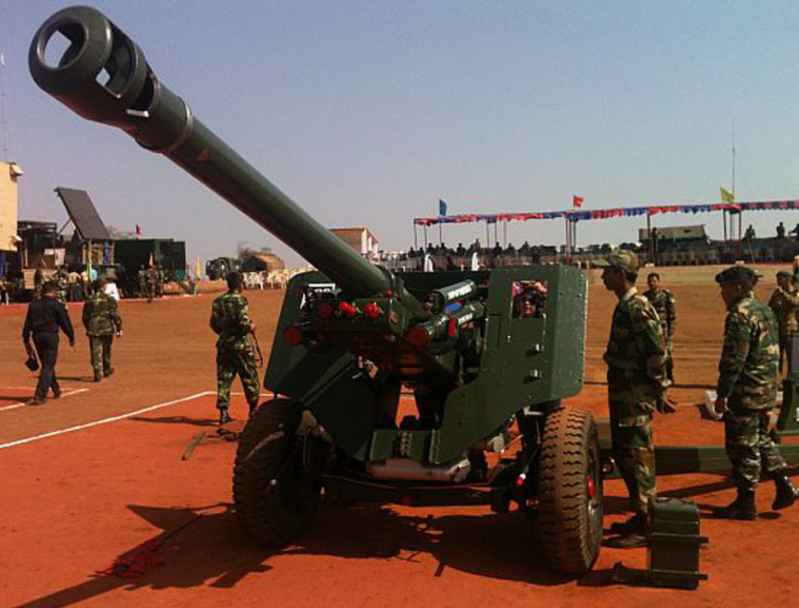
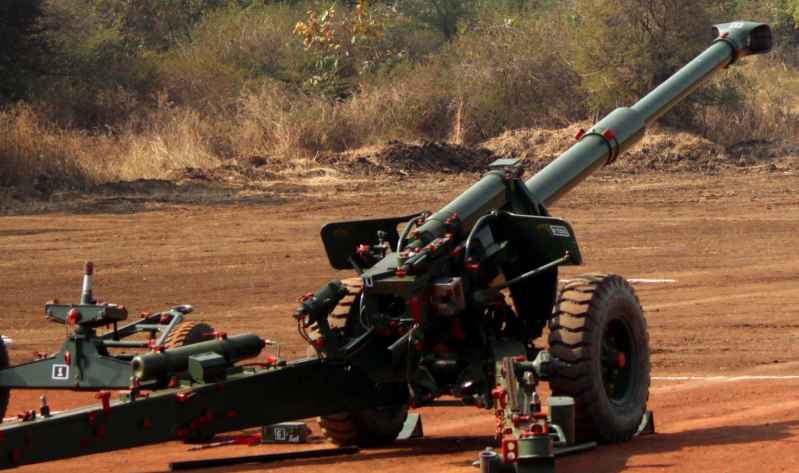
Judging from their appearance rates, 105, 130 and 155 mm howitzers have almost become standard equipment for Indian artillery. The 105mm MK1 and MK2 light howitzers are the few domestic artillery models that the Indian Army is willing to accept. The first type is a product that the Indian Ordnance Board (OFB) mapped and copied based on the original British L13 howitzer in the 1970s, while the second type is a version that they made partial localization modifications based on the British L118 howitzer in the early 1980s. The MK2 weighs 2,274 kilograms and is made of light high-strength alloy steel. It uses a 37-caliber self-tightening tube, a double-chamber muzzle brake, a vertical wedge-shaped gun door and a bow-shaped frame. The maximum range is 17.4 kilometers, the maximum rate of fire is 6 rounds per minute, and the continuous rate of fire is 1 round per minute. It can be parachuted by An-12 and An-32 transport aircraft or hoisted by Mi-26 helicopters. It is very suitable for mountain, jungle and desert operations. It is the benchmark suppression weapon of the Indian Army’s mountain infantry division, and has been provided with military aid to Myanmar, Bhutan and Nepal.
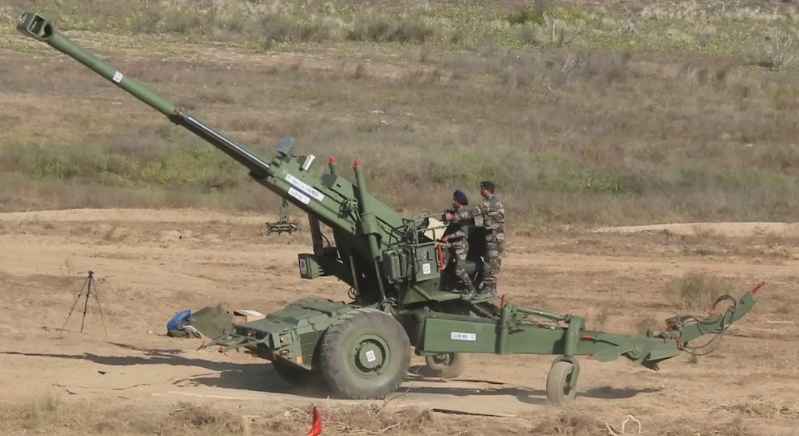
The Indian Army only has 130mm caliber cannons, namely the M46 type provided by the Soviet Union. However, the Avadi Heavy Vehicle Factory under OFB integrated the British Vickers medium tank chassis produced under license with the M46 towed cannon in the 1980s and launched a self-propelled artillery with an open turret. The range when firing a 33.4kg heavy grenade is 27.2 kilometers, and when firing a 33.6kg heavy armor-piercing projectile at a zero-degree firing angle, it can penetrate a 230mm thick steel plate at 1,000 meters. Later, with the retirement of the Vickers tanks, the Avadi plant used the "difficult birth" of the "Arjun" main battle tank chassis of the country’s Defense Research and Development Organization (DRDO) and the M46 for a "second marriage" to form the "Stone Crossbow self-propelled artillery", with exactly the same firepower strike effectiveness, but except for the barracks open day activities, it has hardly been used. Since 2005, OFB has carried out the M46-S artillery upgrade work with the assistance of Israel’s Soltam Company, that is, using the M46 gun mount and replacing it with a 45-caliber 155mm barrel. A total of 180 guns have been modified. However, according to a report on the "Indian Defense Online" website on December 4, 2016, in live-fire shooting, the "old bottle with new wine" M46-S cannot hit the target at 40 kilometers at all, which is far from Soltam’s promise. Moreover, the ability of the improved M46-S artillery to hit the target within 27 kilometers has also dropped significantly. Some officers and soldiers even issued "preferably As a result, only the 21st Mountain Infantry Division of the Indian Army stationed in Assam has two regiments of M46-S artillery that are truly ready for combat. In 2016, the Indian Ministry of Defense quietly purchased 130mm guns and spare parts from the former Soviet Union to maintain minimum combat effectiveness. Of course, the Indian Army artillery is not without "signature goods". In 1986, under the strong push of Indian Army Chief of Staff Sundargil, the Indian Ministry of Defense and Sweden’s Bofors signed a procurement and licensed production contract of up to US$3.5 billion. In the next 10 years, India not only purchased 410 FH77B self-propelled and towed howitzers from Sweden, but also licensed the production of artillery, ammunition and other auxiliary systems including fire control systems in the country. It is a 39-caliber 155mm rifled gun developed on the basis of the FH77A used by the Royal Swedish Army. Bofors has brought its technological advantages in the field of mechanical hydraulics to the extreme.
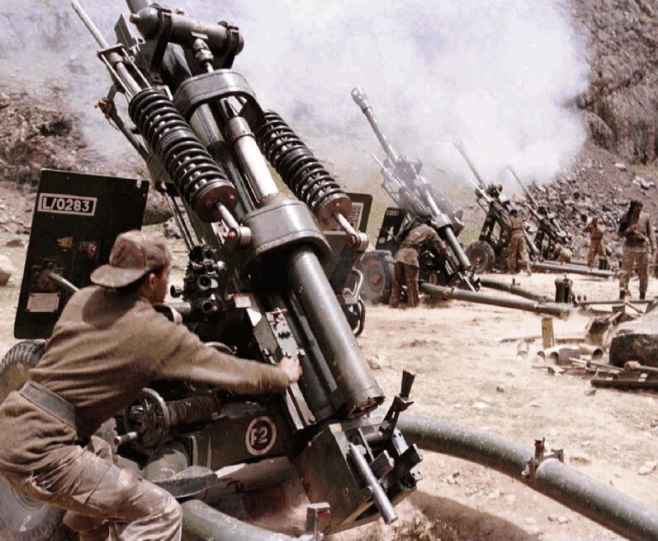
FH77B does not have the mechanical transmission device of elevation and elevation and direction machine that are necessary for general artillery, but uses hydraulic drive to complete elevation and direction aiming. There are two control handles at the aimer’s seat, one for controlling the elevation of the artillery, and the other for controlling the direction of the artillery. Its loading system is also composed of a hydraulic feeder, a hydraulic projectile starter and a loading platform (which can accommodate 3 projectiles). The starter lifts three projectiles from the ammunition vehicle at a time and places them on the loading platform. After the fuze is manually installed, the loader takes out a projectile and places it in the feed slot. After the projectile slides into the cartridge, the feeder is started to send it into the gun barrel. This set of hydraulic loading system makes FH77B have a higher rate of fire and better shooting accuracy. The sustained rate of fire for 20 minutes is 6 rounds per minute, and the burst rate of fire is 3 rounds per 8 seconds. Another secret of FH77B is that it has an auxiliary propulsion unit (APU), which has three characteristics: good mobility, high rate of fire, and rapid deployment. When it is necessary to improve mobility and firepower to offset the opponent’s artillery advantage in number and improve its own survivability, the six gunners of FH77B use the APU equipped with an 80-horsepower gasoline engine to improve off-road and position mobility. Its maximum self-propelled driving speed is 8 kilometers per hour. When the artillery leaves the road, the driver in the tractor cab can start the APU from a distance, so that the four power shafts of the tractor and the artillery are jointly driven to drive off-road. The APU drives the hydraulic motors in the hubs of the two large wheels of the artillery, allowing the artillery to easily pass through uneven areas. When entering the combat state, the two small supporting wheels of the artillery are placed on the ground with a hydraulic device, which is also convenient for the artillery to be removed from the tractor hook. After entering the combat state, the artillery is driven backward, and the hoe is automatically buried underground. The whole action only requires one person to operate, and the time is 1.5 minutes. Although the artillery hydraulic system is operated by the engine, it can be operated manually if the engine fails, and it can also work quietly at night. The FH77B purchased by the Indian Army is equipped with grenades, smoke bombs, flares and rocket-assisted bombs. When using NATO No. 6 charge, the range is 21.7 kilometers, and when using the Swedish version of the "super charge", it reaches 24 kilometers. If a rocket-assisted bomb is used, the range is 30 kilometers.
It should be pointed out that after more than 30 years of use, the Indian army found that the FH77B introduced high-powered powder bags and projectiles to increase the engagement distance with the enemy, but when the range reached 30 kilometers, the barrel life (wear and fatigue) was reduced and the reliability, utilization rate and maintenance problems caused by the use of high-energy propellants were more prominent. So far, due to combat and training losses, as of 2018, the number of FH77Bs available in the entire army has dropped to about 350, especially the protection problems of exposed hydraulic lines and APU control devices have not been solved. Lieutenant General P. Ravi Shankar, former commander of the Indian artillery, pointed out that the FH77B did not adopt revolutionary technological innovations to solve the reliability and durability problems of heavy, long-range, large-caliber artillery, but because of the adoption of some new approaches - the application of hydraulic technology, it solved the problems of ammunition delivery and mobility. "But the actual application of the Indian Army shows that hydraulic operating systems often bring maintenance problems, so solving reliability problems is an important goal in developing new howitzers. The reliability, utilization and maintainability of a heavy artillery, especially a heavy artillery with many automated actions, will ultimately determine the basis for the versatility and operational applicability of the artillery: that is, how many shells can be fired and how far can the artillery move before a component fails or needs to be replaced? When this happens, how long can the artillery be unusable before it can be repaired? Can it be repaired by the gunner or by direct support from the troops?" (To be continued)