
As the year drew to a close in 1968, an incident that shocked the world occurred at Beirut International Airport, the capital of Lebanon: Israeli commandos entered the airport by helicopter, blew up several Lebanese passenger planes parked at the scene with explosives, and then fled the scene in the dark night...
Target: Israeli flight
The explosion at Beirut International Airport is a special chapter in the long history of confrontation between Israel and Arab countries. This tense and confrontational relationship between the two sides has actually existed since Israel declared its founding in May 1948. After Israel appeared in the "land flowing with milk and honey", several Arab countries adjacent to it treated this Jewish country with a fighting attitude, among which Lebanon, which borders Israel’s northern border, became the center of violent struggle.
As an important part of the Arab-Israeli conflict, the conflict between Israel and Palestine has been endless and intensified in the 1960s. The main force in the Palestinian liberation cause, the Palestine Liberation Organization (PLO), has gained a foothold in both Lebanon and Jordan. With the outbreak of the 1967 Six-Day War, the third Middle East War, Arab countries’ support for the Palestinian cause has increased sharply, which has invisibly promoted the escalation of violence in the Palestinian-Israeli conflict.
The Popular Front for the Liberation of Palestine, one of the main factions of the PLO, has always been known for its tough struggle style. Against the backdrop of the Six-Day War further exacerbating the chaos in the Middle East, the organization planned and carried out two attacks on the Israeli National Airlines (EIAI).
On July 23, 1968, three members of the Popular Front took action against El Al Flight 426. The Boeing 707-458C passenger plane that flew this flight was originally scheduled to take off from London Heathrow Airport, stop in Rome, and then go to Tel Aviv’s Lod Airport. Shortly after taking off from Rome, Flight 426 was "taken over" by three Popular Front members who sneaked onto the plane, and then landed at Dar El Beida Airport in Algiers. The Israeli passenger plane was detained for 40 days under the attention of international public opinion, and the hostages were released only after the Israeli side made concessions.
The day after Christmas that year, another similar incident occurred, and the impact was even greater. On December 26, El Al Flight 253 flew from Tel Aviv to New York, USA. When the Boeing 707-320B passenger plane was about to take off after a stopover in Athens, Greece, two Popular Front members suddenly rushed out of a transit lounge and fired at the Israeli passenger plane with machine guns and grenades. Before the security personnel on the scene controlled the two attackers, an Israeli engineer had already been shot and killed. As for the Boeing 707, although there were many bullet holes on the fuselage, it was repaired and put back into operation in a very short time.
Two consecutive attacks on Israeli passenger planes within half a year have deeply shocked Israel. International public opinion also generally believes that Israel will take retaliatory actions. The question is, what form will the retaliation take, and when and where will it come?
Operation codename "Gift"
In fact, after the hijacking incident in July, the Israeli parliament and Prime Minister Levi Eshkol had unanimously decided to take retaliatory action and planned to send the Israeli Defense Forces special forces to raid Beirut International Airport. The goal of the operation was to "maximize the destruction of aircraft belonging to Lebanese Airlines at Beirut International Airport, while avoiding harm to civilians and damage to aircraft of other airlines; destroy airport facilities; if there are fewer passenger planes on the scene, destroy military aircraft that may be located in the military area of the airport."
For several months, the selected special forces members have been conducting targeted training, and the Israeli intelligence department has also been mastering and analyzing the flights in and out of Beirut Airport. The Athens Airport incident after Christmas was like a starting gun. The Israeli cabinet decided not to delay that day. The attack on Beirut Airport will be carried out two days later, that is, on December 28, 1968. The code name of the operation is "Gift".
Before that, the Israeli special forces had assembled at the Ramat David Air Base near Haifa. The Israeli army also set up an air command south of the border with Lebanon to coordinate the tasks during the "Gift" operation. Now, everything is starting to move quickly and the Israelis are ready to turn the plan into reality.
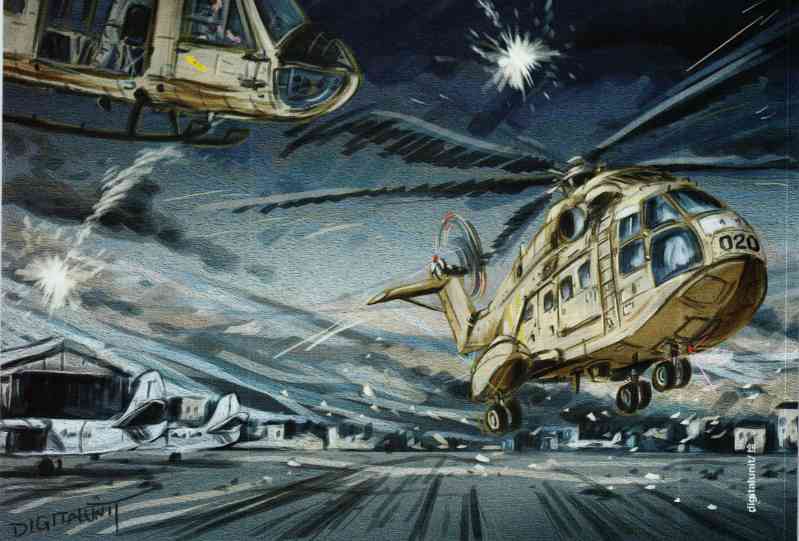
The staff divided Beirut International Airport into three mission areas: the East Zone, the West Zone and the Service Terminal Zone. Each zone is managed by a team of 20 to 22 special operations soldiers. The three teams are named Uzi Team, Negby Team and Digley Team after their commanders. Each team takes a SA321K "Super Hornet" heavy transport helicopter to the airport, and two "Super Hornets" are used as backup aircraft.
7 UH-1 "Huey" general-purpose helicopters will also participate in the operation, of which three are commanded by Lieutenant Colonel Elisa Cohen, acting as forward air control stations during the mission and responsible for placing smoke screens on the airport; another three "Hueys" are used for rescue and evacuation missions, and one is a backup aircraft. In addition to helicopters, the Israeli Air Force will send two A-4 "Skyhawk" attack aircraft and four SO.4050 "Vulture" fighters for target illumination and ground attacks when necessary. The last on the list of military aircraft are four old Nord-2501 "Noratras" military transport aircraft purchased from France, two of which are responsible for dropping flares, and the other two will land at Beirut Airport to evacuate special forces when necessary.
The H time (the time when the operation starts) of the "Gift" operation is set on December 22:00 on the evening of the 28th. However, in the morning of that day, the latest comprehensive intelligence analysis pointed out that the number of aircraft parked at Beirut Airport was not the largest at that time, so the commander of the operation, Brigadier General Rafael Eitan, ordered the launch time of the operation to be advanced to 21:15 after obtaining the consent of the cabinet.
Blast apart
At 20:37 on the evening of the 28th, three "Super Hornets" and three UH-1 helicopters loaded with commandos left the Ramat David base and flew over the border at low altitude. When approaching Beirut International Airport, the helicopter group further descended to an altitude of 60 meters to avoid radar detection. At 21:18, three minutes later than planned, three "Super Hornets" helicopters landed in designated areas of the airport. At the same time, a "Huey" threw a large number of steel nails at the airport to block ground traffic, and another "Huey" dropped 95 smoke bombs and 20 flares in a hovering state. The UH-1, which was the air traffic controller in front, stopped directly opposite the airport terminal.
In the thick enough smoke, the special forces team launched the attack according to the planned plan. The Uzzi team from the East District appeared near the entrance of Runway 36. They could see 8 passenger planes parked neatly there. The commandos used the same method of placing explosives in the front wheel well of the plane and then placing the remaining explosives in the main landing gear well on one side. 7 of the 8 passenger planes were blown up, and only one Douglas DC-3 survived because Lieutenant Colonel Uzzi judged that it did not belong to an Arab airline. During this process, several airport staff tried to approach, but retreated after the Israelis fired warning shots.
The Digley team left the "Super Hornet" on the south side of the airport’s main apron and then quickly ran to the 4 passenger planes parked next to the terminal. Major Digley confirmed that 3 of them belonged to Lebanese airlines, but the identity of the 4th plane could not be determined for the time being. The commandos used the same method of placing explosives to blow up 3 Lebanese passenger planes. There were sporadic bullets fired from the terminal, but no Israelis were hit.
The helicopter carrying Negby’s team landed on the northern edge of Runway 21 in the west of the airport. After leaving the "Super Hornet", the commandos found two Convair CV-990 aircraft and a Douglas DC-7 on the nearby apron, and another DC-7 in the hangar. Captain Negby’s men blew up the three passenger planes on the apron, and the DC-7 in the hangar was preserved because its identity was unknown.
The three teams that completed the mission ran to the area south of the intersection of the airport’s main runway, which was a pre-designated evacuation point. Soon after the commandos laid identification marks on the scene, the "Super Hornet" helicopter arrived. The special forces began to evacuate at 21:47, only half an hour before its landing. About 15 minutes later, the last "Super Hornet" took off, and all the Israeli troops participating in the "Gift" operation left Beirut Airport.
The aftermath of the surprise attack
The "Gift" operation completely achieved the effect of a surprise attack. During the attack, several Lebanese military vehicles that tried to enter the airport were shot by Israeli helicopters. The nearest Lebanese army base to the airport was only 3 kilometers away, but there was no time to send ground troops there.
This was indeed a well-planned, well-organized and coordinated raid, with the three teams carrying out their respective tasks according to a precise schedule. The Israeli military’s assessment report stated, "Everything went according to plan. As colleagues had foreseen, there was no threat." From the initial landing of the "Super Hornet" to the departure of the last commando, the ground portion of the "Gift Operation" lasted only 45 minutes, but destroyed as many as 13 passenger planes.
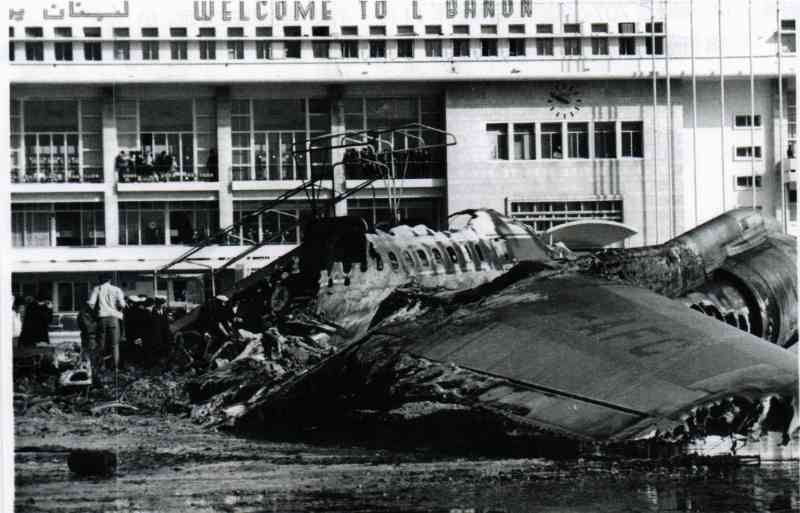
The next morning, when the sun shone on the cold Beirut International Airport, people could clearly see the severity of the night’s damage. Lebanon’s Middle East Airlines (MEA) suffered the greatest losses, with 8 aircraft destroyed, including a Boeing 707-320C passenger plane that was just delivered on November 18 of that year.
Although the blow was great, Middle East Airlines withstood the blow. By renting aircraft from other airlines and several other passenger aircraft of the company that were not in Beirut at the time, the airline quickly resumed passenger operations. In April of the following year, Middle East Airlines urgently purchased several second-hand CV-990s from the United States. passenger planes, thus maintaining its business. To this day, the airline is still developing healthily.
Two of the destroyed planes belonged to the Lebanese air cargo company TransMediterranean Airlines (TMA), which also survived by renting cargo planes from other companies. Next, after years of normal operation, TransMediterranean Airlines ended its operations in September 2014. Unlike the above two companies, Lebanon International Airlines (LIA) was "ended" by the Israeli army’s raid. The company obviously could not bear the consequences of its three passenger planes being bombed, and announced its closure in January 1969. Its remaining personnel and related businesses were taken over by Middle East Airlines.
The "Gift" operation also had subsequent effects, because the 1968 operation was not Israel’s last attack on Beirut International Airport. In 1982, 1985 and 1987, the Israeli army attacked the place again, killing 6 and 2 respectively. 200 and one aircraft destroyed.
From Israel’s perspective, their commandos performed their mission well. The motto of the Israeli special forces is "The Brave Wins", the same motto as the British Special Air Service (SAS). However, considering the fact that the target of the attack was an unarmed commercial aircraft, "Gift!" was an unfair victory after all.