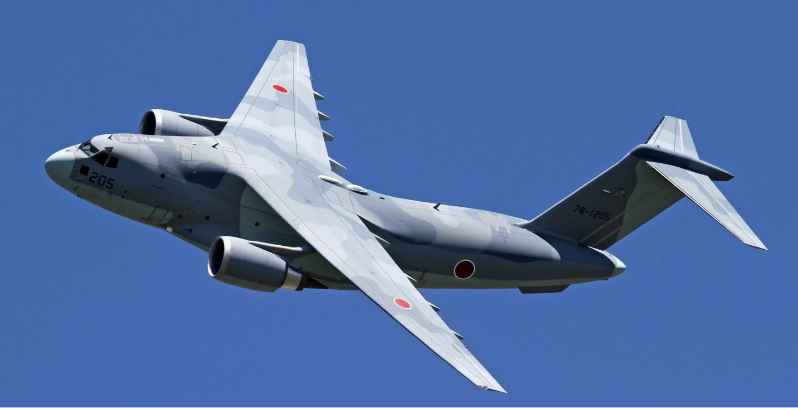
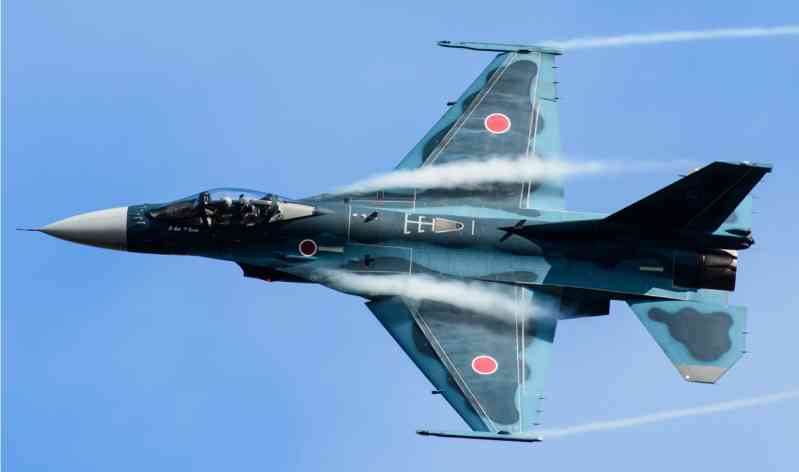
The development of Japan’s aviation industry to the end of the 20th century, after the unsuccessful F-2 "Heisei Zero Fighter", Japan’s military aviation industry further clarified the two major strategic directions for the future: First, through the combination of introduction and self-research, it tried to make breakthroughs in the field of the most cutting-edge fifth-generation stealth fighters, thereby rebuilding the world’s first-class tactical aircraft research and development capabilities and driving the upgrading of the entire aviation industry chain. Its core projects are F-35J (F-35 Japanese version) and domestic fifth-generation aircraft; second, it started the development of quasi-strategic "large aircraft" to lay the foundation for building a strategic "air force" in the future. Its core projects are P-1 anti-submarine aircraft and C-2 transport aircraft.
Next, we will explore the deep-seated problems behind Japan’s aviation industry’s "take-it-as-it-is" by examining its performance in the implementation of the new generation fighter project; at the same time, the actual technical and performance levels achieved by these projects can basically reflect the current capacity limit of Japan’s aviation industry.
F-35J is integrated into the global production chain
As we all know, the Ministry of Defense originally aimed at the F-22 "Dragon", but the United States refused to export this ace air superiority fighter. As a last resort, the Japanese can only make other plans.
On April 13, 2011, Japan’s F-X future fighter bidding was officially launched. Bidders included the United States’ F/A-18E and F-35A, as well as Europe’s "Typhoon." The Ministry of Defense evaluated the models participating in the F-X bidding on a 100-point scale, with 50 points for performance, 22.5 points for price, 22.5 points for Japanese industrial share, and 5 points for after-sales service. In the end, the F-35A won without any surprise. On December 20 of that year, the Japanese government announced the purchase of 42 F-35A fighters, and in 2022 it officially announced the purchase of 6 F-35Bs.
According to the plan, Japan will participate in the manufacture of 40% of the 300 main components of the F-35. At present, Japan has relaxed its military export restrictions, so that the components manufactured by Japan’s aviation industry can be integrated into the global production chain of the F-35, that is, in other countries! The F-35 equipped is also likely to have Japanese genes. Lockheed Martin suggested that Japan participate in the manufacture of wings and tails, and suggested that Mitsubishi Heavy Industries build a general assembly plant in Aichi Prefecture. But in fact, these are nothing. In comparison, the other two bidders are more generous. The European Aeronautic Defense and Space Group (EADS) is willing to provide Japan with 95% of the technology of the "Typhoon" fighter, and Boeing is also willing to provide 80% of the technology of the "Super Hornet".
It is worth noting that, from F-86F, F-4EJ to F-15J, although Japan did not independently develop a fighter jet after the war, it has always maintained the ability to manufacture complete aircraft from basic raw materials according to technology transfer licenses. However, being satisfied with only manufacturing 40% of the parts of the Lightning 2 fighter is obviously far from manufacturing a complete aircraft. Japan even gave up the domestic assembly rights of the F-35 and only planned to purchase the complete aircraft, because domestic assembly is more expensive than buying directly. From this point of view, choosing the F-35 instead of other models with a higher localization rate in the future, at least from one aspect, shows that the Japanese government’s desire to have independent fighter jet research and development capabilities in the future is not as strong as publicly declared, or it is betting on the F-3.
Of course, despite this, compared with the technology transfer treatment South Korea received when it introduced the F-35, Japan, which has stronger technical strength, obviously has more bargaining chips to fight for rights and interests in the negotiations, and it received the "Lightning" 2 much earlier than South Korea.
F-3 ambition
If we believe that Japan is only satisfied with the 40% localization rate of the F-35 and is betting on domestic fighters, then the key to the problem lies in whether Japan’s aviation industry can come up with such a product.
As early as 2019, Japan’s mid-term defense assessment revealed that after the "Shinshin" technology verification aircraft, Tokyo decided to continue to promote its own F-3 air superiority stealth fighter plan. The overall development of this type of aircraft is still responsible for the overall development of Mitsubishi Heavy Industries, the developer of the "Shinshin", and is defined by Japan as a so-called "sixth-generation fighter" with 31--that is, "informatization, intelligence, and rapid response" capabilities.
According to Jane’s Defense Weekly (hereinafter referred to as Jane’s), the F-3 will gradually replace the Air Self-Defense Force’s existing F-15J fighter jets in the mid-to-late 1930s. In March 2018, Japanese TV also showed close-up shots of the XF9-1 turbofan engine and active phased array radar being developed for the F-3 project. The project is expected to cost 5 trillion yen to develop, equivalent to nearly 45 billion US dollars. This means that in the future, the apportioned cost of each F-3 will easily exceed the 20 billion yen (about 179 million US dollars) upper limit originally set by the Ministry of Defense.
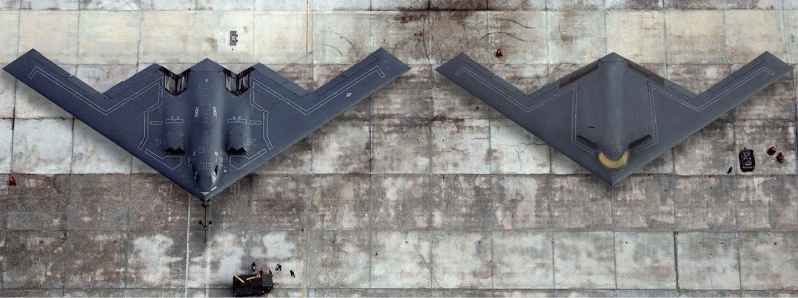
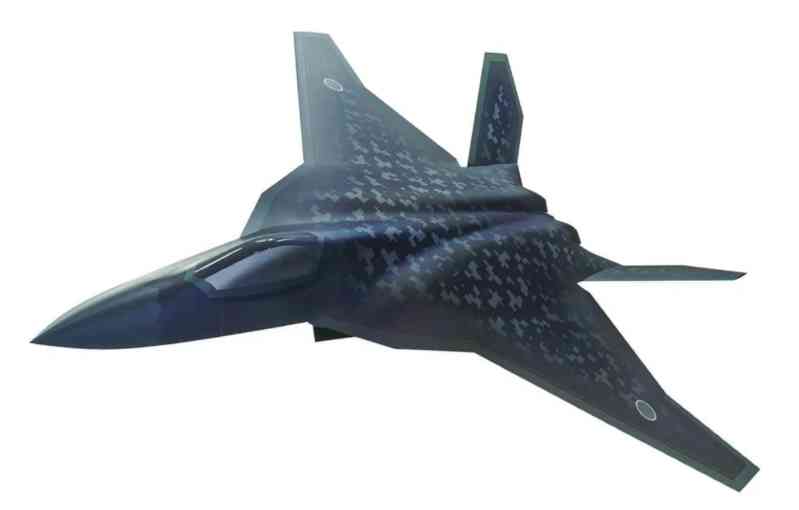
The design and technical details of the F-3 are unknown. However, it is certain that the Air Self-Defense Force needs a twin-engine fighter with an internal bomb bay. Prior to this, Japanese media had released a number of concept sketches. It is not difficult to see from these sketches that the design of this aircraft should refer to the Northrop YF-23 "Black Widow" (which was discontinued after losing the bid with the YF-22), such as the V-shaped tail wing that combines the functions of the horizontal tail and the vertical tail, the S-shaped air inlet groove tail nozzle, etc., but the F-3 is slightly smaller in size.
In addition, the F-3 will naturally adopt some new technologies that have been verified on the "Mind", such as the fiber-optic flight control system, intelligent skin, and "self-repair system. Compared with general fly-by-wire flight control, fiber-optic flight control has faster data transmission speed and has been used on Kawasaki Heavy Industries’ P-1 fixed-wing anti-submarine aircraft. The "intelligent skin" successfully developed by Mitsubishi Heavy Industries in 2011 is made of a new composite material (composite ceramic/silicon carbide), which can directly cover the tile-type phased array radar antenna to greatly expand the radar’s detection field of view, and its own radiation energy is extremely low, making it difficult for the enemy to lock the radiation source. The so-called "self-repair" system is said to be able to detect and automatically compensate for the loss of rudder efficiency of the flight control surface.
Jane’s further pointed out that Japanese engineers are developing an artificial intelligence technology for the F-3 to optimize data flow and reduce the pilot’s operating burden. The "informatization, intelligence, and rapid response" in 31 can all be summarized as network-centric warfare capabilities, that is, the "Raptor" 4S The last "S" in performance. To this end, Japan has been studying military high-speed data links to strengthen the real-time information sorting and sharing capabilities of each air combat node. According to Jane’s, this will help the F-3 to fight against "the superior number of J-20 fighters and H-20 stealth bombers" in the future.
Power ambition
Ishikawajima-Harima Heavy Industries previously equipped the "Shinshin" with two XF5-1 turbofan engines, which were only used for technical verification. The thrust of each engine was 49 kN, which was less than the 156 kN of the F119 on the "Raptor".
Based on the technology of XF5-1, Japan developed a high bypass ratio turbofan engine F7-10 for the P-1 anti-submarine aircraft. Its single thrust is about 59 kN and the bypass ratio is 8. Through the technical accumulation of the above two engines, Ishikawajima-Harima’s next product is ambitious-a low bypass ratio fighter turbofan engine XF9-1 comparable to the F119. Its prototype has now entered the ground test stage and completed the maximum power test. The development plan is expected to cost about 40 billion yen.
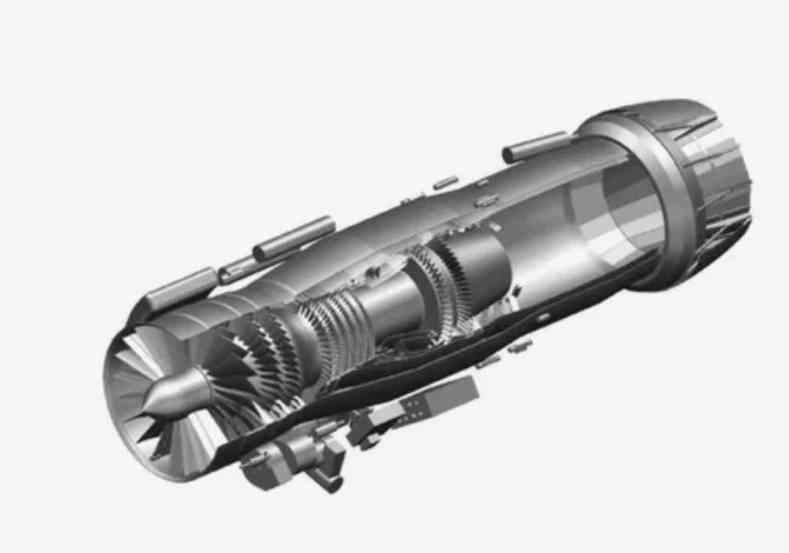
According to Jane’s, the XF9-1 has a military thrust of 11 to 12 tons and a thrust of 15 to 16.5 tons. This data is slightly worse than the F119 on the F-22, which has a military thrust of 13 tons and a thrust of 17.5 tons. But the XF9-1 is much shorter than the F119, and the height is 30 cm shorter than the F-119, which leaves more space for the built-in bomb bay. In addition, each XF-9 engine can also generate 180 kilowatts of additional electricity, which may be used to power laser weapons. The laser weapons on the F-3 will be used to burn the built-in circuit boards of ballistic missiles. This means that this type of aircraft is not only an air superiority fighter, but also has a certain anti-missile capability, which is also a rare innovation of the F-3 compared with the fifth-generation aircraft of other countries.
As one of the "standard features" of the new generation of fighter jets, Japan has also been researching thrust vector tail nozzle technology. The Ministry of Defense’s requirement is that the F-3 can achieve a 20-degree deflection of the tail nozzle in any direction, rather than a longitudinal binary deflection similar to the F-22. This shows that the Air Self-Defense Force does not intend to bet all future air power battles on beyond-visual-range air combat, and it still has high hopes for the maneuverability and visual-range combat capabilities of the next generation of fighter jets.
In addition, the Russian-style omnidirectional thrust vectoring scheme of the F-3 is equivalent to completely abandoning the three-piece deflector scheme that has been verified on the "Shinshin". The latter is a very primitive thrust vectoring technology with many inherent defects, and it is inevitable that it will be abandoned by the F-3 in the end.
Become a British partner
In general, the design level of the F-3 has not yet surpassed the level of the YF-23 30 years ago, and the latter’s design itself has major limitations - if not defects. The appearance design of the YF-23 is obviously more focused on stealth and supersonic cruise. The main reason why it lost to the YF-22 is its lack of maneuverability. As for the so-called "leading a generation" 31 concept that the Japanese vigorously promote, it is nothing more than a Japanese expression of the fifth-generation aircraft’s network-centric warfare capabilities.
In fact, after Tokyo announced its intention to renew its purchase of 105 F-35A and F-35B, many defense experts immediately judged that the F-3 program had actually been "low-key abandoned", although the new version of the defense assessment said something else.
Sure enough, after entering 2020, such a project that was originally based on self-research has undergone major changes. In October 2020, the Ministry of Defense stated in a brief statement: Japan will choose an overseas partner in the new fighter development project.
In 2021, Britain and Japan announced an investment of 200 million pounds to jointly develop the next-generation fighter engine; in February of the following year, the two countries launched an advanced airborne radar project called "Jaguar"; in July 2022, London and Tokyo officially announced the merger of the next-generation fighter project "Storm" and F-3 led by the two countries. On December 9, local time, Britain, Japan and Italy reached a plan to jointly develop the sixth-generation fighter-"Global Combat Aviation Program" (GCAP). With the entry of Japan, the "Tempest" project, which was originally initiated and led by the United Kingdom, has evolved into a joint development by the United Kingdom, Italy and Japan. It is conceivable that Japan basically cannot have more weight and voice than the United Kingdom. In the core engine alone, the strength of the British Rolls-Royce company is more than one level higher than that of Ishikawajima Tetsuma.
From the above, it can be seen that Japan is not confident in independently developing a new generation of fighter jets, but at the same time it is well aware of the water content of the F-35 and urgently needs a real fifth-generation air superiority fighter to solve the urgent problem-even if it gives up independent development. After all, the F-35 is just a fighter-bomber, not an air superiority fighter like the F-22. The main mission of the Air Self-Defense Force is different from that of the US military. The US Air Force is a typical offensive air force. They need a large number of F-35s to perform such tasks, and the air supremacy is the responsibility of the F-22. The Japanese must pay more attention to air defense patrols and interceptions. According to data released by the Ministry of Defense, as early as 2018, the Air Self-Defense Force needed to intercept an average of three Russian and Chinese military aircraft every day, and the intensity will only be greater now. Jane’s pointed out that even the old F-15J is more efficient than the F-35 in performing such tasks. So when Jane’s reporters asked Japanese officials about the five priority capabilities of the F-3, the answer they gave was first "future air superiority."
However, independently developing air superiority fighters is a huge challenge for the current Japanese aviation industry. We have noticed that although Tokyo has repeatedly and high-profilely promoted the development of its own new fighter jets, it is puzzling that Japan, which is not short of money, has neither established its own wind tunnel system nor its own electromagnetic wave test room and other infrastructure for the development of modern military aircraft. For example, the wind tunnel test and RCS (radar cross-sectional area test of the "Shinshin" were completed in the United States and France respectively. This is quite similar to the Indian aviation industry, which is always ridiculed by the outside world.
The F-2 fighter jet, which was previously claimed to be independently developed but was actually ridiculed as a "copycat F-16", ended up with a high price and low quality, which actually proved the weakness of Japan’s aviation industry after the war. Now Japan wants to achieve "rebuilding world-class tactical aircraft research and development capabilities and driving the upgrading of the entire aviation industry chain" through only a fifth-generation aircraft project, but still ignores the consolidation of the aviation industry foundation, so this goal is likely to fail.
Can’t learn by yourself
With the help of "take-it-ism" and strong integration capabilities, Japan quickly developed into an aviation industry power in just over 20 years from the end of World War I to the outbreak of the Pacific War. This is undoubtedly a remarkable achievement. However, this relatively glorious history ended in the summer of 1945. Although Japan quickly achieved economic, industrial and technological achievements that attracted worldwide attention after the war, its aviation industry has never been able to recover-obviously, this is inseparable from its political status as a defeated and occupied country.
But the reason is probably not that simple. The United States certainly does not want to see Japan rebuild an aviation industry that may bring real threats and market competition, but what is Japan’s own attitude? In fact, although Japan’s series of aviation self-developed projects after the war were very high-profile in propaganda, they were always half-hearted in the implementation process, wavering between so-called self-developed technology cooperation, production line assembly, direct import and purchase, etc. This is indeed puzzling for a country like Japan that is not short of money and has a good scientific research foundation. We may be able to find some answers from the psychological dwarfing caused by long-term political dwarfing. And the result is the current decline of Japan’s aviation industry.
In the history of human aviation development for a hundred years, there are too many great geniuses leading the progress of aviation technology. Americans, British, Russians, French, Germans and even Italians account for the vast majority of them. Jiro Horikoshi may be the Japanese who has ever been closest to this top star lineup, but the "Zero Fighter" itself is still full of traces of plagiarism, and there is no major technical or conceptual breakthrough. Today’s Japanese aviation industry is even worse. No matter what the reason is, Japanese aviation has not been able to make up its mind to develop independently. This is a problem that Japanese aviation cannot avoid.