
The main battle tank has gone through more than 100 years of development, and its firepower, survivability and mobility have been greatly improved. However, the modern battlefield continues to pose new challenges to the main battle tank. For this reason, some countries such as Europe have begun to launch the development plan of the next generation of main battle tanks. Many countries have also focused on upgrading the existing armored vehicle platform rather than developing or purchasing new tanks.
Europe
In Europe, the most important new main battle tank plan is the Franco-German Future Ground Combat System plan, which is expected to be in service around 2035, when it will replace the currently deployed Leopard 2 main battle tanks and Leclerc main battle tanks. KNDS (composed of Krauss-Maffei-Wegmann and Nexter) and Rheinmetall, the contractors of the plan, exhibited the EMBT demonstration vehicle and the "Black Panther" KF51 main battle tank at the 2022 Sartori Defense Exhibition respectively.
EMBT uses a significantly improved Leopard 2 body, equipped with a new two-person turret equipped with Nexter’s F1CN120-26 120mm L/52 smoothbore gun (22 rounds ready to fire), and uses a tail-mounted automatic loader that can fire Nexter’s SHARD tail-stabilized armor-piercing projectiles. The main gun installed on the tank during the defense exhibition is the same as that of the "Leclerc" main battle tank, but KNDS plans to eventually choose the "Ascalon" 140mm gun developed by Nexter. The company once claimed during the defense exhibition that the EMBT turret is ready to integrate the "Ascalon" gun.
In terms of auxiliary weapons, the EMBT is equipped with a 12.7mm coaxial heavy machine gun (680 rounds ready to fire), a panoramic sight for the commander, and a remote weapon station equipped with a 7.62mm machine gun (800 rounds ready to fire). In addition, the ARX30 auxiliary remote weapon station equipped with Nexter’s 30M781 electric-controlled machine gun (150 rounds of ready-to-fire ammunition) is installed.
In terms of crew configuration, in addition to the commander and gunner in the turret, there is also a driver and a system operator in the vehicle body. The operator is responsible for operating the ARX30 remote weapon station, the battlefield management system, and various drones that may be deployed on the vehicle. Although the installation of an automatic loader for the tank can cancel the configuration of the fourth crew member, since the operator can play a role in many tasks, such as replacing or repairing tracks, the armed forces of many countries are very interested in configuring the fourth crew member. Therefore, this crew configuration has also received a lot of attention. Considering that the ammunition can be automatically loaded, the fourth crew member is conceived as an EMBT system operator, whose main task seems to be to defend against small air threats and long-range situational awareness, thereby enhancing comprehensive protection and reducing the cognitive burden of the commander, etc.
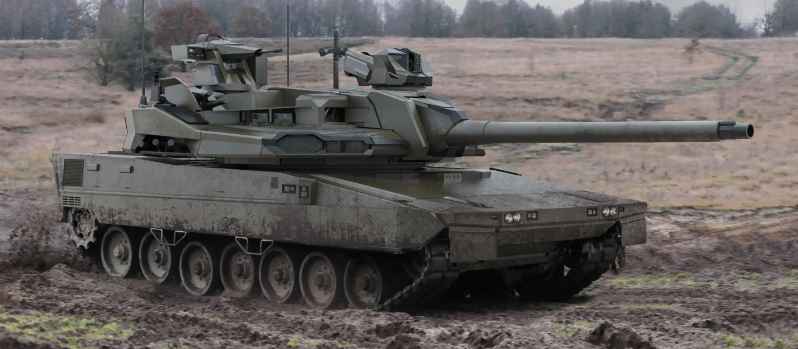
In terms of protection performance, the tank is equipped with Rafael’s "Trophy" active protection system, PILAR V gun acoustic detector E-LAWS laser warning receiving system and 14 GALIX grenade launchers, which can launch smoke bombs and other various ammunition. The EMBT weighs 61.5 tons, which is lighter than many existing main battle tanks. Although the mission system has been enhanced, the EMBT still shows a trend of reducing the weight of modern armored vehicles.
From the design of EMBT, we can get a glimpse of the design ideas of Krauss-Maffei-Wegmann and Nexter. Many of the outstanding design solutions are expected to be incorporated into the finalized design of KNDS for the main ground combat system program.
The Rheinmetall "Black Panther" KF51 main battle tank adopts a significantly improved "Leopard" 2 body and is equipped with a brand-new turret equipped with Rheinmetall’s 130mm/L52 smoothbore gun, which can destroy most existing armor. The 130mm gun has an elevation range of -9 to 20 degrees and uses a tail-mounted automatic loader. The ammunition is provided by two magazines, each of which occupies about half of the space at the rear of the turret and is equipped with 10 rounds of ammunition. If needed, one of the magazines can be replaced with a pod equipped with 4 "Hero" 12 cruise missiles to attack targets beyond visual range.
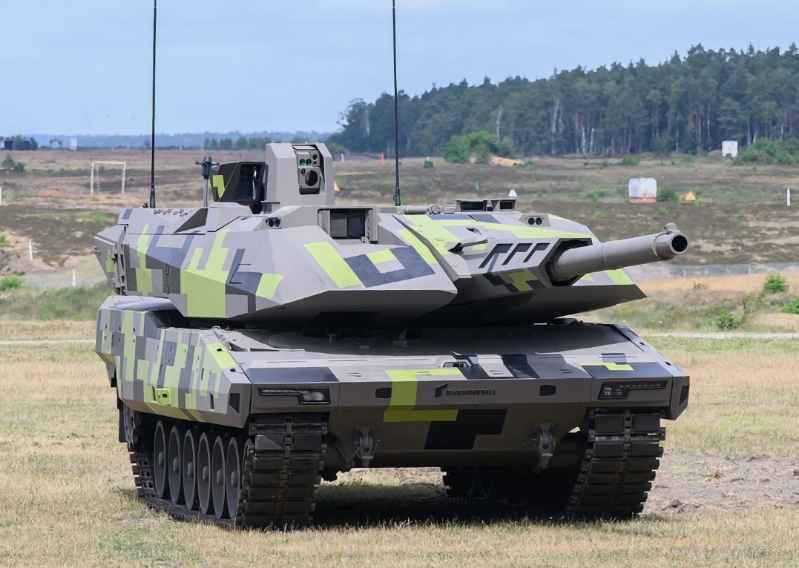
In terms of auxiliary weapons, the "Black Panther" KF51 is equipped with a 12.7mm heavy machine gun (250 rounds of ready-to-fire ammunition); it is equipped with a Rheinmetall NATTER remote weapon station equipped with a 7.62mm machine gun (2500 rounds of ready-to-fire ammunition). NATTER is designed to provide protection against small drones and light ground targets.
The default crew configuration of the tank is 3 people, the driver is located in the body, the commander and gunner are located in the turret, but according to relevant information from Rheinmetall, the crew compartment can be equipped with a fourth crew member-"expert" as needed, sitting next to the driver in the cabin. "Expert" is set to operate drones (similar to the system operator of EMBT), or as a wingman pilot or company commander.

In terms of protection, the vehicle is equipped with the Rheinmetall ROSY smoke bomb launch system: an active protection system can be installed to resist attacks from anti-tank missiles and kinetic energy bombs, and a top attack protection system can also be installed. The "Black Panther" KF51 has a combat weight of 59 tons, which seems to be an important step in reducing the weight of armored vehicles

The UK is trying to upgrade the "Challenger" 2 to the "Challenger" 3 standard, and the many improvement measures taken include: installing a Rheinmetall Rh-120 L55A1 The new turret of the 120mm/L55 smoothbore gun will be able to fire DM73 and KE2020Neo (also known as DM73eo) fin-stabilized armor-piercing discarding sabot rounds; the commander and gunner will be equipped with new sights from Thales, and the driver will be equipped with front and rear thermal sights. The vehicle’s new turret will be equipped with new passive armor components, supplemented by a laser warning receiver and 10 smoke grenade launchers, and Rafael’s "Trophy" hard-kill active protection system. After the above improvements, the weight of the Challenger 3 will increase slightly compared to the 65-ton Challenger 2, and will eventually be about 66 tons, depending on the armor components. Through the upgrade, the Challenger 3 will become a network-enabled digital main battle tank. The British Army expects to receive the first batch of Challenger 3s around 2029, which is only about 6 years before major European allies plan to receive the next generation of major ground combat systems in 2035.

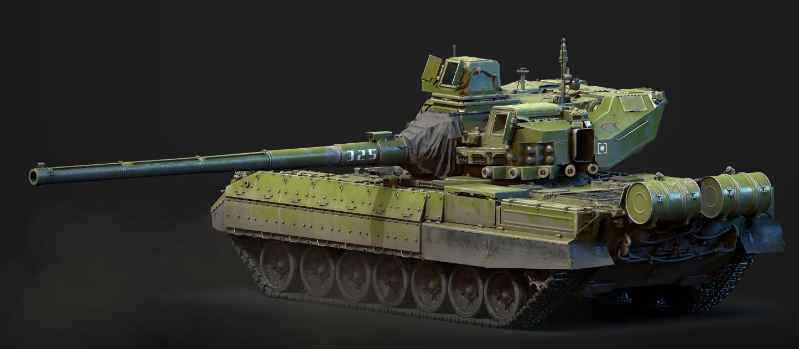
Russia has always maintained the ability to design tanks independently, but the budget and ability to develop new technologies are backward. As a result, in addition to producing about 20 new "Armata" T-14 tanks for testing, it has not started mass production so far. Instead, it has replaced it with improved versions of old tanks, such as T-72B3, T-80BVM and T-90M. All three tanks participated in the Russian-Ukrainian war, but the T-14 tank has not appeared so far.
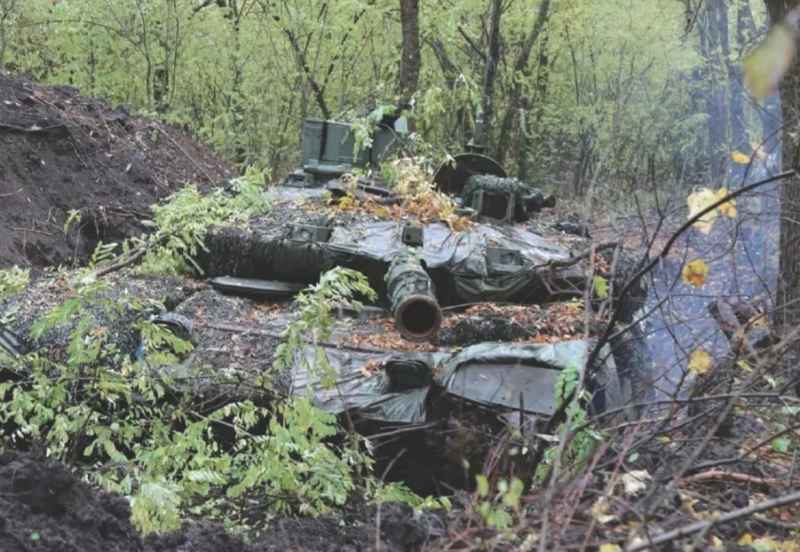
The T-14 features a number of eye-catching design features, perhaps most notably a three-man crew configuration, with the commander, gunner and driver in a protective cabin at the front of the vehicle; an unmanned turret with a 2AM82-1M 125mm gun that can fire longer Vakuum-l and Vakuum-2 fin-stabilized armor-piercing shells. The unmanned turret allows the tank to be significantly lighter than many modern designs, with a combat weight of about 55 tons.
Asia
India has developed the Arjun Mk 1 and Mk 1A MBTs over a long period of time, but the current Indian MBT fleet, which consists of Russian T-72 and T-90 tanks, makes the demand for the vehicle relatively low. India’s Defense Research and Development Organization is currently working on the FRCV future combat vehicle program, which aims to develop a future main battle tank for India with a demand of 1,770 vehicles and plans to enter service by 2030. However, apart from the ambitious list of requirements released in the information request in May 2021, the program has not made much progress so far and is considered impossible to achieve the goal of entering service by 2030.
Hyundai Rotem of South Korea has developed the "Black Panther" K2 main battle tank after developing the K1 (105mm) and K1A1 (120mm) main battle tanks. After a period of delay in the plan, the "Black Panther" K2 entered service and was recently ordered by Poland for 180 vehicles, and another 800 upgraded K2PL vehicles are expected to be manufactured locally from 2026.
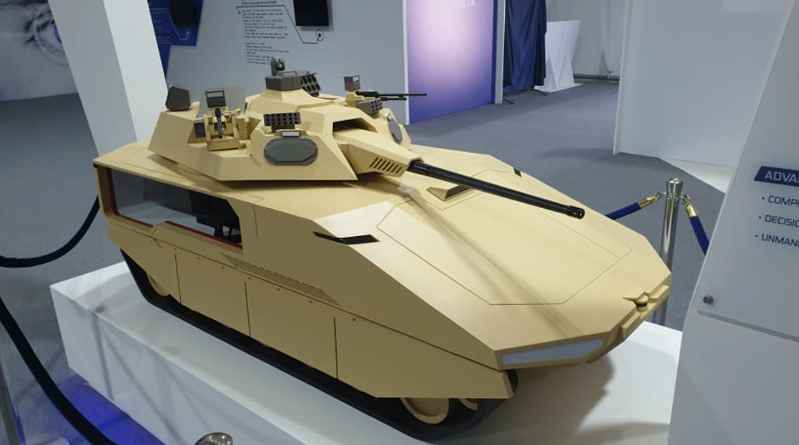
Hyundai Rotem is currently studying the concept of future main battle tanks, including the next-generation main battle tank exhibited in model form at the 2022 Sartori Defense Exhibition. Similar to the "Armata" T-14, the tank is planned to have a crew of 2 or 3 people, all of whom are in the vehicle’s protective cabin and equipped with a remote-controlled turret. In addition, the vehicle weight is planned to be only 55 tons. Since a remote-controlled turret is used, not much passive protection is required, so it is possible to achieve this vehicle weight target. In addition, the tank is planned to use a 130mm smoothbore gun equipped with an automatic loader; install a remote-controlled weapon station equipped with laser weapons, and install a launcher with 2 anti-tank guided missiles at the rear of the turret; install a hard-kill active protection system, with 4 effectors installed on 2 launchers, respectively set on both sides of the turret, supplemented by 16 smoke bomb launchers, 8 on each side of the rear cabin. It is worth noting that the tank used a composite rubber track during the display, which will reduce vibration and weight, but to achieve the 55-ton vehicle weight target, long-term research and development of the composite rubber track is still required.
Middle East
Compared to many other countries, the Israel Defense Forces has high-intensity ground mobile combat experience and has been continuously developing the "Merkava" main battle tank family. But with the "Merkava" Mk5 (also known as "Barak") about to enter service with the Israel Defense Force in 2023, Israel does not seem to be satisfied with constantly upgrading its existing main battle tanks, but has begun to focus future vehicle research and development projects on the "Carmel" family. "Carmel" is designed to be a lighter vehicle family, and is actually based on the main combat model of an infantry fighting vehicle. The lack of plans for future tank designs seems to be a risky move. In contrast, many other countries are developing faster than Israel. For example, the US Marine Corps has decommissioned the "Abrams" MIA1 main battle tank in 2021.

Conclusion
At present, in an era where highly lethal and accurate anti-tank weapons can often destroy passive protection, the development of main battle tanks is under tremendous pressure. In order to meet the new challenges constantly presented by the modern battlefield as soon as possible, various military powers are constantly developing main battle tanks in various ways. Judging from the current development status abroad, the development of future main battle tanks presents the following characteristics. First, in the design of future main battle tanks, the caliber of the main gun is usually greater than 120 mm or 125 mm, and the envisioned plan is 130 mm or 140 mm, which can enhance lethality, but at the cost of reducing the amount of ammunition that can be carried. Because the ammunition is larger, it is too heavy for a loader, so an automatic loader is needed. Secondly, in terms of mobility, hydraulic suspension is gradually replacing torsion bar suspension to further improve the riding comfort of the crew and provide a more stable shooting platform for the artillery. Manufacturers such as Suxi Company are working to solve the problem that the current composite rubber tracks cannot bear the weight of main battle tanks well. Perhaps the most interesting thing in the development history of main battle tanks is that after decades of weight growth, the design of main battle tanks finally began to develop in the opposite direction, and passive armor gradually began to give way to hard-kill or soft-kill active protection systems, signal feature management systems, etc. In addition, as technologies such as unmanned turrets or composite rubber tracks continue to mature, it will provide designers with the potential to develop lighter tanks while retaining a higher level of comprehensive protection.
As the lethality of modern weapons continues to increase, the threat to main battle tanks has become more and more significant. In the face of challenges, main battle tanks have begun to be equipped with many new subsystems, which has led to an increase in power requirements. In this regard, more modern design solutions are needed to install auxiliary power units or energy storage solutions to meet the increasing power requirements. Although the modern battlefield has brought many challenges to main battle tanks, judging from the situation of countries striving to develop main battle tanks, main battle tanks will still be an important part of modern armed forces in the future.