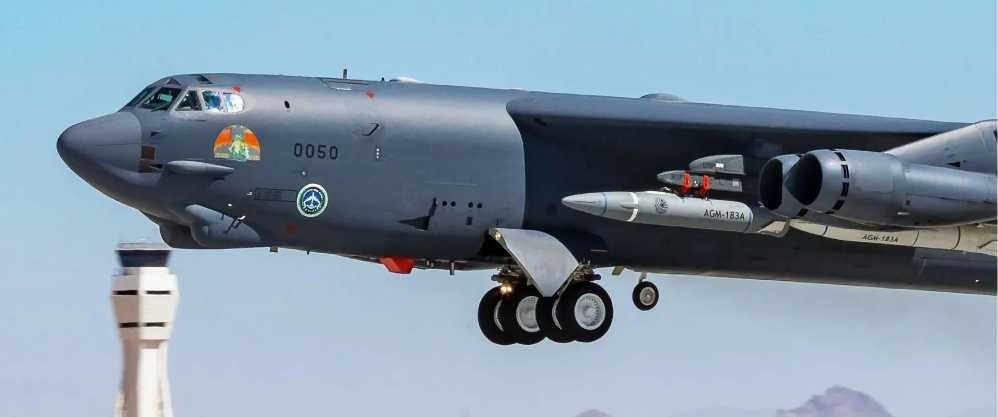

After years of testing and multiple failed test launches, the U.S. Air Force announced that it would abandon the purchase of the AGM-183 Air-Launched Rapid Response Weapon (ARRW). This decision was made after the two most recent tests of the prototype. Generally speaking, if the prototype test goes well, the next step is to purchase and equip it. However, the Air Force has already announced that it will abandon the purchase before two prototype tests have been conducted. This can only mean that the previous tests have brought too much frustration to the Air Force, and this frustration directly prompted the Air Force to decide to "stop playing".
The most recent test took place on March 13, 2023, when the B-52H dropped the second full-state AGM-183A near the coast of Southern California. The so-called full-state test means that this test bomb is manufactured and tested according to the real combat weapon. The U.S. Air Force initially claimed that "the test achieved some of its goals and the test team is collecting data for analysis." But on March 28, U.S. Air Force Secretary Kendall changed his words and said that "this test actually failed." He pointed out directly that "the test was not successful and we did not get the data we needed."
The U.S. Air Force still intends to finish what it started. The head of the U.S. Air Force procurement affairs submitted a written report to the White House Tactical Aviation and Land Arms Committee on March 9, 2023, stating that although the Air Force will not eventually purchase AGM-183, it will still complete the remaining two flight tests of the prototype in order to collect all data and information to facilitate the development of future hypersonic research projects. It can be seen that the Air Force does not intend to give up the development of hypersonic weapons. If you look back a little, it is not difficult to find that the procurement plan for AGM-183 has actually been cancelled by Congress from the fiscal year 2022 budget, and the relevant funds have been adjusted for other research and development projects. In the fiscal year 2023 budget, although a budget of 46.6 million US dollars was approved, only one AGM-183A was purchased throughout the year. In order to complete the remaining test missions of the prototype, the U.S. Air Force requested a presidential budget of 150 million US dollars in fiscal year 2024.
AGM-183 had troubles as early as 2019 when Lockheed Martin began testing. The U.S. Air Force’s testing was even worse, with three launch failures in 2021. The situation seemed to improve in 2022, with three successful tests, including a full-state prototype test - that test was considered "completely successful."
AGM-183A is an equipment project developed on the basis of the Tactical Propulsion Glide Technology Demonstration (TBG) project jointly initiated by the U.S. Air Force and the Defense Advanced Research Projects Agency (DARPA). It is essentially a combination of conventional solid rockets and gliders. The solid rocket will send the glider into the sky and accelerate it to hypersonic speeds. The glider will then separate from the rocket and glide towards the target at a speed of up to Mach 15. Under hypersonic conditions, the glider does not even need a lot of explosives. Its amazing kinetic energy alone can destroy most targets in impact.
The U.S. Air Force was originally very eager for ARRW, especially at the critical moment when hypersonic weapons and equipment in China, Russia and other countries continued to advance and quickly formed combat effectiveness, the U.S. military’s expectations for hypersonic weapons were even more urgent. The U.S. Air Force hopes that ARRW can become "a practical hypersonic weapon that allows the United States to directly threaten fixed, high-value and time-sensitive targets from outside the enemy’s defense zone in future combat environments." The previous series of flight tests are to prove that this missile has battlefield survivability, long-range attack capability and effective damage capability to meet the needs of the U.S. military to strike potential opponents’ key targets located inland and coastal areas. If it weren’t for the twists and turns in the AGM-183 test, this hypersonic missile should have entered service in 2022. No matter how urgent it is, things still have to be done one by one. Judging from the current progress of the test, the U.S. Air Force has to continue to wait.
The military has refused to disclose the specific details of the failed tests. Raytheon did say that it "has been working hard to develop hypersonic weapons technology on an accelerated schedule to meet major defense needs." If this is an excuse, then did AGM183 fail in the rush to catch up?
AGM-183 failed, and the focus of the US hypersonic weapons research and development will shift to the hypersonic attack cruise missile (HACM), which is currently being developed by Raytheon and uses a scramjet engine as a power source. It is scheduled to be put into service in 2027. Raytheon and Northrop Grumman have already cooperated in the DARPA Hypersonic Air-Breathing Weapon Concept (HAWC) project and have conducted two successful launch tests in 2021 and 2022. The two companies are currently developing HACM missiles based on the experience gained from the tests. Relying on Northrop Grumman’s scramjet engine technology, Raytheon is developing a missile that is smaller than ARRW and can be directly equipped with jet fighters. "HACM can provide commanders with tactical flexibility, that is, using fighters to attack some high-value time-sensitive targets, while leaving bombers for other strategic targets," said General Brown, Chief of Staff of the US Air Force. In fiscal year 2024, the Air Force requested a considerable budget for HACM, $381 million.