
Frigates and missile boats of the Iranian Navy
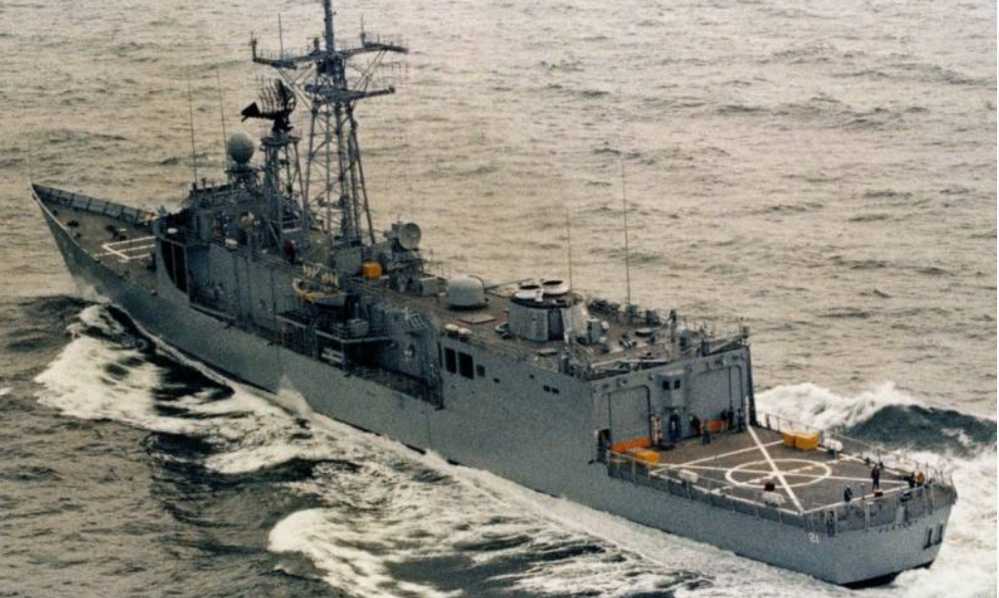
In the late 1960s, Iran received intelligence about Soviet-made missile boats against Iraq and ordered four Mk5 frigates from the UK. Vosper Thornycroft is a famous British ship builder. The Mk5 has a standard displacement of 1,220 tons (strictly speaking, its tonnage is far from enough for frigates at that time, and can only be regarded as a small frigate), is 94.5 meters long, and is powered by two 34,120-kilowatt "Olympus" TM-3A gas turbines and two 2,570-kilowatt Paxman diesel engines, with dual-shaft propulsion and a maximum speed of 39 knots. The weapons on board are: a 114mm Vickers Mk8 dual-purpose automatic gun on the front deck, a twin-mounted 20mm gun on the stern, a triple-mounted "Sea Cat" short-range air defense missile launcher in front of the bridge, a quintuple-mounted "Sea Killer" anti-ship missile launcher and a "Limbo" three-barrel anti-submarine mortar on the rear deck, and the AMS-1 radar equipped on board is a product specially exported by the British Plessy Company, which can detect small aircraft within 60 nautical miles. In short, this is a compact multi-purpose frigate.
Four Mk5s were delivered to the Iranian Navy in the early 1970s, named "Sham" (DE12), "Zar" (DE14), "Rostam" (DE16) and "Faramaz" (DE18), collectively known as the Sham-class frigates. In 1979, the Islamic Revolution overthrew the Pahlavi dynasty, and the four ships were renamed "Evand" (F 71) "Aboz’ (F 72), Sabalan (F 73) and Sahad (F 74), also renamed as Evander class frigates. The British Navy did not purchase this type of warship. It was just a foreign trade military product specially exported to Iran by Vospathanicroft. At the same time, the company also designed the Mk7 frigate "Dat Savary" with similar scale and equipment for export to Libya.
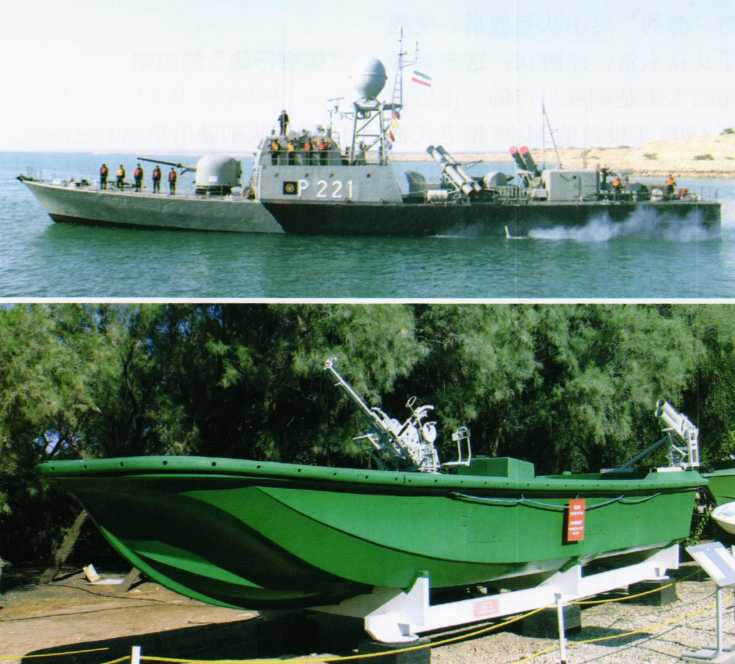
In 1974, the Iranian Navy ordered 12 "Woman Warrior" II missile boats from the French Normandy Machinery Company. The first boat "Stone Crossbow (P221)" was delivered in 1977. This speedboat with a displacement of 234 tons and a length of 47 meters is propelled by 4 diesel engines and has a speed of 38 knots. Its size and layout are similar to the German 148 type and the Israeli Saar class. The armament includes one "Otto" 76mm automatic gun and one "Bofors" 40mm machine gun. The difference is that the 148-class and Saar-class are equipped with French "Exocet" and Israeli "Gabriel" anti-ship missiles respectively, while the Crossbow-class is equipped with four American "Harpoon" anti-ship missiles.
Ship raids in the Iran-Iraq War
Iraq’s land area is less than one-fifth of Iran’s, but there has always been controversy over the demarcation of the Shatt al-Arab River on the border, and relations are tense. In November 1979, the Islamic Revolution in Iran overthrew the Pahlavi dynasty, and Khomeini became the leader of the country. Anti-American forces rose, and students occupied the US Embassy in Iran, and the domestic situation was turbulent. In November 1980, the then 43-year-old Iraqi President Saddam Hussein thought there was an opportunity and suddenly sent a large number of T-55 and T-64 tanks to invade Iran. However, due to the resistance of Iran’s Khomeini Division and the combat effectiveness of the British-made "Chieftain" tanks, the Iraqi army’s blitzkrieg failed, and the two sides fell into a bloody tug-of-war.
In order to break the deadlock, in March 1984, Iraq announced that it would attack any ship entering the Persian Gulf, and dispatched fighter jets to attack Panamanian tankers near Iran’s Kharg Island with "Exocet" missiles. Iran also responded tit-for-tat, dispatching fighter jets to attack Arab and other countries’ tankers heading to Iraq. The ship-raiding war began and intensified. Before the Islamic Revolution, the extremely pro-American and anti-Soviet Pahlavi obtained a large number of advanced American fighter jets, including 79 F-14A, 190 F-4E/D and 160 F-5EFF. But after Khomeini came to power, a large number of officers and pilots were purged, and most of the fighter planes could not be used due to maintenance or lack of spare parts. At this time, Iraq could obtain advanced MiG-23, Mirage F.1, Super Etendard fighters and Exocet missiles from the Soviet Union and the West. By 1983, Iraq had an 8:1 advantage over Iran’s air force. Therefore, Iran often uses warships and shore-based anti-ship missile attacks, as well as sea minelaying and small boat sea harassment to block the sea passages in the Persian Gulf.
Iran’s tanker killer
Since September 1987, Iranian militia armed motorboats have begun to harass oil tankers sailing in the Persian Gulf. Among the Iranian naval vessels participating in the ship-raiding war, the Sabalan was the most active of the four Evander-class frigates. In December 1987, the seventh year of the Iran-Iraq War, the Liberian oil tanker "Stina Concordia" sailing to Saudi Arabia in the Persian Gulf was discovered by the Sabalan. The Sabalan launched a "Sea Killer" missile at the 269,000-ton supertanker. This type of missile is Italy’s earliest domestically produced anti-ship missile, 4.6 meters long and 0.9 Mach in speed, similar to the "Harpoon", but with only 1/3 of its charge and 1/9 of its range, and its combat capability is not strong. Its guidance method is similar to the early American "Beagle" and "Brass Knight", which is a mixed method of beam and radio command guidance. The missile hit the engine room of the tanker, and the tanker sank after catching fire. When attacking the tanker, Abdullah Manawi, the captain of the Sabalan, often boarded the tanker to pretend to be friendly, but once he returned to the ship, he ordered to open fire on the bridge and the sailors’ quarters of the tanker. This behavior earned him the notoriety of "Captain Nasty".
In March 1988, a 61,762-ton Japanese tanker was besieged by Iranian militia armed motorboats 16 kilometers off the coast of the United Arab Emirates. These small boats were called "Borgmar" (actually, this was the name of the Swedish shipyard that sold speedboats to Iran in the 1980s). Most of them were equipped with a Soviet-made 12.7 mm machine gun on the bow, and some were equipped with rocket launchers or recoilless guns. They adopted the tactic of taking turns to approach and shoot at high speed and then leave, causing a fire on the tanker. On March 31, Captain Abdullah Manawi, stimulated by the small boat, went out again. He found the Cypriot supertanker "Hefon" 30 kilometers northwest of Doha, and ordered the main gun of the "Sabaran" to fire. The 114 mm/55-caliber Vickers Mk8 automatic gun was also the standard main gun of the British Type 42 destroyer and Type 21 frigate at that time. Its rate of fire was 25 rounds/minute and the bullet weight was 25 rounds/minute. 36.5 kg, with strong lethality. The 230,000-ton tanker caught fire, slowed down and ran aground. The Sabalan also became a notorious tanker killer.
The "Ghost" of the Persian Gulf
After the outbreak of the Iran-Iraq War, in order to protect the interests of its own oil companies, the United States established the Middle East Joint Task Force Command, with the command ship "La Salle" (AGF-3) converted from an amphibious dock transport ship as its flagship, and sent the "Enterprise" nuclear aircraft carrier battle group to the Persian Gulf. Due to the escalation of the ship-raiding war, Kuwait, sandwiched between Iraq and Iran, applied to the UN Security Council for escort. On July 21, 1987, a US destroyer escorted a fleet of 11 Kuwaiti tankers and 2 US tankers under the US flag. The fleet sailed from the Gulf of Oman to the Kuwaiti oil export port of Ahmadi. After entering the Persian Gulf, the "Bridgetton" supertanker triggered a mine. Fortunately, this 40 The 10,000-ton ship was saved from sinking by its double hull and compartment structure. The then US Secretary of Defense Weinberger responded immediately by dispatching 8 RH-53D "Sea Stallion" minesweeping helicopters, 5 minesweepers and 6 coastal minesweepers to the Persian Gulf. On September 21, in international waters northeast of Bahrain, the US MH-6 "Little Bird" special warfare helicopter discovered the Iranian warship "Ajer" laying mines with night vision goggles, and immediately opened fire on the 614-ton landing ship built by Japan, killing 5 people and capturing 26 people. When the "Navy SEAL" commandos boarded the ship, they found 9 mines. After identification, these mines with tentacles were produced by North Korea and designed by Russia in 1908. The US military also found that the Iranian minelayers were hidden near the oil platform during the day and went to the Gulf to lay mines at night. On October 15, the Iraqi army launched the Silkworm anti-ship missile from the northwest coast of Iran, hitting the Kuwaiti oil tanker "Island City" flying the US flag. Three days later, the US military launched "Agile Archer Operation", and four destroyers fired at Rostam, destroying two offshore oil platforms controlled by the Iranian Revolutionary Guard. But the Iraqi army did not stop there, and continued to secretly lay mines in the Persian Gulf.
The origin of "Operation Praying Mantis"
On April 14, 1988, the 14th Escort Group of the US Army had just sailed out of the Strait of Hormuz when the "Samuel Roberts (FFG-58)" in front of the formation triggered a mine, and the engine room of this Perry-class frigate, which had only been commissioned in April 1986, was blown out. The ship had a 7.6-meter-long hole and lost power. The officers and soldiers on board had to perform damage control for 5 hours before they were saved from sinking. The next day, the Avenger-class minesweeper of the US military salvaged 5 mines in the sea area where the accident occurred. After identification, the serial numbers on these mines matched the mines on the "Ajer".
The United States was furious. President Reagan and senior officials decided to attack the base of Iran’s ship attack war. In order to punish the "Sabaran", Admiral Crowe, Chairman of the Joint Chiefs of Staff, decided to fight near its home port, Bandar Abbas, and first attack the oil platform in the northeastern waters of the Qatar Peninsula as the command point of the ship attack war, in order to draw out Iranian warships for attack. The operation code name was "Operation Praying Mantis"
The flagship of the operation is the command ship "Coronado". The nuclear aircraft carrier "Enterprise" carrying the 11th Carrier Air Wing cruised in the Strait of Hormuz under the protection of the nuclear cruiser "Truxton" and the frigate "Leesenna", providing air and strike support for the US ships in action.
In order to attack the Iranian frigate, the US military collected information on ships from the United Kingdom, the Soviet Union, Iraq, Saudi Arabia, the United Arab Emirates and other countries in the Persian Gulf, and strictly ordered careful ship type identification before the attack to avoid accidental attacks. At the same time, the nearby oil platforms in the United Arab Emirates and Bahrain cannot be harmed.
"Operation Praying Mantis": Combat
At 8:00 am on April 18, the USS Trenton, the USS Merlin and the USS McCosker of the US Surface Action Group C (SAG Charli) approached the Sasan oil platform and broadcast a message, requiring Iraqi officers and soldiers on the platform to leave within 20 minutes. When some Iraqi troops left by tugboat, the US ships opened fire, and the Soviet-made ZU-23 twin guns on the platform were silenced. At 9:25, the USS Trenton dispatched a helicopter, and the AH-1T "Sea Cobra" crushed the remaining Iraqi resistance with a "TOW" missile. The Marines on the CH-46E landed on the platform, captured intelligence documents and weapons, and destroyed the "Sasan" platform with explosives.
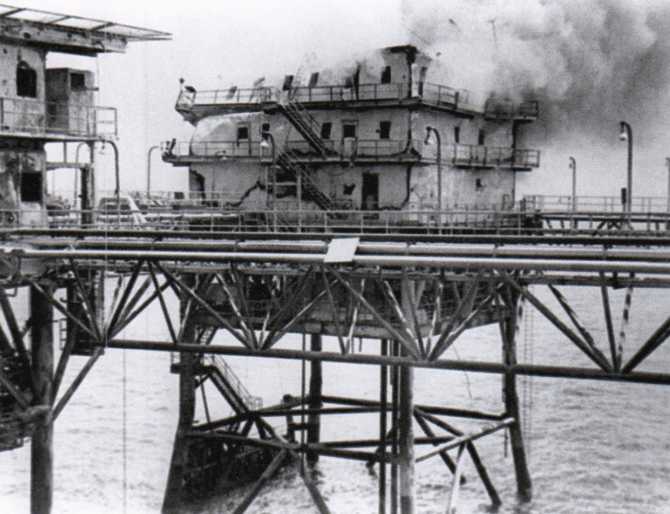
The process of the US surface action group B (SAGBravo) attacking the "Siri" oil platform was similar to that of the "Sasan" oil platform, but the bombardment of the cruiser "Wainwright", the frigate "Simpson" and the "Bagley" caused the oil and gas tanks to explode violently, completely destroying the "Siri" platform, and the "Seal" commandos gave up the action of boarding the platform.
At 11:30, the Iranian Shina-class missile boat "Joshan" (P225), guided by shore-based radar, sailed towards the B surface action group at a speed of 35 knots. It ignored the warning of the "Wainwright", approached and launched the "Harpoon" missile first. The "Wainwright" hurriedly launched chaff jammers and maneuvered to evade, escaping the disaster. The US ship then counterattacked. One "Standard" 1 missile launched by the "Simpson" and two "Standard" 1 missiles launched by the "Wainwright" both hit the "Joshan", and one "Harpoon" launched by the "Bagley" missed. The "Joshan" was severely damaged and sunk by the US ship, and 15 officers and soldiers on the boat were killed. This time, the "Standard" 1 originally used for regional air defense on the US ship demonstrated its ability to deal with surface targets. 12:50 At 1:30 p.m. on the 27th, the USS Wainwright used two Standard Missiles to intercept two incoming F-4 Phantom fighters, one of which was hit and forced to land at Abbas base with damage.
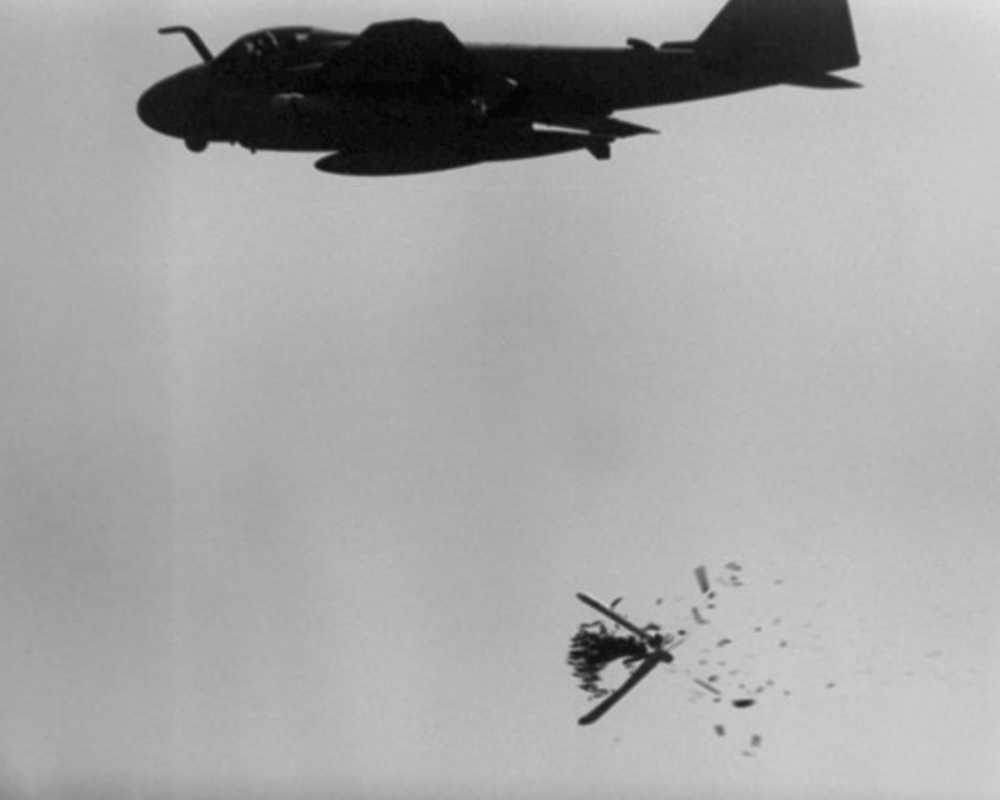
13:30, when the USS Strauss, the destroyer USS Aubonnon and the frigate USS Williams of the D Surface Action Group (SAG Delta) were searching for Iranian warships, they found that the Revolutionary Guard’s Borgmar armed speedboats attacked the US supply ship Willy Ted, the Panamanian oil tanker Scan Bay and the British oil tanker York Marlin in the Persian Gulf. The USS Enterprise immediately dispatched A-6E carrier-based attack aircraft. At 14:25, the USS Joseph Strauss guided two A-6Es of the VA-95 squadron to the Iranian speedboats, and the A-6Es dropped four CBU-59 cluster bombs on the targets. After being dropped, this bomb will split in the air and release more than 700 bomblets. It is a large-scale lethal weapon. The bomb immediately destroyed one "Borgmar" and damaged several other speedboats. The remaining speedboats fled to Abu Musa Island and ran aground to survive.
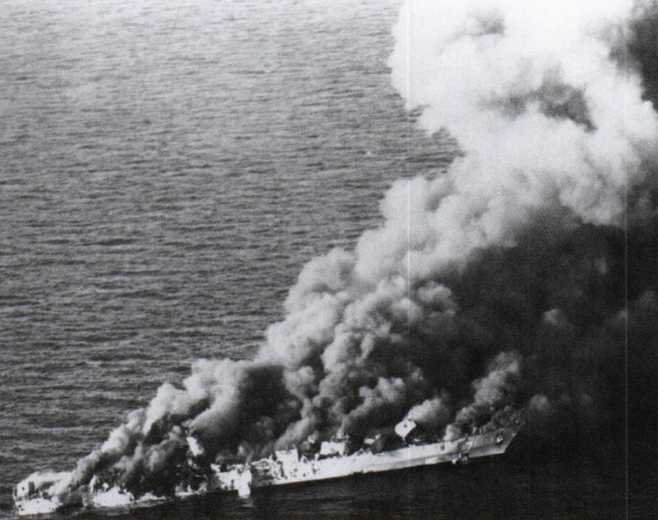
At this time, an E-2C early warning aircraft of the VAW-117 squadron that took off from the Enterprise discovered that an Iranian frigate had left its berth in the port of Abbas. It was identified as the sister ship of the Sabalan, the Sahad, which was heading towards the D surface action group at high speed. At 15:30, the two A-6Es summoned by the E-2C avoided the shooting of the Sahad’s naval guns while locking the target with radar, infrared and laser illuminators, and launched two "Harpoon" missiles and four laser-guided bombs at the Sahad. The Joseph Strauss also fired a "Harpoon" at the Sahad. The flames burning on the Sahad, which was hit by multiple bombs, caused the ammunition depot to explode. The bow of the ship was seen to be downward and tilted to the left, and a column of thick smoke emerged and sank into the sea.
At 17:15, the Sabalan hurriedly sailed to fight. After two A-6Es avoided the Seacat anti-aircraft missiles launched by it, they each dropped a Paveway II laser-guided bomb on it. One bomb penetrated the chimney of the Sabalan and exploded in the engine room. The captain was killed and the warship was paralyzed and caught fire. At this time, the senior officials of the Pentagon who had been monitoring the battlefield situation decided to stop while they were ahead and stopped further attacks by the US military, ending the "Mantis Operation". The severely damaged Sabalan was pulled back to the port of Abbas by a tugboat.
On July 18, 1988, Khomeini accepted the UN Security Council Resolution 598 to permanently stop hostilities against Iraq on August 20, and the eight-year Iran-Iraq War finally ended.