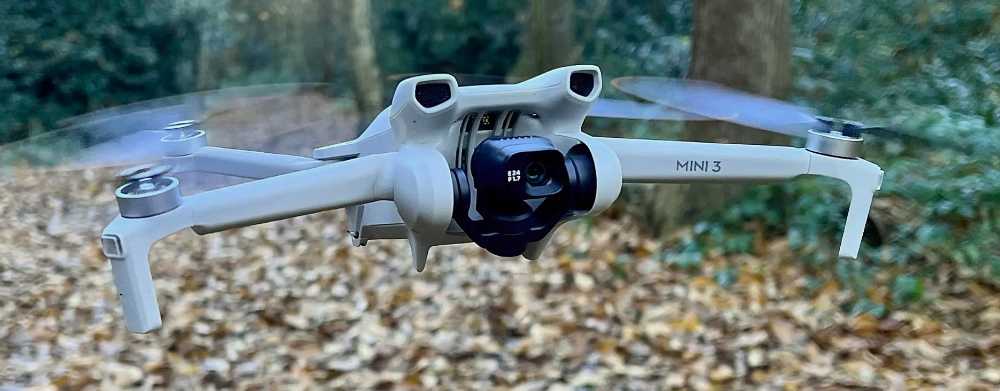
In recent years, multi-rotor drones have appeared in all aspects of our lives. In most people’s minds, this small aircraft has to some extent replaced large fixed-wing models such as "Predator" and "Pterosaur", becoming the standard image of "drone". But what you may not know is that these multi-rotor drones with different shapes and names can play their unique role in emergency rescue, law enforcement and counter-terrorism, and even military fields in addition to their well-known aerial photography uses. At present, multi-rotor drones generally have outstanding advantages such as low price, easy operation, vertical take-off and landing, strong scalability, and high safety. Therefore, they are widely used in various scenes in production and life, giving wings to all walks of life.
Emergency Pioneer
In the field of rescue, drones of different sizes and uses have become one of the most effective assistants for rescuers, playing their unique advantages in earthquakes, fires, electricity, communication repairs, epidemic prevention and control, wildlife rescue, etc.
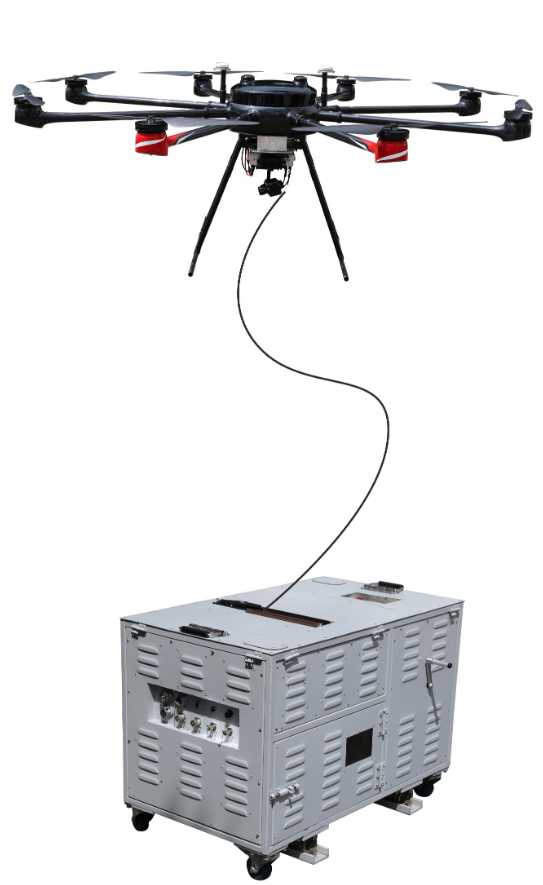
In early February 2023, a series of strong earthquakes occurred in the Turkish-Syrian border area. When many rescue teams rushed to the disaster area for rescue, they all carried multi-rotor drones. Among them, the GB1801 tethered lighting drone carried by the China Blue Sky Rescue Team became the "brightest star in the night sky" in the disaster area and was widely reported by major media. Different from the familiar lithium battery-powered and radio-controlled models, tethered drones are powered by ground generators, and the electricity and control signals are transmitted to the multi-rotor drones through light and thin cables, thereby realizing the power supply and control of the drones.
Compared with airborne lithium batteries, the power transmitted by ground generators is almost never exhausted and has greater power, so this type of drone can carry more powerful lighting fixtures to achieve long-term airborne. The GB1801 tethered lighting drone can illuminate an area of 3,000 square meters for 24 hours.
Compared to traditional lifting pole lighting vehicles, this tethered drone lighting system is not only more portable, but can also fly higher to provide a larger lighting range. Compared with unmanned helicopters that can also take off and land vertically, multi-rotor drones do not require complex rotary pitch and tail rotor mechanisms, have relatively small rotor diameters, and can still safely land after individual drive motors fail. They are not only easy to maintain, but also safer and more reliable.
Multi-rotor drones can also carry out epidemic prevention and disinfection, on-site modeling, life search, fire observation and other operations in disaster areas. For example, large agricultural multi-rotor drones from brands such as DJI and XAG can carry up to 50 kilograms of disinfectant to help disaster areas carry out efficient epidemic prevention and disinfection. Some high-end models can even use artificial intelligence technology, in conjunction with airborne active phased array radar (AESA) and binocular cameras to achieve active obstacle avoidance and terrain tracking flight, making flight safer and more efficient. With the help of high-precision satellite navigation and real-time differential positioning (RTK) technology, multi-rotor drones equipped with high-definition aerial survey cameras and laser radar (LiDAR) can achieve high-precision hovering, efficiently collect data in various complex terrains, and cooperate with high-performance ground computers and supporting modeling software to help rescue personnel establish a three-dimensional real-life model of the scene, providing information support for subsequent rescue command decisions.
The currently booming uncooled thermal imaging cameras can also be installed on the three-axis stabilized gimbal of multi-rotor drones, providing a "God’s perspective" for rescue personnel to search for life and observe fire conditions. In 2021, in the Hangzhou Wildlife Park leopard escape incident, a multi-rotor drone equipped with a thermal imaging camera successfully locked the third leopard in the dark night. In addition to carrying payloads of various functions, multi-rotor drones are also a smart aerial transportation tool. Not only can they quickly reach their destinations regardless of ground traffic conditions like unmanned fixed-wing aircraft and unmanned helicopters, they also have the outstanding advantages of low take-off and landing site requirements, high safety and high reliability.
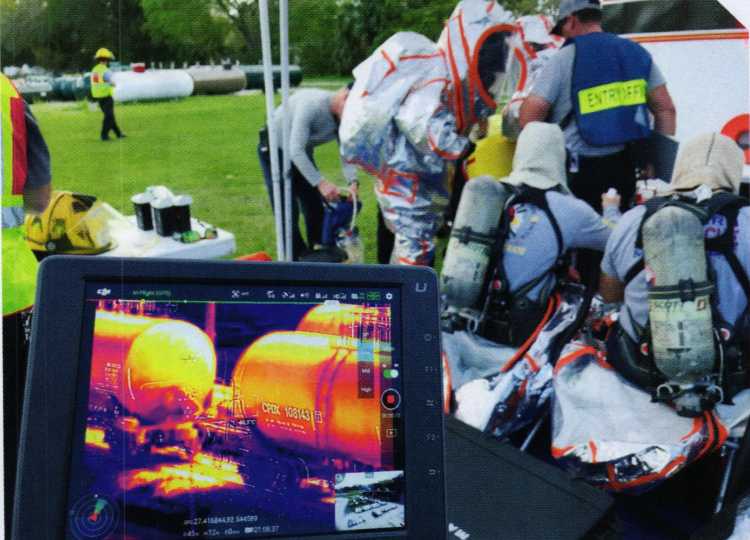
Although multi-rotor drones have a wide range of application scenarios in disaster relief missions, they still have shortcomings. Safety issues are the first priority. When a drone used for urban emergency transportation crashes, it is not only very easy to destroy the items carried on board, but it is also likely to cause incidental property losses to ground personnel. Secondly, some payloads still have great limitations in actual use. For example, in the above-mentioned leopard search incident, the thermal imaging camera lost its target due to vegetation obstruction after the leopard entered the woods. During the day, the ground temperature is high, and thermal imaging cannot even identify the target at all. Finally, battery-powered multi-rotor drones generally have a slow flight speed and limited battery life, while tethered drones are difficult to perform long-range, large-scale flight missions.
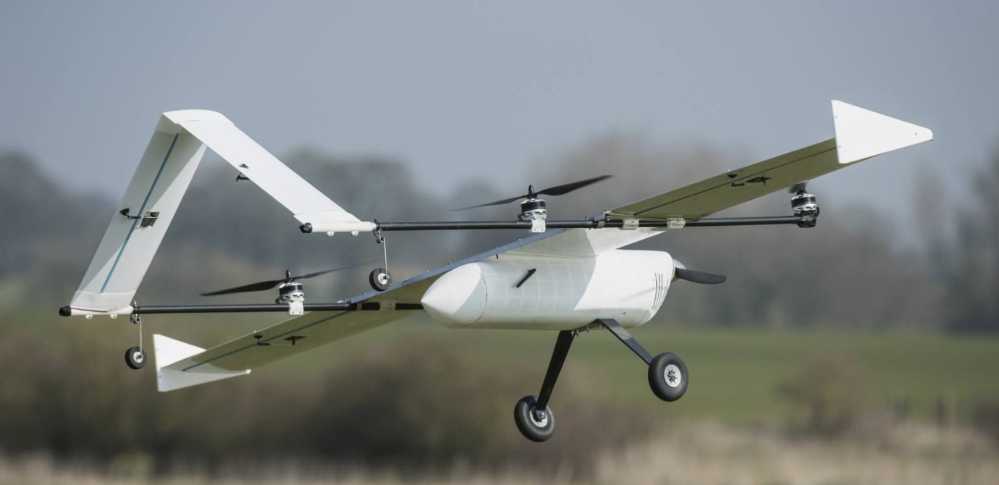
UAV manufacturers improve the reliability of drones and reduce losses in the event of a crash by means of multiple redundant designs of key components and installation of parachutes. Research teams are also developing artificial intelligence algorithms to integrate and analyze data from multiple sensors to maximize their strengths and minimize their weaknesses. Some teams have added several motor-driven rotors to existing fixed-wing drones, creating a hybrid drone that can fly at high speeds for a long time like fixed-wing models, and can hover and take off and land vertically accurately like multi-rotor models.
A powerful tool for law enforcement
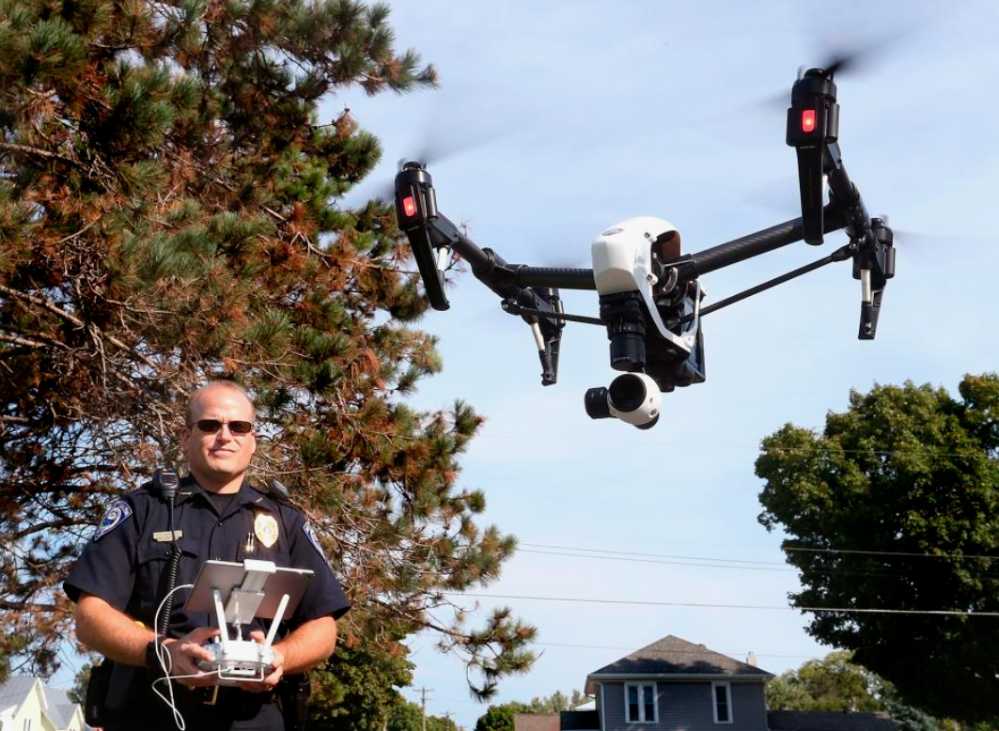
Multi-rotor drones are light and portable, flexible in takeoff and landing, and have a variety of payloads. They can be operated by a single person for fast patrols, and can also achieve multi-machine collaboration through ground station software. Therefore, in addition to the field of emergency rescue, law enforcement departments in various countries have also introduced multi-rotor aircraft as a new law enforcement tool. Similar to participating in emergency rescue, multi-rotor drones are mainly used for aerial optical reconnaissance in the field of law enforcement. Some law enforcement departments have also tried to transform them so that multi-rotor drones equipped with various police equipment can directly participate in law enforcement.
According to Xinhua News Agency, the Wuhan police in Hubei Province have established a police drone reconnaissance brigade, which has conducted in-depth exploration of the application scenarios of multi-rotor drones and carried out targeted transformation. When on duty in densely populated areas, drones equipped with dual-band cameras for visible light and thermal imaging can instantly obtain crowd distribution density maps and guide ground police forces; when searching for target buildings, high-speed multi-rotor drones-crossing drones quickly search each floor and each room, and can even launch attacks by collision when necessary; at the scene of mass incidents, drones can mount and release non-lethal ammunition in a timely manner; when facing dangerous aircraft models and "black flying" drones, cross-country drones equipped with net guns can chase targets and launch capture nets for interception.
In addition, the department is also equipped with a drone nest system to achieve air patrols in key areas. The device is box-shaped. After receiving the take-off command, the box cover automatically opens and unfolds into a drone landing platform. Then the multi-rotor drone automatically takes off and cruises autonomously according to the set mission route. The control center uses the cellular mobile network to receive images in real time. When the mission is completed or the battery is low, the drone automatically returns, and the electrodes on the landing gear dock with the automatic charging device to achieve automatic charging.
Battlefield Strange Soldiers
Compared with large military drones, civilian multi-rotor drones have poor anti-interference and anti-bad weather capabilities, and cannot carry a large number of missiles to perform long-duration missions that take dozens of hours and fly thousands of meters. However, due to the relatively low price and the fact that operators can operate without long-term professional training. Therefore, civilian multi-rotor drones have also been used in wars by various military forces in recent years.
Although major civilian drone companies have repeatedly stated that they oppose the use of their products for military purposes and restrict them through various means. However, the parties to the war are often able to crack the restrictions taken by drone companies. Therefore, civilian multi-rotor drones can still be seen in the skies over the battlefield today.
The evolution of civilian multi-rotor drones in military applications is exactly the same as the history of fixed-wing manned aircraft in military applications. Initially limited to reconnaissance, they were subsequently used in practice for shooting psychological warfare propaganda materials, carrying explosives to launch "suicide attacks", air bombing, material transportation, signal relay, and even intercepting enemy drones.
In 2014, Islamic State militants began using civilian multi-rotor drones to conduct battlefield reconnaissance and shoot images of suicide bombings as propaganda materials. In October 2016, Islamic State militants deliberately crashed a multi-rotor drone in northern Iraq. The aircraft had an improvised explosive device in its battery. When two Kurdish militants picked up the drone, the bomb exploded, killing the two men. In the following months, both the Islamic State militants and the Iraqi military used multi-rotor drones to drop improvised bombs on each other in the Kurdish region. The bombing drone used by the former had a relatively simple structure. They installed a leaky plastic cylinder at the bottom of the DJI Phantom 4 drone, and the operator released the explosives through a component attached to the side of the fuselage. The military drone was more sophisticated. It was based on the DJI M100, with two bombs modified from rifle grenades hanging on the lock controlled by the servo under the fuselage. The tail of the bomb was equipped with a badminton for stabilization. Due to its high precision, this bombing device has been continuously borrowed and developed by various military forces since its introduction. Today, the bombing drones commonly used in the Russian-Ukrainian conflict have inherited a similar structure.
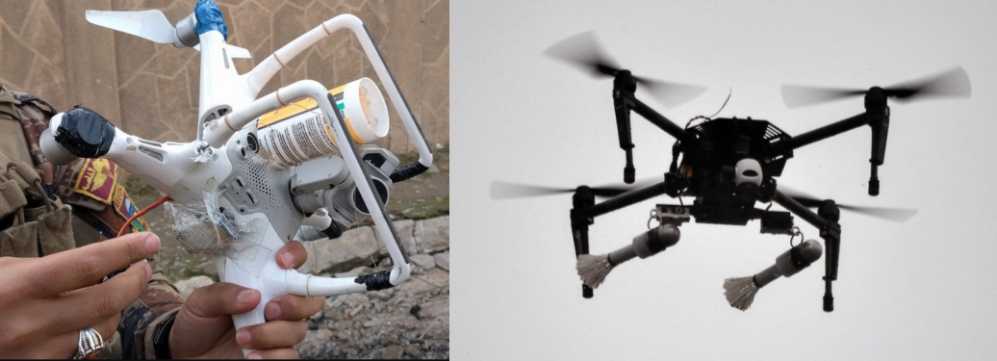
Compared with the precision-guided munitions launched by large military drones, this self-modified simple bombing drone relies almost entirely on the images sent back by the drone camera and the operator’s experience when aiming. Videos circulating on the Internet show that experienced operators can use drones to accurately drop small bombs next to enemy soldiers or even into the bacon of a bunker. In addition to small grenades assembled from badminton and 3D printed parts, mortar shells are also used as bombing ammunition because they have their own tail fins and are more powerful. In the Russian-Ukrainian conflict, the large four-rotor bombing drone assembled by the Ukrainian side can carry 6 82mm mortar shells and drop them continuously, which is amazingly powerful.
At the Venezuelan military parade in August 2018, a large six-rotor drone flew to the rostrum when the country’s President Maduro was giving a speech and exploded. The attack injured many people, but fortunately Maduro himself was not seriously injured. This is the most famous assassination incident using multi-rotor drones in recent years.
The first large-scale use of civilian multi-rotor drones in war was the Russian-Ukrainian conflict that broke out in 2022 and continues to this day. We can often see on the Internet the battle scenes filmed by armed personnel from both sides using civilian multi-rotor drones, and even "teaching materials" on how to add a bomb dropper to a commercially available civilian drone, or directly bundle an anti-tank warhead. These civilian drones can shuttle freely in the hail of bullets with the help of a compact fuselage made of composite materials, low-altitude and low-speed flight characteristics, and flexible control performance, becoming "air guerrillas". Although enemy personnel can visually detect them, it is often difficult to shoot them down.
In order to more effectively detect and intercept these battlefield ghosts, both Russia and Ukraine use countermeasures such as DJI Cloud Sentry (a device that searches for nearby DJI drones through specific broadcast signals), individual jammers, and drone jammers, but civilian multi-rotor drones with weaker anti-interference capabilities than military products can still appear and disappear. The reason is that on the one hand, the signal coverage of the above-mentioned countermeasures equipment is limited, and on the other hand, civilian-grade drones are cheap, so even if they are shot down, the loss is not great. In addition, most drone jammers can only block the satellite positioning and remote control signals of the target drone, but cannot take over its control. Civilian drones that lack high-precision inertial navigation systems will become "headless flies" after losing all radio signals. This means that if the enemy drone carries explosives and the jamming signal range is not long enough, the enemy aircraft may crash near the enemy’s position, which may also cause losses.
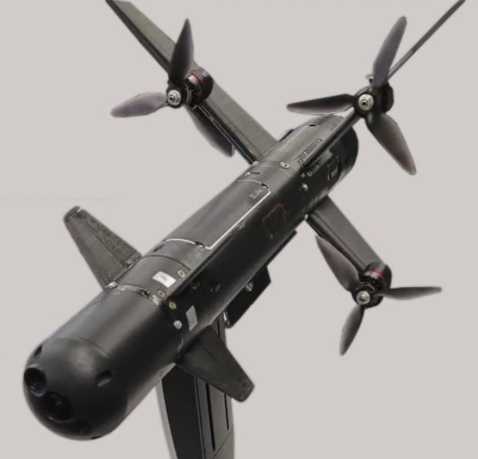
In order to avoid the various shortcomings of interference with anti-drone, the Ukrainian scientific research team has developed a multi-rotor and fixed-wing hybrid configuration interceptor drone called "Hunter". According to the official website, the drone adopts a multi-rotor configuration to take off vertically and can be converted to a fixed-wing mode in the air for high-speed level flight. After the drone is released, it first searches for the target drone through a low-cost infrared and visible light dual-band camera, and then releases a mesh inflatable catcher when approaching the target. After completing the task, it lands in a designated area for charging. Of course, the drone can also be set to direct impact mode and perish together with the target. With the breakthrough of energy and technology, the military practicality and battlefield survivability of multi-rotor drones will be significantly improved. The integration of technologies such as autonomous decision-making and artificial intelligence assistance will also improve the efficiency of human-machine combat to a new level and give birth to new combat methods and weapon systems.
Although civil-grade multi-rotor UAVs still have problems such as relatively low reliability, simple payload, low intelligence, weak anti-interference ability, and lower high-speed flight efficiency than helicopter configuration, they can still play their unique value in aerial photography, emergency rescue, law enforcement and even the military.