The so-called "big plane" is actually a relatively vague concept. How big is considered big? Is it divided by type and function? Or is it calibrated by specific parameters such as size, take-off weight, and load? There seems to be no unified standard in the world. However, it can be roughly regarded as a comprehensive concept of more than one standard, that is, passenger planes whose size, take-off weight, and load exceed those of general tactical (or light) aircraft of the same era: transport planes, bombers, and some special function aircraft (such as early warning aircraft, anti-submarine aircraft, etc.). Before the end of World War II, four-engine heavy bombers were considered typical "big planes" at the time. In World War I, the "Ilya Muromets" of Tsarist Russia pioneered the trend. The American B-17, B-29 and the British "Lancaster" models were carried forward. Japan also developed two four-engine heavy bombers, "Shinyama" and "Lianshan" during the war. The former referred to the basic design of the American DC-4E four-engine transport aircraft, and the latter was a modification of the B-17. There are many references, but they were not actually put into combat because of their substandard performance or because they appeared too late near the end of the war, and the Japanese aviation industry’s initial attempt at large aircraft was hastily ended.
At the same time, the "Shinyama" and "Lianshan" bombers once again highlighted the consistent "take-it-as-it-is" philosophy of the Japanese aviation industry. However, with the introduction of a comprehensive ban on the Japanese aviation industry by the United States after the defeat, this shortcut was temporarily blocked.
Frequent failures at the start
After the outbreak of the Korean War, the United States began to rearm Japan. In 1952, the United States formally approved Japan to rebuild its aviation industry. The "harmless" and low-tech light transport aircraft became Tokyo’s natural choice at this time, although later facts proved that this model named YS-11 was not "harmless".
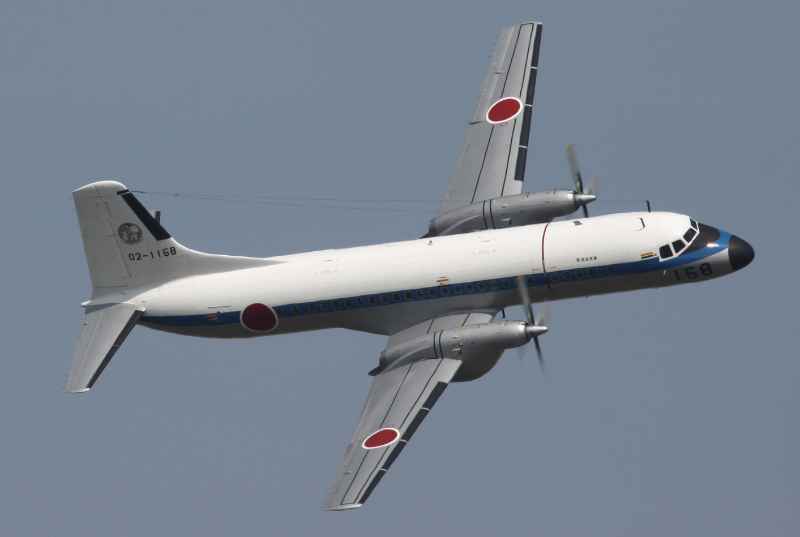
On May 30, 1956, Japan officially released the "Medium-sized Conveyor Domestication Plan", the main goal of which was to develop a medium-sized transport aircraft that can take off and land on a 1,200-meter runway and meet the requirements of regional aviation. As the first model independently developed after the war, the Japanese government has given great support to the YS-11 plan in terms of policy and funds. In addition to official departments, it also gathered almost all the elites of Japan’s aviation manufacturing industry, including Mitsubishi Heavy Industries, Fuji Heavy Industries, Kawasaki Heavy Industries, ShinMaywa Industries, Showa Aircraft, and Japan Aircraft. Most of these companies produced military aircraft or related military products during World War II.
On June 1, 1959, the Japanese government, based on the "Conveyor Design Research Association", gathered all the companies participating in the YS-11 plan to establish the "Japan Aircraft Manufacturing Co., Ltd." (NAMC). The Japanese government has invested 42 The YS-11 made its maiden flight in Nagoya on August 30, 1962. The first YS-11 production model was delivered to Japan Transoceanic Airlines in March 1965. On September 7, the same year, the YS-11 received the type certificate from the Federal Aviation Administration (FAA).
A total of 182 YS-11s were produced, with the first two being prototypes. There were 75 civilian aircraft in Japan, 34 official aircraft, and 76 exported to 13 countries. The aircraft was discontinued in 1974, and the once ambitious NAMC was disbanded. It failed to become Japan’s BAE (British Aerospace Systems), reflecting the Japanese government’s determination to develop its own aviation industry. The YS-11 itself also gave the "take-it-and-use-it" an opportunity to revive. Its overall layout clearly borrowed from the previous generation of piston transport aircraft such as the American C-47. It uses two British Rolls-Royce "Dart" 10 turboprop engines, with a maximum take-off weight of 24.5 tons and a range of 1,110 kilometers. The civilian standard version has 64 seats. The YS-11 is not a purely civilian aircraft. The Maritime Self-Defense Force ordered 10, the Air Self-Defense Force ordered 13, and the Coast Guard also ordered 5. The aircraft still ranks first in the global regional passenger aircraft accident rate, with 36 accidents, 23 of which were fatal, 26 aircraft destroyed, 254 people killed, and a total destruction rate of 14.2%.
Tojo transport aircraft
In the post-war restart phase of Japan’s aviation industry, there is a name that cannot be avoided. He is not a genius master who has never appeared in the world, but he has indeed played an important role in promoting the reconstruction of Japan’s aviation industry after the war-although he has a regrettable "bloody" surname.
Hideki Tojo, the top war criminal in Japan during World War II, and his wife Katsuko Tojo gave birth to 3 sons and 4 daughters. The most famous of these children is the second son, Teruo Tojo. Teruo was born in 1914. After graduating from Tokyo Imperial University, he joined Mitsubishi and participated in the development of the "Zero Fighter" under the leadership of Jiro Horikoshi before the war. Japan’s defeat and Tojo Hideki’s execution did not have much impact on him. In the YS-11 R&D team, Tojo Teruo was already an important member. And the next R&D project he participated in was the first test of Japan’s domestically produced military large aircraft after the war - the C-1 transport aircraft.
C-1 is a twin-engine medium tactical transport aircraft developed by Kawasaki Heavy Industries of Japan to replace the Air Self-Defense Force’s outdated C-46. The design requirements of C-1 are to have the endurance to fly to all parts of the country within the Japanese archipelago without refueling, and to have all-weather performance as well as airdrop, airborne and short-range takeoff and landing capabilities. The development of the aircraft started in 1966 and was officially put into use on January 1, 1976. By the time it was discontinued in 1981, a total of 31 C-1s had been produced.
Compared to the YS-11, the C-1 is slightly larger, with a maximum take-off weight of 45 tons and a maximum load of 12 tons. It can carry 60 soldiers or 45 paratroopers, as well as howitzers, jeeps and other equipment of the Ground Self-Defense Force. The aircraft is equipped with two American-made Pratt & Whitney JT8D-M-9 turbofan engines produced under license from Mitsubishi, and has a range of 1,500 kilometers when carrying 8 tons. The transport capacity of the C-1 is the worst among transport aircraft of the same level at the same time. It cannot carry main combat equipment such as infantry fighting vehicles. The maximum range when empty is only half of that of the Soviet-made An-72, and it cannot even perform the mission of traveling back and forth from the mainland to the Ryukyu Islands.
In addition, this transport aircraft also had many accidents during its service: in April 1983, two C-1s crashed into a mountain in Mie Prefecture, killing 14 people on board; in February 1986, a C-1 crashed during takeoff and the aircraft was scrapped; in June 2000, a C-1 crashed on the west coast of Japan, killing five crew members; in 2019, a C-1 actually threw an 81mm mortar into a tree... From the high accident rate of YS-11 and C-1, the low localization rate of core components, and the outdated performance, it is not difficult to see that during the Cold War, Japan’s large aircraft industry was far from the world-class level of the United States and the Soviet Union, although neither of these two products was really a "large aircraft".
As for their important promoter, Teruo Tojo, he has always been favored by fate. He became the president of Mitsubishi Motors in 1981 and became one of the most influential businessmen in the world. Unlike his anti-war and anti-militarist elder brother, Teruo Tojo had a close relationship with his father since childhood. Although he never entered politics, it is said that many activities of right-wing extremist organizations in Japan were funded by him. In 2011, Teruo Tojo died after living for 98 years.
A defective aircraft that wastes tax money
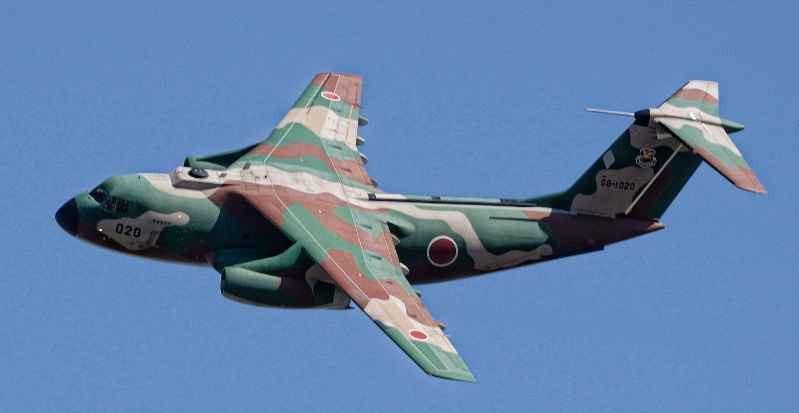
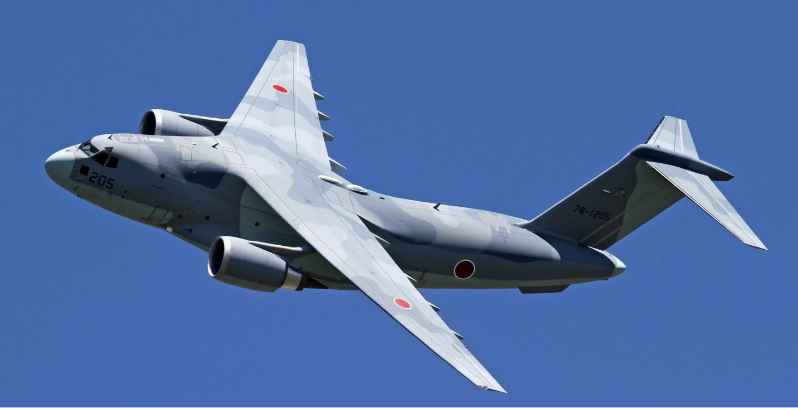
The Air Self-Defense Force still has as many as 26 C-1 transport aircraft in service. The main reason why it is reluctant to retire such an outdated model is that its replacement C-2 has not been able to take over. The planned purchase volume of the latter is as high as 40 aircraft, which is obviously far from the realization of this goal.
The C-2 transport aircraft was approved for development in 2001, with a unit price of more than 200 million US dollars. However, it repeatedly experienced serious accidents during the development process, resulting in the aircraft not being put into service until 2017. It was 4 years later than the P-1 anti-submarine aircraft, another domestic large aircraft that was launched in the same year, has a more complex structure, a higher localization rate, and should have been more difficult to develop. It is worth noting that the C-2 still does not use domestic engines, but uses two American-made General CF6-80C2L1F turbofan engines.
C-2 went to Ukraine to support some military supplies such as bulletproof vests and helmets after the outbreak of the Russian-Ukrainian war this year. Almost at the same time, China’s 6 Y-20s, a total of 18 sorties, went to Serbia to deliver a complete set of air defense missile systems ordered by Serbia. In comparison, the C-2 has a huge gap. This type of aircraft is actually just a medium-sized transport aircraft with a maximum take-off weight of only 140 tons and a maximum load of 30 tons. This is completely different from the maximum take-off weight of 220 tons of the Y-20 and a load of more than 60 tons. Of course, compared with Japan’s previous generation C-1, C-2 is still a "next-generation" product. Not only is its load capacity nearly three times that of the former, but its 10,000-kilometer range (empty) has finally solved the "short legs" defect of the Air Self-Defense Force’s transport fleet.
At the same time as C-2, Japan’s large aircraft industry is also promoting another core product, the P-1 anti-submarine aircraft. Currently, most of the fixed-wing anti-submarine patrol aircraft used by countries around the world are improved from transport aircraft or passenger aircraft. This is not the case in Japan. The P-1 anti-submarine aircraft and C-2 transport aircraft plans are developed in parallel. The fuselage platform is specially developed by Kawasaki Heavy Industries. It can be said to be the world’s first real "professional anti-submarine aircraft." In order to save costs, P-1 and C-2 have certain commonality in fuselage structure and platform technology. Even so, the unit price of P-1 is still more than 200 million US dollars, which is definitely the most expensive anti-submarine aircraft in the world.
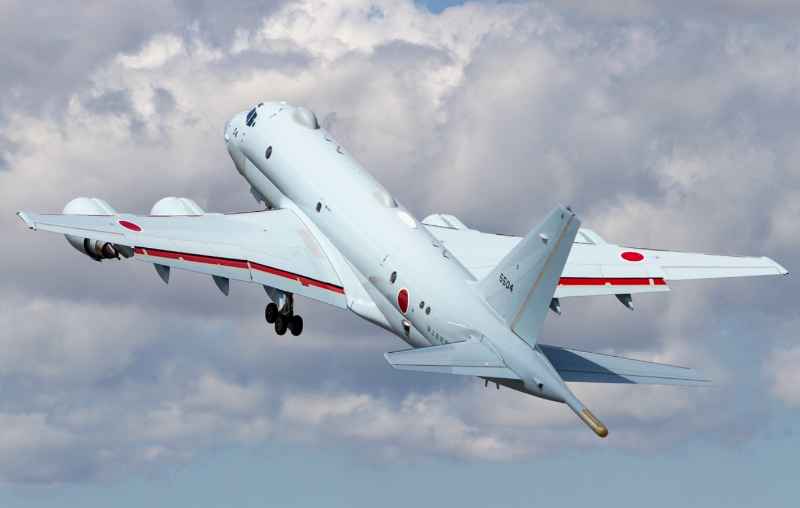
The first prototype of the P-1 anti-submarine aircraft was completed in 2007. From 2007 to early 2013, Kawasaki Heavy Industries conducted ground and air tests on the P-1 for 6 years. It was not until March 26, 2013 that the first production P-1 was delivered to the Maritime Self-Defense Force.
According to the original plan, the total number of P-1s purchased by the Self-Defense Force will exceed 70. The Maritime Self-Defense Force hopes that the aircraft can completely replace the P-3C, not only to curb the free actions of the Chinese and Russian naval submarine forces, but also to form 24-hour uninterrupted surveillance of disputed waters such as the Diaoyu Islands, Dokdo (called Takeshima in Japan), and the Southern Kuril Islands (called the Northern Four Islands in Japan). However, such a quasi-strategic aircraft with high hopes has been a "problematic aircraft" from its development to its service, completely inheriting the "fine tradition" of Japanese large aircraft.
On May 13, 2013, the P-1 encountered a shocking moment in the sky over the sea near Aichi Prefecture as soon as it was put into service. Its four engines unexpectedly stopped, and the aircraft plummeted from an altitude of 10,000 meters to 8,000 meters. Thanks to the pilot’s emergency manual restart of the engine, the tragedy of the aircraft being destroyed and killed was avoided. The accident caused all P-1s to be grounded, and the equipment, deployment and maritime patrol plans of this type of aircraft were all postponed. This is not the first time that a similar accident has occurred in the P-1. In October 2012, the aircraft also had a failure of one engine stopping during the test flight.
Unlike other outdated large aircraft projects in Japan before, the P-1 was accompanied by a certain degree of recklessness from the beginning because it required world-leading technical performance but had no development experience. The fuselage and engine of this type of aircraft are all newly developed and completely independently developed by Japan. Unlike the P-3C which uses turboprop engines, the P-1 is equipped with four low-noise Ishikawajima-Harima F7-10 turbofan engines. Its cruising speed, endurance and flight altitude are far superior to those of the P-3C, and it can reach the threatened sea area in a short time.
However, large aircraft and modern aviation engines are high-investment and high-risk industries after all. As the Japanese ambitions expand, various troubles also follow. There have been three major technical failures during the development and test flight of the P-1. The first was when the fuselage was pressure tested on the ground, and 15 to 20 cm long cracks appeared at the root of the main wing, near the fuel tank and at the tail. The second and third times were engine shutdowns in the air.
If the series of accidents in 2013 and before can be explained by the reasons that the aircraft were brand new and had problems to be solved during the test flight, then the fact that the P-1 still had troubles after serving for several years really annoyed the Self-Defense Forces. In June 2017, in order to participate in the Paris Air Show, two P-1s set off from Japan to Europe. The trip was originally intended to advertise Japan’s aviation industry under the spotlight of the world. However, one of the P-1s broke down as soon as it flew to Djibouti, Africa. Because there was no time to transport spare parts from Japan, the aircraft had to give up the trip to France.
In February 2019, the Japanese media broke the news that a retired officer of the Maritime Self-Defense Force’s anti-submarine aircraft unit privately told the media that the serviceability rate of the 20 P-1s in service was only 10% throughout 2018, and only 2 of this type of aircraft were available for deployment at any time. Based on this, the Japanese media complained that the aircraft was a "defective aircraft that wastes tax money"
Faced with such a "defective aircraft", the Maritime Self-Defense Force has not renewed the order after the initial 33 orders, but instead proposed to the Ministry of Defense to extend the service life of its 54 US-made P-3Cs. From this, we have every reason to speculate that the Japanese Maritime Self-Defense Force is not satisfied with such a domestically produced anti-submarine aircraft that claims to be more advanced than the US P-8 "Poseidon".
MRJ Give Up?
Looking back at civil aircraft, after the YS-11 was discontinued: Japan had a plan to develop a successor aircraft, using jet engines instead, codenamed YS-X, but it was not implemented later. However, backed by the Japan-US alliance, Japan’s aviation industry successfully connected to Boeing’s industrial chain during the Cold War, and participated in the research and development and manufacturing of almost all passenger aircraft projects from Boeing 737 to Boeing 787, and the proportion of division of labor obtained increased year by year.
Mitsubishi Heavy Industries undertook the production of the main wing box of the Boeing 787 and all the main wing parts except the active surface. The carbon material developed by Toray was used on the Boeing 787. The strength of this material is more than 9 times that of steel, but the weight is only one hundredth of that of steel; the tire giant Bridgestone provides landing gear tires for Boeing passenger aircraft; All Nippon Airways also undertook the design of almost all software parts of Boeing passenger aircraft... No wonder some Japanese media boasted that the Boeing 787 can be called "quasi-made in Japan".
The Japanese Aviation Industry seems to have regained its ambition from working for Boeing. Therefore, in the new jubilee year, Japan launched a regional aircraft development plan, namely the MRJ project. Whether from the project launch time or the model positioning, MRJ and China’s ARJ21 seem to have a competition in the market in the future, and Canada’s Bombardier and Embraer will also usher in a strong challenger. However, later facts proved that the Japanese did not seem to be very determined.
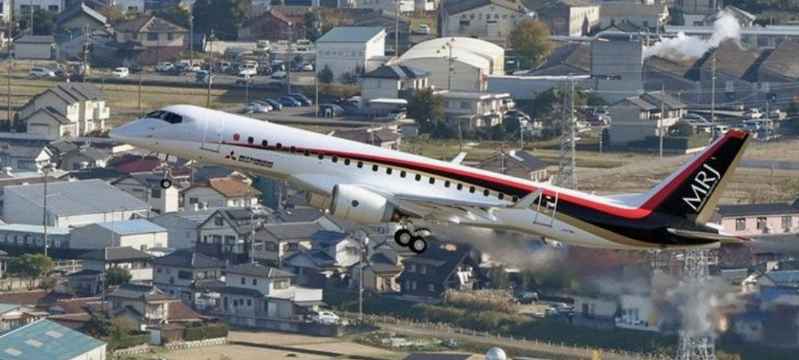
MRJ was led by Mitsubishi Heavy Industries, and other major Japanese heavy industry companies, including Kawasaki Heavy Industries, Fuji Heavy Industries, Ishikawajima-Harima Heavy Industries, and even Toyota Motors, participated in it. The project was highly anticipated at the beginning, and was even praised by the Japanese people as the "small 787". MRJ adopts a series development approach, including two main models, the MRJ-70 with 70 to 80 seats and the MRJ-90 with 86-96 seats. Each model has derived a basic extended model and an extended range model. The overall idea is good. As of 2017, MRJ has received 447 orders, of which 300 are from the United States---everything seems to be good.
However, the reality is cruel. For a long time, Japan’s aviation industry has neglected basic research and engineering support, believed in "take-it-as-it-is" and constantly wavered between domestic production and import. The inherent problems soon had a serious negative impact on the development of MRJ. In 2004, Mitsubishi first announced the design plan. The optimistic Japanese even planned to deliver the first aircraft to customers in 2013. But since then, the delivery time has been postponed for 6 times. It was not until 2014 that the first MRJ prototype rolled off the assembly line, and the first test flight was completed two years later. In the same year, the financial department of Mitsubishi Heavy Industries revealed that the cost of MRJ research and development had exceeded US$5 billion, more than three times the original investment.
Since then, the project has basically stagnated. In 2020, it was reported that Mitsubishi slashed the registered capital of the project, which was interpreted by the outside world as "giving up treatment." It was not until a document officially released by Japan in 2021 that the key reason why the project has been unable to make progress was revealed. It turned out that an engine of its second prototype suddenly failed during the test, and the aircraft was almost destroyed and killed. The test site happened to be in Oregon, USA, so MRJ did not get FAA certification. What’s worse is that when the accident occurred, MRJ’s 3, 4, and 5 prototypes had already been offline. The US attitude is very clear. Because of major safety defects, MRJ must be "improved" again before it can continue to participate in the test. In other words, the first five MRJ prototypes produced by Japan are basically scrapped. They can no longer participate in FAA certification applications, and everything starts from scratch. And the Japanese side actually concealed this key information for several years before announcing it. At the beginning of 2022, Mitsubishi revealed that all test flights of MRJ were stopped in early 2020 due to the COVID-19 pandemic and that in October 2021, it had decided to shelve the project for three years.
Compared to the 100th delivery of ARJ21 in 2022 and the successful delivery of C919 mainline passenger aircraft in 2022, MRJ may no longer be a competitor. The Japanese think the problem is simple. Being able to build 35% of mainline passenger aircraft does not mean that 100% of regional aircraft can be built. Boeing can outsource some non-core replaceable projects to Japan, but it will not let the Japanese take away the full set of large aircraft research and development and manufacturing technology. There is still a huge gap between them. It is not impossible to cross, but it requires unimaginable all-round efforts. China has done it, and Japan continues to waver.
Dreams have everything
Everyone has dreams, but dreams must be realized through unremitting actions. In recent years, we have seen more than one MRJ in Japanese large aircraft PPTs. The Japan Aircraft Development Association once stated that Japan would launch a new long-range, low-emission hybrid large aircraft after 2030 to achieve the so-called "overtaking on the curve"; in June 2005, Japan announced cooperation with France to develop the next generation of "Concorde" supersonic passenger aircraft, shortening the flight from Tokyo to New York to 6.5 hours. After the project was abandoned, Japan’s hypersonic research "JAXA2025 Vision" once again proposed that Japan will develop hypersonic passenger aircraft and transport aircraft with a flight speed of up to Mach 5, and complete system technology flight verification by 2025. Its range is not less than 8,700 kilometers, its carrying capacity is not less than 13 tons, and it can carry 100 passengers. It only takes 3.5 hours to fly from New York to Paris or London...
Looking back at the not-so-sci-fi MRJ at this time, I can only say that there is everything in dreams.