
From KN-09 to KN-22, North Korea’s armaments have advanced by leaps and bounds
KN-09 rocket launcher
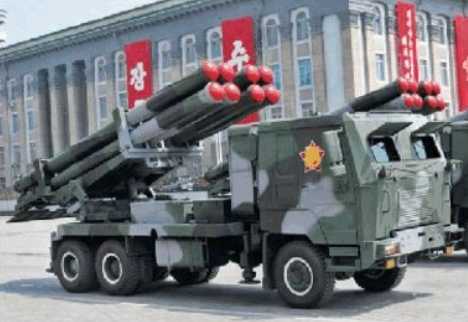
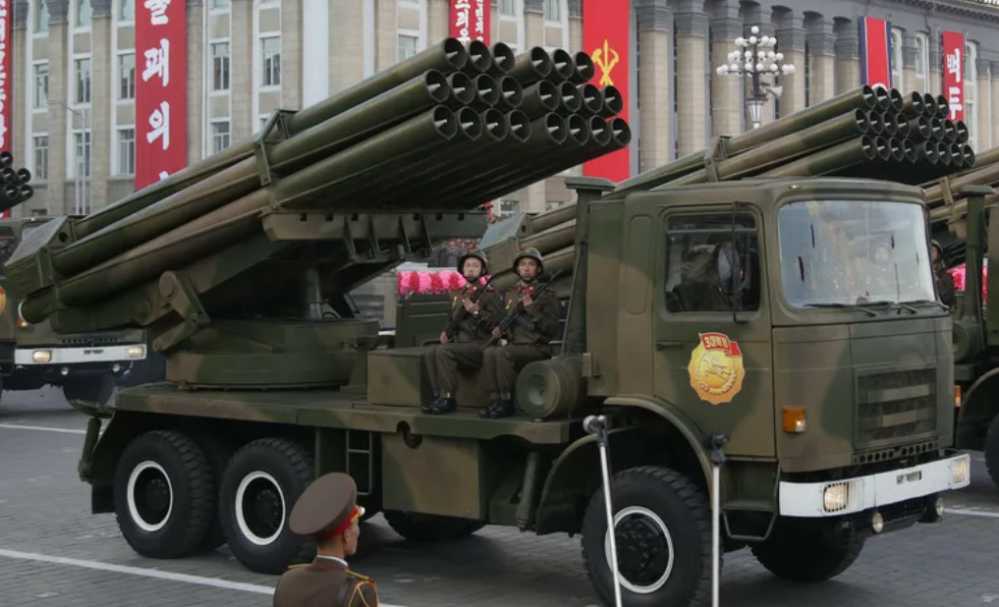
Although it was initially reported that KN-09 might refer to the name of the North Korean modified version of the Russian Kh-35 anti-ship cruise missile, KN-09 actually refers to the 300mm (or possibly 333mm caliber) rocket launcher system. The KN-09 is reportedly capable of reaching a range of 200 kilometers and can hit Gyeryongdae in South Chungcheong Province, South Korea when fired from the armistice line. The launch vehicle can carry 8 rockets. Some claim that the KN-09 is called the "Juche 100th Year Rocket Launcher" in North Korea. When the US satellite first discovered the new North Korean rocket launcher in 2013, it had only 4 launch tubes. Iran has a Fadjr 5C rocket launcher with similar performance. From May 18 to 20, 2013, North Korea launched six new rockets in succession, with a range of 130 to 150 kilometers. On March 4, 2014, North Korea launched four 300mm rockets and three 240mm KN-09 rockets, which flew 155 kilometers. According to a report by South Korea’s JoongAng Ilbo on July 31, 2014, North Korea has launched this new type of rocket launcher five times in Wonsan and other areas on the east coast, launching 3 to 4 rockets each time. According to the South Korean Joint Chiefs of Staff on June 26, 2014, North Korea launched three KN-09 guided rockets from the eastern city of Wonsan to the eastern waters of the peninsula at about 5 pm that day, with a range of 190 kilometers. North Korea first unveiled the 8-unit KN-09 rocket launcher at the 2015 military parade. The KN-09 chassis that appeared in the public photos was modified from a Chinese HOWO6x6 civilian truck, with a maximum speed of about 90 kilometers per hour. On March 4, 2016, North Korea first publicly released the test-firing footage of the improved version of the KN-09 long-range rocket launcher, which uses a box-type launcher. The rocket accurately hit the simulated enemy stronghold. On March 21 of that year, when it was tested again, it accurately hit the reefs at sea, and North Korea threatened to use these rocket launchers to destroy the Blue House. The improved version displayed at the military parade on April 15, 2017, has armor protection added outside the cockpit. On May 4, 2019, North Korea conducted shooting drills with 240mm rocket launchers, 300mm rocket launchers and new tactical guided weapons. The 300mm rocket launcher launched this time is a cylindrical launcher that debuted in 2015. Through this shooting, it was confirmed that the two models of KN-09 use the same or similar guided rockets and have comparable ranges. In 2021, North Korea released a piece of online propaganda material in which it described the KN-09 as a "large-caliber controllable rocket." South Korea’s JoongAng Ilbo analyzed that the guided rockets of North Korea’s KN-09 rocket launchers are integrated with satellite navigation equipment imported from Russia (plus simple inertial guidance), so the strike accuracy is high and can hit the Pyeongtaek base of the US military stationed in South Korea and the headquarters of the South Korean Army, Navy and Air Force, Jilongtai.
KN-10 missile
KN-10 missile is an extended-range version of the KN-02 missile. On August 14, 2014, North Korea launched three unidentified missiles during Pope Francis’ visit to South Korea, and the South Korean Joint Chiefs of Staff thought they were 300mm multiple rocket launchers. However, the next day, August 15, North Korea announced the launch site, showing that it was an improved version of the KN-02 missile. This was the first time that North Korea publicly released the launch footage of the "Mars" 11 missile. The range of the missile has been increased to about 220 kilometers. Its range exceeds that of the Russian version, and it also indicates that North Korea has mastered advanced solid engines and their control technology. North Korean media said that this launch has greatly improved the missile’s hit rate and power, and it shows that the North Korean army has mastered all strike means such as short-range and medium- and long-range missiles "to reach the world’s level of ultra-precision key." Later, North Korea’s KN-23KN-24 missiles were improved on this basis, and the KN-24 missile was confirmed to be the "Mars" 11B. On September 1, 2014, North Korea launched a "Mars" 11, and on September 6, it fired three more in the Wonsan area. On September 22, 2014, South Korean intelligence told the "Joongang Ilbo" that North Korea is developing a new missile capable of carrying tactical nuclear warheads. Since August 14, North Korea has conducted a series of new short-range missile test launches. The new surface-to-surface missile is designated as the KN-10 and is believed to be designed to carry a nuclear payload. Unlike strategic nuclear weapons, which are designed to destroy large targets such as cities and factories, tactical nuclear weapons are designed to be used on the battlefield. They are developed by placing a relatively small nuclear payload on a short-range missile to destroy military targets. This is the first time the South Korean government has discovered that Pyongyang is developing a tactical nuclear missile. Another source told the JoongAng Ilbo that, ironically, North Korea’s long-standing economic crisis is the reason behind the development of the new weapon system. "Due to economic difficulties, North Korea cannot win the conventional arms race and it is using all its resources to develop nuclear capabilities, which is an asymmetric weapon," the official said. "We believe that North Korea is developing a tactical short-range missile because it has reached the final stage of miniaturization of its nuclear warhead."
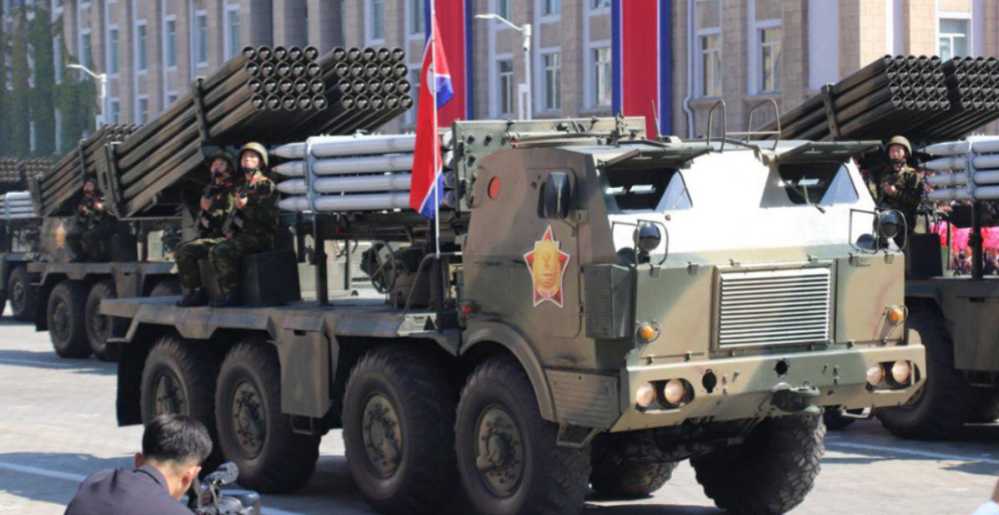
The KN-10 missile is an improved version of the Soviet SS-21 surface-to-surface missile. The new missile is also launched from a mobile launcher and uses solid fuel. These characteristics make the system difficult to detect in advance. "Even without a tactical nuclear warhead, the destructive power of the new missile will far exceed that of the MLRS system." Intelligence circles believe that North Korea has been developing new tactical missiles since early 2010. The new system is believed to have a range of about 200 kilometers and is capable of carrying a warhead weighing up to 500 kilograms. North Korea’s 300mm rocket launchers have a similar range, but they can only carry a payload of 100 kilograms at most. The nuclear warhead is much heavier. Sources said that while the 300mm MLRS system is guided by Russian satellites, the guidance method of the new tactical missile is unclear. The key to North Korea’s completion of the new missile program is the miniaturization of nuclear weapons. The United States assesses that North Korea has plutonium warheads and has the technology to make uranium warheads. "Through three nuclear tests since 2006, North Korea has managed to take a step towards miniaturization to a certain extent," said Shin In-gyun, head of the South Korean Defense Network. "We must be prepared that they will be operational in a short time." As North Korea steps up its development of new missiles, there are also signs that Pyongyang is trying to expand its production of weapons-grade plutonium and uranium. On February 8, 2015, from 4:20 to 5:10 p.m., North Korea fired five missiles from Wonsan toward the East Sea. At 10:30 a.m. on April 2, 2015, North Korea fired another missile from Dongchang-ri, North Pyongan Province toward the West Sea. The next day, April 3, North Korea fired four missiles again. According to analysis, the missile on April 2 was fired from north to south, indicating that North Korea is very confident in the reliability of the missile. The missile has been successfully mass-produced and equipped to the troops in large numbers. The range of the Mars 11 is comparable to that of the KN-09 missile, but its warhead is heavier and has the potential to carry tactical nuclear warheads. Later, North Korea combined the technologies of the two and developed the 600mm caliber KN-25 multi-mounted "super-large rocket launcher"
KN-11 missile
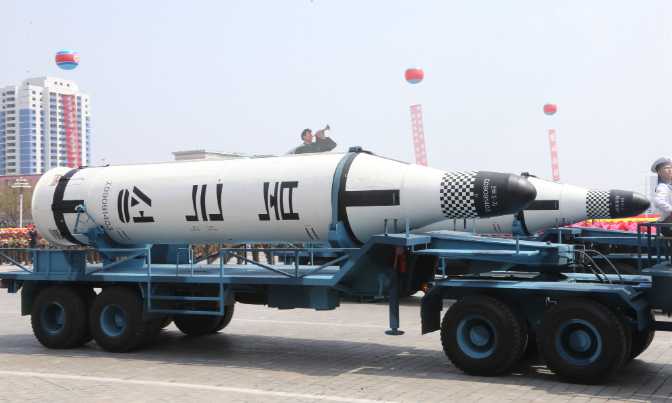
KN-11 missile is North Korea’s "Polaris" 1 submarine-launched missile. Since October 2014, it has conducted 11 ejection tests. The sea launch test on August 24, 2016 successfully flew about 500 kilometers (flight altitude of 550 kilometers), and was assessed to have basically completed the development work. Its aerodynamic layout design obviously borrowed from the Soviet-made R-27 submarine-launched missile, and the warhead design is almost the same. However, North Korea’s submarine-launched missile uses a two-stage solid engine and an advanced composite fiber material shell, as well as a mode of underwater ejection and then ignition, which makes it more concealed in combat. On February 12, 2017, a ground-launched version of the missile was tested, the Polaris 2 (KN-15). It uses an 8-pair tracked chassis modified from the Sungun tank chassis, and has a range of 1,200 to 1,300 kilometers, comparable to the Mars 7 missile.
KN-12 rocket launcher
KN-12 refers to the new 40-tube 122mm rocket launcher that debuted at the 2015 military parade. Its design is very similar to the Czech RM-70 rocket launcher, and the vehicle also carries 40 rounds of rapidly reloadable spare rounds, which improves the sustainability of firepower. North Korea is also developing and exporting 122mm guided rockets.
KN-13 surface-to-air missiles There are data that KN-13 is a surface-to-air missile, an improved version of the SA-2 air defense missile. North Korea has been developing a mobile SA-2 air defense missile system. The missile and its launcher are installed on the back of the MAZ-630308-224 truck. The missile is equipped with an infrared seeker. This will improve the combat effectiveness of these old missile systems.
KN-14 missile
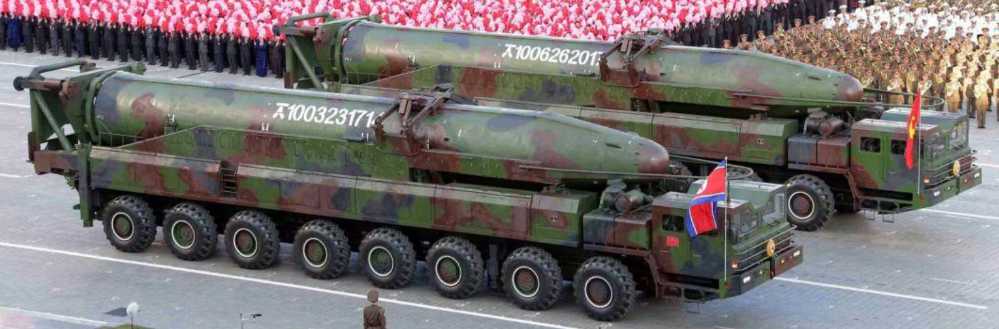
KN-14 missile is an improved version of the KN-08 missile. It debuted at the military parade on October 10, 2015. The KN-14 missile has a range of 8,000 to 10,000 kilometers. The missile is shortened to about 17 meters in length and uses a two-stage liquid engine. The missile head design is clearly inspired by the Soviet-made R-29 missile. North Korea has produced at least 6 missiles of this type. The missile head may use a starlight guidance system, and its final booster stage may have the potential to launch multiple warheads.
KN-15 missile
KN-15 is the "Polaris" 2 missile. On May 21, 2017, North Korea successfully launched the "Polaris" 2 again. This time it was launched from a preset position on a concrete surface hidden on the river beach, and it was immediately withdrawn to the woods after the launch, which was very practical. The missile’s flight altitude increased to about 633 kilometers, of which the first stage burned for about 57 seconds, the speed at separation was 947 meters/second, and the altitude was 22.2 kilometers. The second stage separated at 1 minute and 59 seconds, at which time the flight speed was 2769 meters/second and the altitude was 120.2 kilometers. At 7 minutes and 10 seconds, the missile reached its maximum altitude. According to American missile experts, if launched at a normal angle, the range of the Polaris 2 missile can be more than 1,000 to 1,250 kilometers (the ballistic height is controlled at 200 to 300 kilometers). This range can just replace the unreliable Mars 7 liquid medium-range missile. North Korean officials said that the purpose of this launch is to finally confirm the overall technical indicators of the Polaris 2 ground-to-ground medium-range strategic ballistic missile weapon system, fully assess the applicability in various combat environments, and deploy it in actual combat in the troops. Polaris 2 seems to integrate hydraulic, power supply and distribution, aiming, temperature control and other equipment on a vehicle. The missile launcher is similar in appearance to the Russian "Topol" missile launch tube, with an electrical circuit device for missile external detection, and a heating air conditioning pipe, which can launch missiles at low temperatures.
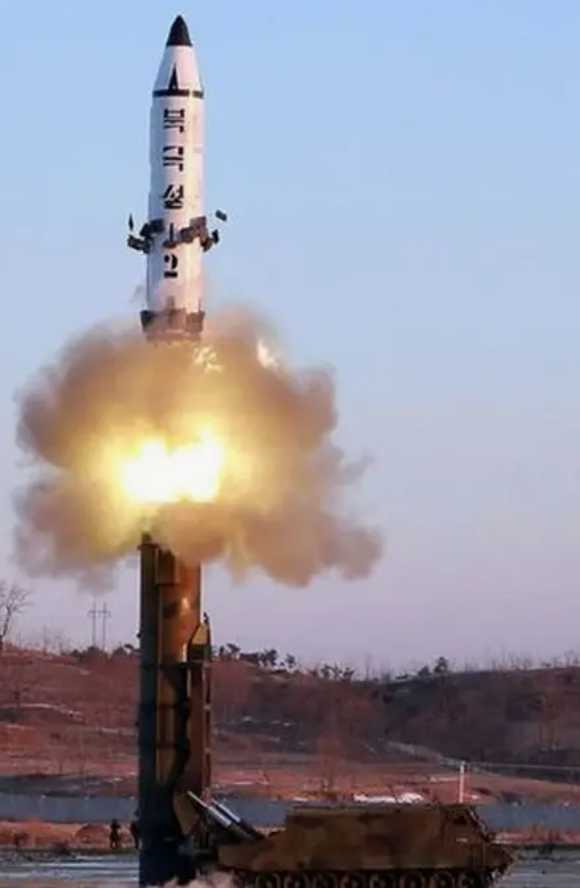
The reason why the missile is equipped with air conditioning is that the ambient temperature has a certain influence on the burning speed of solid propellant. The higher the ambient temperature, the higher the initial temperature of the propellant grain. The higher the initial temperature, the faster the propellant burns and the greater the pressure reached in the combustion chamber. As a result, the missile engine wall thickness and weight increase. On the contrary, the initial temperature is low, the combustion speed is slow, and the pressure reached in the combustion chamber is small. This can make the engine wall thinner and the weight lighter, but if the pressure is too low, some propellants will have unstable combustion or even flameout, which is also not allowed. The change in the burning speed of solid propellants will inevitably cause the change in the total impulse of the engine (the product of the average thrust and the burning time), which will eventually affect the control accuracy of the missile. Therefore, missiles using solid propellants generally need to adjust the ambient temperature of the missile. In addition to supporting, positioning and protecting the missile, the "Polaris" 2 missile launch tube is also equipped with a temperature control device that can ensure the ambient temperature of the missile storage and transportation. There are two parallel round tubes and long strips of protrusions on the upper left side of the missile launch tube. These are actually the ventilation ducts of the air conditioner. The air conditioner host is installed in the equipment compartment of the transport, erection and launch vehicle, mainly used for rapid temperature adjustment. The front part of the long strip-shaped protrusion is connected to the front cover of the launch tube, and the rear part is connected to the tail of the missile, and is respectively connected to two round tubes to form an air conditioning circuit. One of the two round tubes is responsible for air supply and the other for return air. The protrusion on the right side of the launch tube is part of the auxiliary temperature control system of the launch tube. The auxiliary temperature control equipment usually consists of a generator set, a temperature sensor, a power supply and distribution system, a temperature control element, a launch tube, etc. Its characteristic is that the temperature control element directly acts on the outer wall of the launch tube, and adjusts the temperature of the missile storage space through the heat transfer of the intermediate medium, which can make the temperature change of the missile more uniform and have better thermal insulation performance.
The adaptive base design at the bottom of the missile launch tube means that the vehicle has the ability to launch without support, which can greatly improve the randomness, mobility and concealment of missile launches and enhance the survivability of the weapon system. Previously, North Korea’s liquid missiles were launched by relying on preset positions on roads. The disadvantage is that the preset positions are set up very close to the roads and are easily detected by the enemy in advance; second, the liquid missile launcher can only rely on roads for mobility and is also more vulnerable to enemy attacks. The tracked launcher of the "Polaris" 2 missile does not need to rely on road mobility, and the launch site does not need to be prepared in advance. The launcher can stop and launch at any time during the maneuvering process. However, North Korea still needs to solve the problems of positioning, orientation and azimuth aiming of the missile system. South Korean media said that the launch preparation time of the missile is only 5 to 10 minutes. The liquid "Labor" missile takes 30 minutes to refuel, and the launch preparation time of early models even exceeds 1 hour, which is easier to be discovered and attacked. In addition, the more advanced "Polaris" 3 is also under development. In addition to using a composite shell, its solid engine may use a swing nozzle, the diameter of the projectile is also increased, and the range is longer.
KN-16 rocket launcher
KN-16 may refer to the 22-tube 240mm rocket launcher with a new chassis that was unveiled at the military parade on April 15, 2017. The gun uses an armored cockpit and has a range of up to 70 kilometers. It may also be able to launch new guided rockets. There are also data that KN-16 refers to a new type of multiple rocket launcher discovered by South Korean and US intelligence agencies in the Sanyindong Weaponry Research Institute in Yongcheng District, Pyongyang in January or February 2017. According to other reports, the KN-16 has a longer range than the KN-09, reaching 250 kilometers, and is currently equipped with video guidance equipment to enhance precision strike capabilities. A 12-tube 300mm rocket launcher that appeared at the military parade celebrating the 75th anniversary of the founding of the Workers’ Party on October 10, 2020 is believed to be the KN-16.
KN-17 missile
KN-17 is the "Mars" 12 missile that was unveiled in 2017. This is a new medium- and long-range missile that is more reliable than the "Mars" 10. It directly uses the latter’s MAZ-547 launcher. The later "Mars" 14 also borrowed the launcher of the "Mars" 13 to quickly complete the launch mission. Its improved range can reach 4,500 kilometers. On October 4, 2022, North Korea launched a medium-range ballistic missile eastward in the area of Wupingli, Jagang Province. The missile flew over Aomori Prefecture, Japan, and landed in the Pacific Ocean about 3,200 kilometers east of Japan. It is reported that the maximum flight speed of the missile is 17 Mach, the total flight distance is 4,500 kilometers, the ballistic peak height is 970 kilometers, and the flight time is about 22 minutes. The next day, North Korea released photos showing that this is the latest improved version of the "Mars" 12. The "Mars" 12 missile can also carry North Korea’s latest developed arrowhead-shaped waverider aircraft and transform into a hypersonic missile.
KN-18 missile
KN-18 is a precision-guided version of the "Scud" C ("Mars" 6) missile, which debuted on April 15, 2017. The missile exploded during the launch on April 17, and some people speculated that this ballistic missile with canard wings may be an anti-ship ballistic missile. The missile may be equipped with a radar seeker. On May 29, 2017, the missile was launched from Wonsan. The next day, North Korean media reported that it had a flight distance of 450 kilometers (maximum ballistic altitude of 120 kilometers) and an accuracy of 7 meters, which would give new life to North Korea’s large number of "Mars" 5/6 missiles. The missile’s head and body can be separated, and it has a certain penetration capability. The missile uses a tracked launch vehicle that is rarely used for liquid missiles, which means that the missile still uses the previous steel shell. The missile can perform limited maneuvers when fully filled with propellant, greatly shortening the combat preparation time.

KN-19 missile
KN-19 is a copy of the KH-35 anti-ship missile. The system is mounted on a tracked chassis modified from the "Cheonma" 216 tank. Early models can carry 4 missiles per vehicle. On June 8, 2017, North Korea conducted a test launch of a ground-to-ship version in Wonsan. The next day, North Korean propaganda media disclosed the launch. Kim Jong-un also personally observed the scene. The missile has an estimated range of 200 kilometers, a warhead weight of about 145 kilograms, and uses an advanced radar seeker. After launch, it can immediately rise to an altitude of 2 kilometers, then fly sea-skimming and hit the target ship. An infrared camera is installed on the missile warhead, which can transmit the terminal image back in real time, and has stronger anti-interference ability. In February 2018, it appeared again at the military parade marking the 70th anniversary of the founding of the North Korean army. On April 14, 2020, North Korea launched multiple cruise missiles from the Wenchuan County area of Gangwon Province. It is believed to be the KN-19 missile, which has the potential to be transformed into air-to-ground and air-to-ship missiles. On the same day, North Korea’s Sukhoi fighter jets may also attack and launch air-to-ground missiles. On July 5, 2020, North Korea launched a cruise missile again. On the occasion of the 75th anniversary of the founding of the Workers’ Party of Korea in 2020, the new land-to-ship version was unveiled. The new version of the missile launcher has doubled the missile capacity to 8 missiles. The launcher chassis is the same as the KN-24 missile. This means that the two missiles are of the same length (5~6 meters)

KN-20 missile
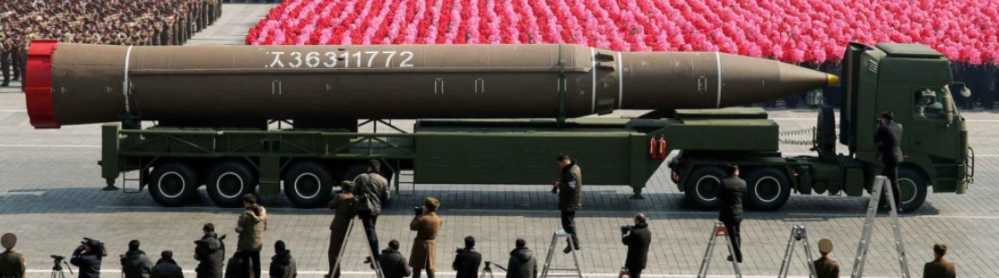
KN-20 missile is the "Mars" 14 intercontinental missile that was successfully tested twice in July 2017. The missile uses a two-stage liquid engine, the first stage comes from the "Mars" 12 missile, the second stage comes from the third stage of the "Mars" 13 missile, and the launcher also comes from the "Mars" 13. The warhead can carry North Korea’s "hydrogen bomb". The missile has a takeoff mass of about 33.8 tons, a length of about 19.5 meters, and a diameter of about 1.7 meters. It can carry a nuclear warhead with a TNT equivalent of 150,000 tons: the maximum range is 10,000 kilometers. On September 3, 2017, a photo of Kim Jong-un inspecting the "Mars" 14 nuclear warhead was made public. On August 8, 2017, The Washington Post (WP) reported that the US intelligence agencies concluded last month that North Korea had successfully developed a small nuclear warhead that can be loaded on an intercontinental missile. Until recently, the US authorities also judged that North Korea had successfully developed a ballistic missile with a range capable of hitting the western United States, but had not yet solved the technology of miniaturization and re-entry of nuclear warheads. This conclusion was reached through a confidential assessment of North Korea’s nuclear development program at the end of the year. Although the Americans claimed that the light produced by the re-entry of the "Mars" 14 warhead tested on July 28 disappeared at an altitude of 3 to 4 kilometers above the sea surface, North Korea still insisted that the missile re-entered successfully.
KN-21 missile
On August 26, 2017, North Korea launched three unidentified missiles into the East Sea, with the missiles flying at an altitude of about 50 kilometers and a flight distance of 250 kilometers. At that time, the South Korean military intelligence department believed that it was a KN-16 guided rocket, and the US Pacific Command identified it as a short-range ballistic missile. However, a few days later, according to the joint assessment of South Korea and the United States, it was reassessed as a short-range ballistic missile. On September 26, 2017, it was revealed that the missile was named KN-21. The United States and South Korea believe that this is an improved version of the "Scud" missile. It is said to be shorter than the Scud B (with a ballistic altitude of 80 kilometers and a range of 300 kilometers) and a longer range than the existing KN-09 rocket launcher (with a firing altitude of 40 kilometers and a range of 200 kilometers). The missile is mainly aimed at the interception blind spot between the Patriot missile and the THAAD. Since North Korea did not disclose the launch site on August 26, it is difficult to obtain more information. However, judging from the trajectory, it is more likely to be an early version of the North Korean version of the "Iskander" missile that debuted at the military parade on February 8, 2018. Its launch vehicle is significantly different from the later KN-23 missile. The 4-axle launch vehicle of the early KN-23 missile looks like an improved version of the "Mars" 11 missile launch vehicle. The missile storage-launch compartments of the two have similar appearance designs, and the wheel models and The vehicle lengths are similar. In order to enhance the vehicle’s carrying capacity, the chassis was changed from the original 3-axle to 4-axle, and the equipment compartment behind the cab of the original "Mars" 11KN-02 missile launcher was cancelled to accommodate the lengthened missiles. After the number of missiles carried doubled, the weight of the vehicle body increased, which means that the new vehicle must be replaced with a more powerful engine. The missile usually lies flat in the storage and launch cabin behind the cab, which is protected by two foldable covers. The interior of the cabin can maintain a constant temperature and humidity. When the missile is ready to launch, the cover on the cabin is opened, and the missile is erected vertically before ignition and launch. This is different from the tilted launcher used by the "Mars" 11 missile. Vertical launch is conducive to the all-round deployment of missiles and avoids the problem of position and direction selection. The new missile can be like the "Iskander" "Like this, two missiles are launched in a short period of time. It is difficult for the enemy’s anti-missile system to intercept this new weapon with fierce firepower.
KN-22 missile
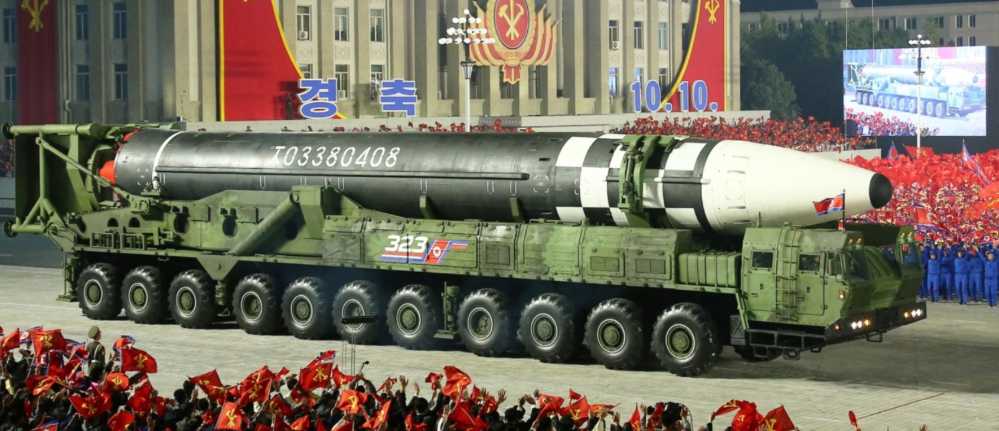
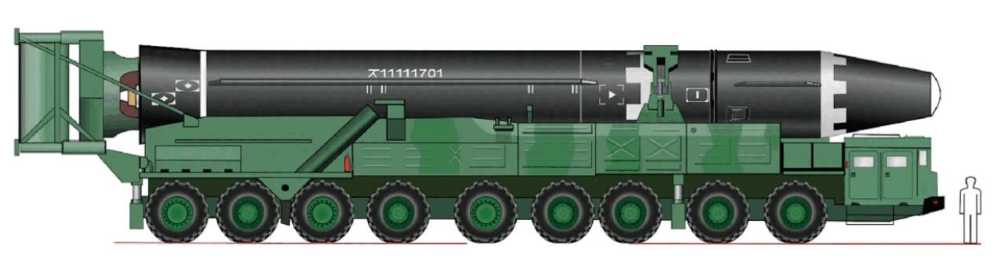
KN-22 missile is the famous "Mars" 15 intercontinental missile. Before the test launch of the "Mars" 17 missile in March 2022, it was the missile with the longest range in the "Mars" series. Japan’s "Asahi Shimbun" reported in October 2017 that North Korea is developing an improved version of the "Mars" 14. The source of the news is "Seoul’s military news." At around 3:30 a.m. on November 29, 2017, the "Mars" The first test launch of the Hwasong-15 missile was successful in the area of Pyongyang, South Pyongan Province. Wright, director of the Global Security Project of the Union of Concerned Scientists, estimated that if North Korea launches at a normal angle, the missile’s range can reach 13,035 kilometers (the warhead weight needs to be reduced to 600 kilograms), which means that all cities in the United States, including the US capital Washington, are within the strike range of the former. The weight of the "Hwasong" 15 missile (weighing about 50 to 60 tons) is about twice that of the 25 to 30-ton "Hwasong" 12, and its takeoff thrust (about 80 tons) is also nearly twice that of the 25 to 30-ton "Hwasong" 12. The first-stage engine of the "Hwasong" 15 adopts a one-pump dual-chamber design, which is the same as the Ukrainian RD-250/251, but it is changed to thrust vector control and the wandering engine is cancelled. Its design is simpler than the first stage of the "Hwasong" 13, and its reliability is improved. North Korea mastered the dual-engine parallel technology in the process of testing the "Hwasong" 13 engine. The propellant of the "Hwasong" 15 missile is unsymmetrical dimethylhydrazine and nitrogen tetroxide, which needs to be temporarily refilled before launch. North Korea officially announced that its military industry has achieved the localization of the large 9-axle 18x12 launch vehicle carried by the "Mars" 15. All elements such as its body, engine, large tires, lifting mechanism, launch rail, hydraulic device, electrical control device, power unit, etc. are 100% domestically produced, which surprised the outside world. Later, the appearance of the 11-axle large carrier of the "Mars" 17 missile proved North Korea’s statement. North Korea is still continuing to improve this type of missile. On November 3, 2022, a "Mars" 15 equipped with a new warhead was launched from Pyongyang Sunan Airport. The missile’s launcher is combined with the launcher. After launching the missile, it can quickly evacuate the launcher and continue to load the next missile. The new missile shortens the interstage between the first and second stages and lengthens the warhead length, which helps to shorten the missile length and increase the terminal speed of the warhead when it re-enters the atmosphere, improving the missile’s penetration capability. In the future, North Korea will continue to test-fire new intercontinental missiles
(To be continued)