
Relativity’s 3D printed rocket encountered many twists and turns in its test launch, including weather problems, technical accidents, and intruder problems. Three consecutive launch attempts were abandoned, but fortunately the rocket is still there and is still on standby on the launch pad.
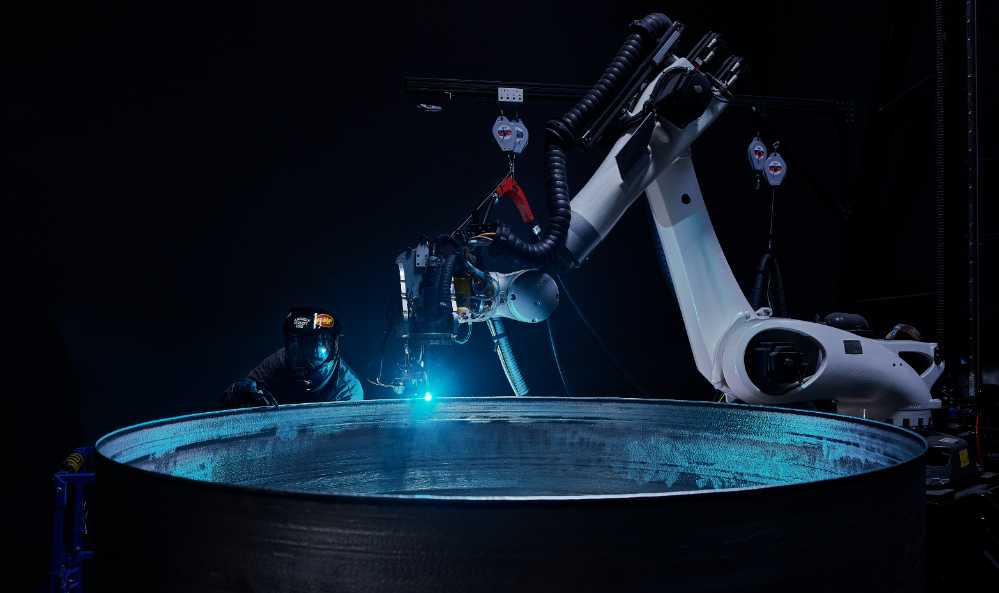
In 2015, when Tim Ellis founded Relativity, he was only a 25-year-old young man. There was only one reason that supported him to boldly join the aerospace technology startup, that is, he believed that 3D printing technology could bring revolutionary changes to rocket design and manufacturing. In the past 8 years, Relativity has actively developed rockets on the one hand, and vigorously developed 3D printing robots for the manufacture of large rocket parts on the other. The rocket manufacturing is now undertaken by the company’s Stargate, which is said to be the fourth generation and the world’s largest 3D printer. The name can be translated as "Star Gate" or "Star Gate", which is sci-fi and powerful enough.
3D printing is not new. It is a relatively mature industrial additive manufacturing technology. Relativity has been busy until today. Its biggest achievement is to manufacture the launch vehicle "Terran 1" which is almost entirely 3D printed. "Terran" 1 is 33.5 meters tall, of moderate build, with a low-Earth orbit carrying capacity of about 1,250 kilograms. This launch did not carry any spacecraft and was considered a test launch. It is said that except for rubber parts, computer components and some pipeline valves, "Terran" is almost entirely made by 3D printing robots, even including rocket engines. A significant benefit of this is that parts of the same material that need to be connected to each other can be printed as a whole, and a large number of connectors are no longer required. In addition, special cavities that were originally impossible to process with traditional processes can also be easily obtained. What is even more rare is that the load-bearing structure of the rocket can achieve the theoretical optimality-in the past, technicians had to compromise between the theoretical optimal structural solution and engineering feasibility, but now they can let 3D printing robots directly create the theoretical "optimal solution". By eliminating a large number of connectors, the total number of rocket parts will be greatly reduced. It is said that the total number of traditional rocket parts exceeds 100,000, while the "Earthling" reduces this number to 1,000, which is almost a hundred times simplification. The structural weight of the rocket will also be optimized, thereby improving the payload efficiency. According to Relativity’s calculations, the launch cost of the "Earthling" is about 12 million US dollars. In this way, the launch cost per kilogram of payload will be reduced to less than 10,000 US dollars, which is indeed a very attractive level.
The "Earthling" 1, which uses methane and liquid oxygen fuel, is just a pathfinder. Relativity’s bigger goal is behind. Once the "Earthling" 1 is successfully launched, Relativity will devote all its efforts to building a larger "Earthling" R, with a carrying capacity of more than 20 tons, a more perfect structure and appearance, and full system reusability. If all goes well, Relativity will join the ranks of the world’s medium-sized rocket development companies. The low-cost attribute of 3D printing, coupled with the ability to be reused, is expected to further reduce the cost of human space launches. In the words of Tim Ellis, Musk’s SpaceX should not be the only "traditional concept destroyer", it should have more competitors. Relativity is one of them.
In Relativity’s view, 3D printing technology can handle most of the work of rocket production. If this idea is verified through a successful launch, the complexity of rocket design and manufacturing will be greatly reduced, and companies will not need to invest huge sums of money and spend years to build complex production systems to quickly manufacture advanced launch vehicles. Relativity claims that they can complete rocket manufacturing from raw materials within 60 days.
The theoretical expectations are good, the past verification results are also good, everything is good. What is needed now is a successful launch into orbit. From 2015 to today, Relativity, which was established 8 years ago, has done a good job. It has not only developed high-level 3D printing equipment, but also developed the "Earthling" rocket. Investors are also very interested in start-up technology companies with aerospace as their label. In 2021 alone, Relativity successfully raised $1.3 billion in financing. Now the company has sufficient financial strength to continue to promote the printing of rockets.
Like all private high-tech innovative aerospace companies, Relativity also faces a lot of technical and experience problems. It is understandable that it encountered setbacks or even failures in the early stages of rocket launches. If there are really enough ideals that are both full and realistic, and there are enough ways to put them into action, and they can also be favored by the capital market, then the opportunity has come. The current problem is that Relativity needs to take advantage of the current period of abundant resources to overcome the current technical problems, use small and cumulative victories to continuously prove the value potential of its ideas, concentrate on the real core capabilities, and expand the market pie. At present, in addition to rockets, the core capabilities of Relativity also include their carefully crafted 3D printing robots, which are also potential stocks.