
From the perspective of the Russian-Ukrainian conflict in 2022, the Russian army did not achieve its strategic goals, and the results of the conflict were not satisfactory for Russia. Around the New Year, many senior leaders of the Russian government and the military came forward to express their views on the duration of the special military operation: On December 7, 2022, Russian President Putin said that the special military operation "may last for quite a long time"; On February 1, 2023, Russian President’s Press Secretary Peskov said when talking about NATO’s provision of main battle tanks to Ukraine that the weapons and equipment provided by NATO would not change the battlefield situation, and the special military operation would continue; On February 12, Russian Defense Minister Shoigu said that the special military operation would continue until all the stipulated strategic goals were achieved. For this reason, the Russian Ministry of Defense has listed the special military operation against Ukraine as the highest strategic task when formulating the main strategic tasks for 2023.
For Russia, the room for maneuver in special military operations is currently shrinking rapidly. From a strategic perspective, after the Ukrainian army stabilized its position in the "decapitation" strike by the Russian army, it took advantage of this opportunity to accelerate the process of de-Russification, Russophobia and extreme nationalism in its own country. At the same time, this special military operation gave Ukraine an opportunity to get closer to the West, actively integrate into the NATO and EU systems, and seek strategic interests from NATO and the West in the name of so-called "common values". NATO also saw the feasibility of weakening, restricting and encircling Russia to a large extent through supporting Ukraine, and even through battlefield failures, cultivating internal opposition forces in Russia, and completely overthrowing the current Russian regime. Therefore, it is willing to "invest" in Ukraine to a certain extent and consume Russia with the blood of Ukrainian civilians. Due to Russia’s special military operations, NATO and Ukraine unexpectedly formed a relationship of mutual use and collusion, which led to Russia’s strategic choice of special military operations. As long as Russia did not achieve its strategic goals, even if there was a slight contraction and concession, it would allow NATO and Ukraine to take advantage of the chaos and advance step by step. For Russia, which is already in a defensive posture, its own concession and NATO’s approach are undoubtedly fatal, and may drag Russia’s geopolitical situation and even the entire country into a "no return" situation. Therefore, for Russia, special military operations must continue, either through active actions to directly achieve strategic goals, or through long-term consumption to force NATO to make peace with it and basically achieve strategic goals. There is no middle option.
At the battle level, the Russian army cannot stop special military operations. Judging from the current situation of the Russian army in various battle directions, it has not occupied a favorable defense zone in the Svato direction and the Zaporizhia direction. Among them, the defense depth in the Svato direction is only a dozen kilometers, and the three main defense bases in the Zaporizhia direction, Kuban, Gulepoli, and Bolshaya Novosylka, are all in the hands of the Ukrainian army. On these two fronts, the Russian army’s defensive posture is relatively stable, but not solid. Once the Ukrainian army puts the heavy equipment and trained new mobilized troops provided by NATO into the battlefield, it is possible to break through the Russian army’s defensive deployment in these two battle directions, thus putting the Russian army in a more unfavorable situation. Although the Russian army has an advantage on the battlefield in the Artemsk direction, it has not been transformed into a victory in the battle, and the encirclement of Artemsk has not been completely completed. As for Donetsk, the Ukrainian army is still shelling Donetsk residential areas on a daily basis. After the special military operation began, this shelling completely lost its constraints, causing a huge impact on the daily life of Donetsk residents. If the Russian army suspends or even abandons the special military operation, the Artemsk campaign will be anticlimactic, the shelling threat to Donetsk will not be lifted, and Russia’s strategic goals for the special military operation will end in failure. Therefore, for the Russian army, stopping means failure, not only a defeat in the battle, but also a pause in the battle will lead to a strategic retreat, which means that the entire Russian country is showing weakness, and the country’s weakness will make Russia’s geopolitical environment more unfavorable. Therefore, in the new year, the Russian army will not stop special military operations, and their scale and intensity may further expand.
Russia’s failure to achieve its strategic goals does not mean that Ukraine can achieve its strategic goals. After all, the war is still going on in Ukraine. For the Ukrainian government, completely expelling the Russian army from the country and protecting the integrity of its territory and sovereignty are the biggest strategic goals and the most important source of legitimacy for the Ukrainian government. Especially in the context of the rapid polarization of ideology in Ukraine and its rush towards extreme nationalism, any compromise and concession to Russia will be backfired by domestic extreme nationalists. Therefore, although both Russia and Ukraine have been calling for peace talks on the conflict, the conditions for peace talks between the two countries are far apart. Russia requires Ukraine to "launch unconditional negotiations on the basis of reality", that is, to recognize the reality that the four states of Donetsk, Luhansk, Zaporizhia and Kherson have "joined Russia" and negotiate on this basis, while Ukraine has repeatedly refused this, first asking the Russian army to withdraw from the front line on February 24, 2022, and later even asking the Russian army to withdraw from Crimea. For example, on February 12, Russian Deputy Foreign Minister Vershinin mentioned again in an interview with Red Star TV that the negotiations between Russia and Ukraine "must take into account Russia’s strategic demands on the basis of reality", reiterating the status quo of the four states joining Russia and Russia’s previous strategic requirements such as demilitarization and de-Nazification. Ukraine responded immediately, declaring that "only Ukraine’s victory can end the war", and Zelensky also repeatedly declared on informal occasions that as long as Putin is the leader of the Russian state, he will not negotiate with Russia. Ukraine’s attitude and domestic objective reality have also made it increasingly difficult for Russia and Ukraine to stop the Ukrainian crisis and resolve the Ukrainian conflict peacefully.
Ukraine not only faces pressure from many extreme nationalist political factions at home at the strategic level, but also faces more severe objective realities. Due to the Russian army’s missile strikes across Ukraine, the occupation of a large number of resource and industrial areas by the Russian army, and the large-scale mine-laying operations carried out by the Russian army in Ukraine, Ukraine’s economy suffered a nearly devastating blow in 2022. According to statistics from the Ukrainian economic department and the International Monetary Fund, Ukraine’s GDP lost more than 30% in 2022, wheat production dropped from more than 33 million tons to more than 19 million tons, and corn production dropped from more than 37 million tons to more than 26 million tons; Ukraine’s industrial output value has almost returned to zero, and the basic industrial cycle has been completely destroyed by the Russian army. The largest steel industrial base Mariupol, the largest nuclear power plant Ankhed, the largest nitrogen chemical industrial base Severodonetsk, and the largest salt mine Suledar have all fallen into the hands of the Russian army, and the national power generation has dropped to about half of that in 2021; the only remaining economic activities in Ukraine are basically centered around military activities. According to statistics, the total amount of military aid given to Ukraine by NATO and the EU reached more than 30 billion US dollars in 2022, accounting for about 21% of Ukraine’s total GDP. Ukraine’s military expenditure accounts for more than 70% of the total fiscal expenditure, which means that Ukraine’s military expenditure ratio even exceeds that of the Taliban regime in Afghanistan, becoming a de facto "military-first politics" country.
Therefore, for Ukraine, if the conflict stops immediately, the economic losses suffered by Ukraine cannot be compensated, and the large amount of lost industrial and resource areas will be difficult to get back. If NATO and Russia reach a compromise and make peace to stop the conflict, then Ukraine will become the first object to be abandoned by NATO. This will be tantamount to a catastrophe for Ukraine, whose economy and finances are on the verge of collapse and which relies entirely on NATO financial support to barely maintain its operations. It may even lead to Ukraine’s total collapse after the war. On the contrary, the most appropriate option for Ukraine is to try its best to maintain the status quo of the conflict and try its best to show its "value for money" in NATO’s strategic containment of Russia. Although this option is a Ponzi scheme that is like drinking poison to quench thirst, Ukraine has no more choices. Therefore, from a realistic perspective, Ukraine has the motivation to continue to maintain the conflict and it is best to completely drag down Russia to "get compensation from Russia".
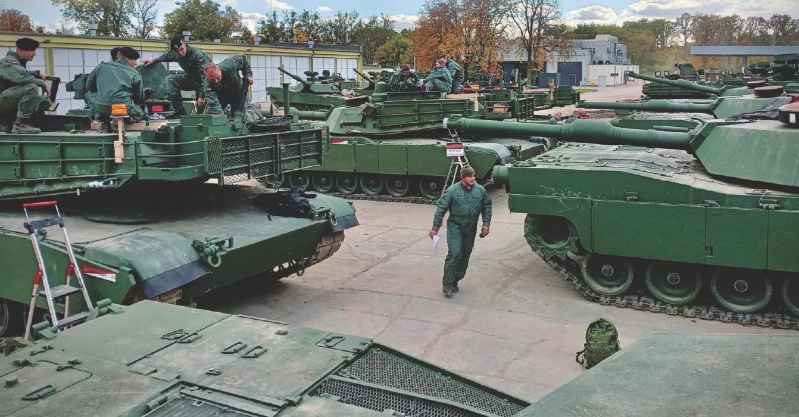
Ukraine’s "maintaining the conflict" is not just talk. The Ukrainian army has launched a new round of conscription work at the end of 2022. Judging from various channels, this round of conscription has shown a trend of fishing in a dry pond, and has begun to recruit a large number of company, enterprise, school and even government department staff. It is said that the total number of conscriptions in the new round exceeds 100,000, and more than 20 combat brigades have been rebuilt and newly built. In 2023, the Ukrainian army also plans to receive more than 300 main battle tanks provided by NATO (including 155 advanced NATO standard tanks), more than 800 armored vehicles/infantry fighting vehicles and a large number of long-range strike weapons. Ukrainian Defense Minister Reznikov said that once the Ukrainian army is reorganized, it will immediately launch a counterattack. Several Ukrainian senior officials confirmed that the Ukrainian army plans to launch a campaign offensive in the spring and summer of 2023. Therefore, even if the Russian army suspends the campaign offensive, the Ukrainian army’s campaign offensive will not stop.
Moreover, in the current Russian-Ukrainian conflict, in addition to the warring parties, NATO, led by the United States, has become a de facto party. There is no doubt that the United States is the initiator of the Russian-Ukrainian conflict. Now it continues to provide weapons and equipment to Ukraine, undermine the negotiations between Russia and Ukraine, and continue to fuel the Ukrainian crisis. Some former Soviet and Eastern European countries that have close relations with the United States and have a strong anti-Russian tradition, such as Poland, Estonia, the Czech Republic and other countries, are charging ahead, and even hijacking the attitude of the entire Europe in the Ukrainian crisis.
In the current situation, the strategic intentions that the United States wants to achieve in the Ukrainian crisis are both geopolitical and economic: In terms of geopolitical intentions, NATO, led by the United States, attempts to strategically contain Russia in the form of "NATO provides guns and Ukraine provides people", forcing Russia into a protracted conflict, leading to the collapse of Russia’s domestic economy and even a "secondary disintegration", fundamentally disarming a major competitor, and intending to win without fighting; In terms of economic intentions, the United States attempts to use the Ukrainian crisis to force Europe to "decouple" from Russia in terms of energy, such as blowing up the "Nord Stream" No. 2 natural gas pipeline, firmly grasping Europe’s energy lifeline in its own hands, and at the same time forcing more European industries and financial capital to transfer to the United States for risk aversion, intending to weaken Europe’s economic and financial strength, which is a real "harming others for self-interest" behavior.
At present, the United States is "getting better and better" in using Ukraine to implement its own strategic intentions. Apart from paying the price of money and a small amount of weapons and equipment, there is almost no strategic loss, but it can reap the benefits. Therefore, there is no reason to believe that the United States will stop intervening in the Russia-Ukraine conflict. Unless the United States believes that too many resources have been invested in Ukraine and cannot achieve strategic goals, or that the resources invested in Ukraine hinder its strategic investment in the Indo-Pacific region, it is possible to "stop the loss" of the Ukrainian crisis, strategically abandon Ukraine, and lead the peace with Russia. But under the current situation, we cannot see this possibility for the time being.
The impact of the Russia-Ukraine conflict is very far-reaching. In the course of the war, the war can only be truly stopped when one party involved in the war has no intention and ability to continue the war. Judging from the actual situation of the Russian-Ukrainian conflict in 2022 and the war willingness and war strength of Russia, Ukraine and NATO, the outside promoter, although the Russian army did not achieve its strategic goals in the 2022 operation and the war results were not good, the domestic understanding of the current situation in Russia is relatively clear. It must achieve its strategic goals directly or indirectly through conflict or negotiation, otherwise it will fail, and the consequences of failure are extremely serious for Russia. Therefore, the Russian government has enough willingness to maintain the current conflict situation. At the campaign level, in order to advance to a more favorable defensive position and protect the existing territorial achievements, the Russian army must also maintain an offensive posture on multiple fronts, with active defense or forward defense campaign guidance, and launch more active and offensive campaign operations. Finally, after the Izyum: Kupyansk Campaign in September 2022, Russia has in fact begun the process of militarization of the national economy, including appointing Medvedev to take charge of military production, investing heavily in military enterprises, and recruiting workers to switch to wartime production. According to Russian media reports, the production of Russian precision-guided weapons has increased "several times" since the end of 2022. Therefore, based on the situation of the Russian army, the Russian army has the willingness and certain ability to continue the conflict.
In the case of Ukraine, Ukraine lost more than 2/3 of its weapons and equipment in the conflict in 2022. It is estimated that the irreversible loss of troops (death, capture, missing, serious injury and unable to return to the team, escape) will exceed 200,000, and more than 10 million people will become refugees or enter Russia. The ground weapons and equipment provided by NATO will not be cut off at least in 2023: and for Ukraine, it is extremely important to recover the territory and fight back Crimea, and obtain war compensation from Russia to make up for its losses. It is even a strategic demand that cannot be turned back and has no room for maneuver. Therefore, Ukraine’s willingness to force Russia to surrender through conflict is equally strong. It is expected that in 2023, the Ukrainian army will still have plans and determination to implement campaign offensives.
As for NATO, in a sense, NATO’s investment in Ukraine has become a sunk cost." According to relevant statistics, in order to support Ukraine, NATO mobilized more than The $100 billion in funding has almost emptied the Soviet arsenals of Eastern European countries. Even the United States has supported about 1/3 of its own war reserve stockpile of "Javelin" anti-tank missiles and 155mm grenades. If Ukraine is defeated or surrenders, NATO’s "investment" will never be recovered, and even its own prestige and strategic deterrence will be affected. Therefore, NATO also has the intention and ability to further "increase" the conflict and economic sanctions, intending to make Russia surrender in 2023.
Russia, NATO, and Ukraine, the strategic intentions of the three are too different, and compromise is not possible. The possibility of a negotiated peace is very low, and all parties concerned are willing to continue the conflict, which means that in 2023, the Russian-Ukrainian conflict will not only continue, but the intensity may even be higher. This largest military conflict in the 21st century after the Cold War has become increasingly strategically significant globally: on the one hand, due to the strong intervention of the NATO group, the Russian-Ukrainian conflict has in a sense evolved into a "proxy war" of NATO against Russia, with "NATO providing guns and money, and Ukraine providing people" to fight Russia. This not only makes the conflict extremely intense, but also makes this conflict unprecedentedly large. The nature of direct confrontation with the United States.
On the other hand, with NATO’s strategic intervention and the gradual clarification of NATO’s strategic plot against Russia, the geopolitical nature of the Russian-Ukrainian conflict is becoming more prominent. In terms of NATO’s strategic plot against Russia, attempts to weaken Russia, and even the intention to cause Russia’s "second disintegration" by weakening Russia, are frequently seen in the discourse of Western think tanks. Ukraine, as the "vanguard" of the NATO group, has gone even further and has already divided the national borders of independent countries after Russia’s "second disintegration". Therefore, the essence of the Russian-Ukrainian conflict should be seen as a maritime power led by the United States. The geopolitical conflict of "sea power and land power struggle" in the new era, which attempts to suppress and dismember Russia, a land power, is a conflict in which the NATO group led by the United States attempts to fragment the Asian continental geopolitical plate, re-establish the strategic advantage of sea power countries over land power countries, and even re-establish its global status.
In fact, the West is very clear about the nature of the Russian-Ukrainian conflict. As early as the beginning of the Russian-Ukrainian conflict, people like British Foreign Secretary Truss tried to "expel Russia from the existing international relations system. The ambition to prepare for strategic results before the war is fought is obvious. Various signs show that the West’s suppression of Russia is actually destroying the results of mankind’s victory in the anti-fascist war in World War II: destroying the principle of great power balance formed under the framework of the United Nations. When examining the Russian-Ukrainian conflict, we cannot help but be extremely vigilant about this deep-seated strategic plot of the NATO group. Once NATO succeeds, it will lead to a comprehensive imbalance of international geopolitics and the existing international relations system in a direction that is favorable to NATO.
Finally, judging from the role played by NATO in the Russia-Ukraine conflict, the "Ukraine model" seems to be gradually taking shape. The so-called "Ukraine model" is to use offensive geopolitical strategies to repeatedly touch the geopolitical red lines of major powers, supplemented by other comprehensive means such as political, economic and public opinion, and actively shape the situation to force major powers to passively fall into conflicts with neighboring small countries or regions. Subsequently, a comprehensive strategic encirclement and suppression of this major power was launched, including political suppression, economic sanctions, military containment, and public opinion smearing, with the intention of containing and weakening the power of the major power through proxy wars, forcing it to change internally, and thus completing the overall victory of the geopolitical struggle in the form of profiting from the bloodshed of other countries. This is actually a geopolitical "directional blasting" model. It can not only be used in the Russia-Ukraine conflict, but also by the NATO group led by the United States, and applied to any major power with which it has potential conflicts. Therefore, we must not only strictly prevent the continued Russia-Ukraine conflict from causing an imbalance in the balance of power among major powers, but also strictly prevent the crisis of the conflict from spilling over, especially the "Ukraine model" being used by the United States in strategic conflicts with other major powers. This "Ukrainian model" was formed because of Russia’s weak national strength and a series of wrong decisions after the war. If NATO was not also weak, Russia would now be in a greater crisis or even lose its country.