

At the end of 2022, on December 26, five North Korean drones entered the southern part of the peninsula. South Korea dispatched aircraft to intercept and opened fire, but failed to shoot down any of them. This incident is indeed very embarrassing. According to a report by Yonhap News Agency on January 5, 2023, South Korean military personnel confirmed that a North Korean drone had briefly entered the P-73 no-fly zone around President Yoon Seok-yeol’s office, which caused an uproar in South Korea. P-73 is a circular area with a radius of 3.7 kilometers, with the Yongsan Presidential Palace and the Ministry of National Defense Building as the center, covering parts of Seoul’s Seocho District, Dongjak District, and Jung District. In theory, North Korean drones have the ability to carry out assassin-style sneak attacks on key targets in South Korea.
North Korean drones are like entering an unmanned area, which also reminds people of the old things during the Korean War. At that time, the North Korean People’s Army used Soviet-made Po-2 light aircraft to infiltrate at low altitude in the dark night, broke through the air defense around Seoul, and successfully attacked the "Ministry of National Defense" building of the Syngman Rhee regime. More than 70 years later, in terms of the level of aviation industry research and development and the modernization of air force equipment, the South of the peninsula has far surpassed the North. However, when the North’s infiltration aircraft changed from manned to unmanned, the South’s reaction was still as unprepared as usual.
Mysterious North Korean drones
The South Korean military did confirm that North Korean drones had infiltrated, but it was also confused about what type of drone it was, and could not give a clear explanation. What’s more, the development process of North Korean drones itself is a mystery.
Western researchers believe that North Korea obtained the first batch of drones from China sometime between 1988 and 1990, mainly the D-4 piston drone developed by Northwestern Polytechnical University. The D-4 itself was commissioned by the Shaanxi Provincial Science and Technology Commission to develop the Northwestern Polytechnical University as a military-to-civilian project. Its main tasks are civilian aerial photography and remote sensing. It can be launched and taken off using a simple launch pad with the help of rocket thrust, without the need for an airport or runway. The D-4 is powered by a 30-horsepower 4-cylinder air-cooled piston engine that can use ordinary automobile gasoline and be recovered by parachute. It is difficult to tell whether the Western researchers’ claims have any definite basis or are reliable. However, the "Fanghyeon" type 1 and type 2 drones launched by North Korea after 1993 do look similar to the D-4. It is very likely that North Korea first obtained the D-4 as a civilian product in China, then reverse-engineered it, and finally completed the military modification. The "Fanghyeon" drone is 3.23 meters long, with a maximum flight altitude of 3 kilometers, a maximum speed of 162 kilometers per hour, and a combat radius of 4,000 meters. Fanghyeon is a place name in North Korea, with a People’s Army Air Force base, located in North Pyongan Province.
During the height of the Cold War, the US AQM-34 "Firebee" drone conducted hundreds of reconnaissance missions against North Korea. During the Fourth Middle East War in 1973 and the Fifth Middle East War in 1982, Israel used drones as bait to induce enemy ground air defense forces to launch missiles to expose targets, and the Israeli fighter jets that followed easily killed these air defense positions. All this makes North Korea very sensitive to the development of drone technology. In 1988, North Korea learned that the South authorities had signs of launching a drone project, so it was logical to take the lead in developing the "Fangxian" drone.
Since the Gulf War in the 1990s, the development of North Korean drones has accelerated significantly. In 1994, they obtained the Soviet-made Tu-143 drone (DR3) from Syria, which was used by Syria in the Lebanese conflict. Then, between 1997 and 1998, North Korea purchased 10 Pchela-1T drones from Russia. This is a small propeller-powered drone developed by the Yakovlev Design Bureau. Its purpose is similar to the People’s Army’s Fangxian drone, but it is said to have a higher configuration of reconnaissance components.
From target drones to drones, and then expanding the functions of drones from reconnaissance to attack, it is a natural process for the development of drones in many countries. "The Fangxian can carry 20-25 kg of explosives and become an unmanned attack aircraft.
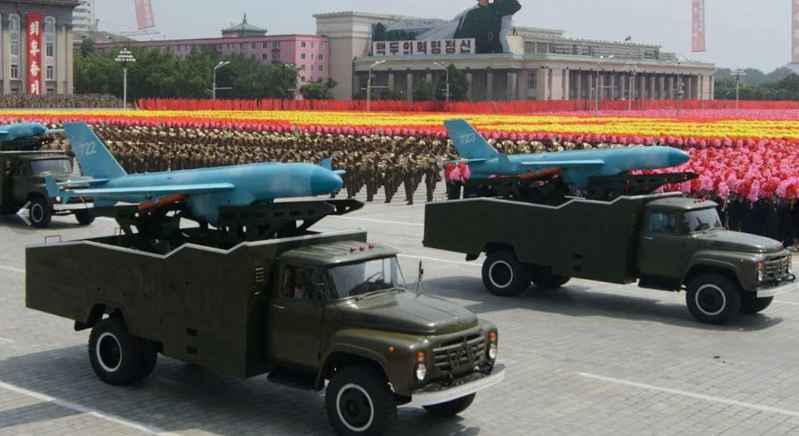
In 2012, South Korea reported that North Korea had given the "Bee"-1T drone an attack function. On the morning of April 15, 2012, North Korea held a military parade in the capital Pyongyang to commemorate the 100th anniversary of the birth of the late leader Kim Il Sung. At this military parade, a new type of multi-purpose drone made its debut. It is about 5.5 meters long and about 3 meters wide. The launch rail is mounted on a ZIL-130 truck. Western analysts believe that the appearance of this drone is similar to the American MQM-107D Very similar, but much smaller in size, with a shorter fuselage and longer wingspan, it is obviously optimized, with sensors installed under the fuselage and in front of the engine air intake.
In 2013, North Korean leader Kim Jong-un inspected a live-fire exercise near Pyongyang. North Korean officials reported that during the exercise, the drone followed the route of attacking the "Southern puppet" and accurately hit the target. The West discovered through blurry images that the appearance of this attack drone is very close to the one that appeared in the 2012 military parade, and the launch platform has become a 4-wheel trailer. This also means that this mysterious North Korean drone has at least two configurations, one for reconnaissance and the other for suicide attacks. Regarding the technical origin of this North Korean drone, some people in the West believe that it comes from Syria, so where did Syria get it from? Iran? Iran was a staunch supporter of the United States in the Middle East during the Pahlavi dynasty in the 1970s, and it was indeed equipped with the US MQM-107D as a target drone. The North Koreans finally combined their own use needs, reduced the size and increased the payload, and turned it into a drone with the characteristics of the peninsula. This process is indeed legendary.
North Korea’s drone research and development has been effectively promoted, but like their strategic missile project, it has always been shrouded in mystery and little is known to the outside world. The "Red-crowned Crane" drone (DURUMI), with a range of about 350 kilometers and a total weight of no more than 35 kilograms, has both attack and reconnaissance capabilities. It was reported in news reports around 2014, but there are no clear pictures. South Korea has only drawn hypothetical pictures. With this weight, combined with North Korea’s actual electronic industrial capabilities, it is difficult to say that it is a drone with "reconnaissance and strike" capabilities. However, underestimating North Korea’s research and development capabilities may be a mistake.
On December 7, 2022, just a few days before the North Korean drone flew south, a very blurry satellite photo appeared on the Internet. The area taken was the Fangxian Base of the Korean People’s Army Air Force. Outside the hangar, a blurry large drone aroused the curiosity of many people. Western analysts believe that the size of this drone is very large, and it is at the same level as the US MQ-9 and China’s Rainbow 4. Is it self-developed? Imitation? Or obtained from other channels? It is confusing.
However, it is obvious that the Middle East melee and the conflict between Russia and Ukraine have made North Korea realize the huge military value of "reconnaissance and strike" drones. Even Turkey can produce "reconnaissance and strike" TB-2 and TB-3 drones. Given time, North Korea may not be able to produce its own. This small country in Northeast Asia is ambitious and has already developed intercontinental missiles and launched its first military reconnaissance satellite.
Elusive
You know, this is not the first time that North Korean drones have infiltrated the South. In the 21st century, North Korea already has a lot of reconnaissance drones and has begun the process of localization. They use these drones near the "demilitarized zone" that separates the peninsula, and then in the direction of the Yellow Sea (called the "West Sea" by the North Korean and South Korean governments). The 1953 Korean Armistice Agreement basically divided the status quo of the peninsula’s land, but there are disputes in the Yellow Sea. In August 2010, North Korea conducted live-fire exercises in the Yellow Sea, during which it sent drones to conduct reconnaissance near the South Korean-controlled Baeknyeong Island and Yeonpyeong Island. On November 23, North Korea shelled Yeonpyeong Island to demonstrate its control over the disputed waters. Therefore, the drone reconnaissance in August was interpreted by the South Korean military as a prelude to the shelling.
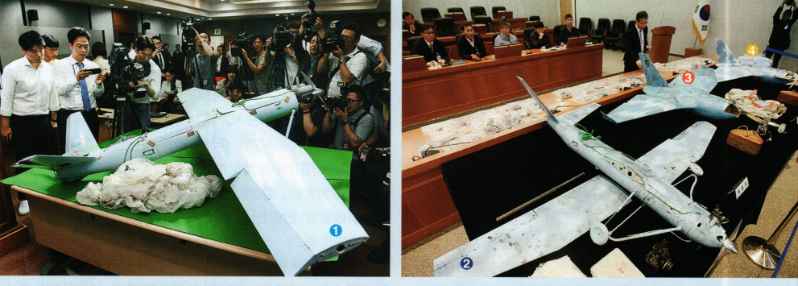
On March 24, 2014, a North Korean drone crashed near the military demarcation line in Paju City, Gyeongdo, South Korea. South Korea discovered that the aircraft was equipped with a Canon 550D small digital camera, which took blurry pictures of the Blue House presidential palace and Gyeongbokgung Palace. Then, at about 4 pm on March 31, 2014, the South Korean military discovered another crashed North Korean drone on Baeknyeong Island. This drone looks different from the one found in Paju. It has a cylindrical body and a V-shaped tail. It also carries a small camera, but it has been replaced with a more upscale Nikon D800.
In early April 2014, local residents led South Korean soldiers to identify the site of a crashed drone on a mountain near Samcheok City on the east coast of South Korea. In October of the previous year, they went up the mountain to collect herbs and found the wreckage of the drone. They removed the camera, but fortunately kept the memory card. The restored image shows that the drone captured the coastline. There are many military targets around Samcheok, and in the adjacent Uljin County is the largest Hanwei Nuclear Power Plant in South Korea.
The North Korean drones that crashed in Paju and Samcheok are called "Cheon" 09P, with a two-cylinder Japanese propeller engine and a body made of polycarbonate (the main component of products such as CDs, aircraft canopies, car glass, and mobile phone films). The V-tail drone found near Baeknyeong Island is called UV-10, and the propeller engine is a 4-cylinder European-made one.
On September 15, 2014, a fisherman found the wreckage of the Sky O9P drone in the waters west of Baengnyeong Island. After that, North Korean drones were sent out in August 2015 and January 2016 to conduct reconnaissance on South Korean targets near the military demarcation line.
On June 9, 2017, something happened again. Someone picked up a North Korean drone in Inje County in the northeast of Gangwon Province, South Korea, which is less than 40,000 meters away from the military demarcation line. The infiltrated drone was still UV-10. South Koreans found that it had penetrated 300 kilometers to the south of the peninsula and photographed the "THAAD" anti-missile position of the US military stationed in South Korea in Seongju County, North Gyeongsang Province!
I don’t know when the North Korean drone came in. It’s also unclear whether it has come in before. The embarrassment of the South Korean military lies in its limited response capabilities. In addition to collecting scraps, the intelligence on North Korean drones is very vague. A South Korean official once estimated that North Korea has 300 drones, but it is hard to say whether the source is reliable.
As a result, at the end of 2022, when the old year is about to end and the new year is about to begin, North Korean drones performed another good show. This move was interpreted as North Korea’s tough response to the US-ROK joint air military exercise.
It is really difficult to deal with low, slow and small targets
What is a "low, slow and small" target? The flight altitude is less than 1,000 meters, the flight speed is less than 200 kilometers per hour, and the radar reflection area is less than 2 square meters.
Combined with the current known information, the drones sent by North Korea to the south to perform reconnaissance and infiltration missions have common characteristics: flight control is achieved through onboard radio equipment, and remote control is achieved by receiving signals from the global satellite positioning system (GPS), but the photos taken cannot be transmitted in real time; the fuselage is filled with patchwork parts, which are basically civilian products that can be purchased on the market. In addition, they are the most difficult to deal with. Dealing with such "low, slow and small" targets is a problem all over the world. Even a big country like the United States may not be able to do it perfectly. Once, a civilian enthusiast used a DJI drone to visit the vicinity of the White House, which made the Federal Bureau of Investigation (FBI) and the Department of Homeland Security (DHS) very unhappy. Not to mention Russia, the multi-rotor drones on the battlefield in Ukraine that can throw grenades after simple modification have already given them a lot of headaches.
Unlike the previous times, this time at the end of 2022, South Korean radar finally barely captured the signal of the infiltrator. However, according to relevant reports, 4 of the 5 target signals quickly disappeared, and only the remaining signal was very clear-entering the northwest of Seoul, then turning and returning safely to the north. What the military radar could not catch, the people’s naked eyes saw. On the screen broadcast by South Korea’s KBS TV station, a North Korean drone did appear. Although the picture was so blurry that it was difficult to determine the specific model, the wings were straight, probably still UV-10. It seems that North Korea has no need to send out the more advanced model of the 2012 military parade, but the possibility cannot be completely ruled out. However, the interception aircraft dispatched by the South Korean Air Force has obvious characteristics on the screen broadcast by KBS. The F-15K fighter was dispatched, and the AH-1S "Cobra" armed helicopter was also vivid. On the same day, South Korea also dispatched two KA-1 attack aircraft, one of which crashed in an accident. Fortunately, the two pilots ejected and escaped. During the interception, the South Korean aircraft fired more than 100 rounds, but no hits were recorded.
The lively interception drama ended, with South Korea losing one manned aircraft and North Korea losing zero.
The Russian-Ukrainian battlefield witnessed the rise of low-cost drones as contradictions grew and ebbed. Deconstructing the traditional strength of superpowers and super air forces may not be an impossible task for the "weak". The seemingly crude civilian version of the assembly machine once again proves that one of the basic rules of war is still that weapons are easy to use, sufficient, and inexpensive. Russia’s most advanced Su-35 and Su-57 fighters can’t do anything to the opponent’s small multi-rotor aircraft that attack everywhere, just as the famous F-15K can’t do anything to the simple North Korean drones.
Effective defense against "low, slow and small" is a very complex issue: to be able to "see", we need to have more advanced active phased array radars, especially new-system optoelectronic radars; to be able to "catch", we must have electrical, magnetic and acoustic means to effectively interfere with, deceive or even hijack the target’s link and navigation system; to be able to "hit", in addition to traditional artillery and missiles, microwave, laser and other directed energy weapons must be available, whether handheld or carried on vehicles, ships and aircraft. In fact, these means are ineffective, and hitting with sticks and nets will also work. However, there is no country that has all the above capabilities. The strong side in the contradiction is still the mobile and flexible drones. After the emergence of swarm technology, the trend has intensified.
After the incident, the South Korean government ordered the Ministry of National Defense to create a drone unit that performs multiple tasks such as surveillance, reconnaissance and electronic warfare, and to build a system that can produce a large number of small drones within the year; at the same time, it is necessary to speed up research and development, strive to produce stealth drones within the year, and quickly build anti-drone and drone systems. Not to mention that building a system requires a certain amount of technical accumulation and talent reserves, specifically defending against "low, slow and small" enemies actually involves a huge system engineering. This is something that only countries with full sovereignty, complete industries, military and political independence, unity between officials and the public, and advanced technology can do (and we dare not say that they can do it all).
The infiltration of 5 North Korean drones once again shows the predicament of South Korea’s military not being able to be completely independent under the protection of the United States. The South Korean government’s intentions also sound somewhat anxious.