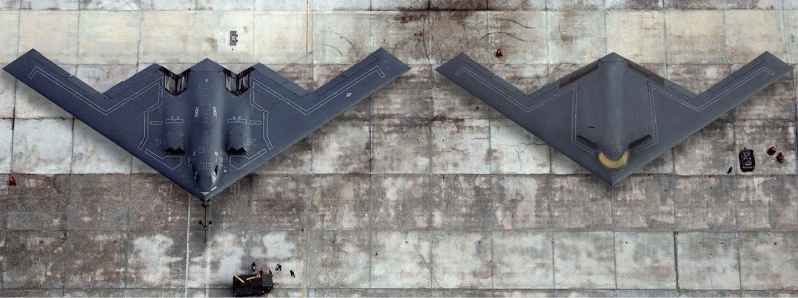
The much-anticipated B-21 has finally been unveiled. This time, the U.S. Air Force and Northrop Grumman were on high alert, and no one could see the B-21 from the angle they didn’t want people to see. Back when the B-2 was unveiled, the security was also very tight, but the devil was one foot taller than the road. The reporter of Aviation Week actually hired a private small plane and flew over the unveiling site despite the ban, taking a bird’s-eye view of the B-2, allowing the world to see the full picture of the B-2 at the first time. This is the biggest failure in the history of U.S. military aviation security, but it is also the biggest benefit for aviation fans and military fans around the world.
The U.S. Air Force has fully learned its lesson this time. Not only is the security tight, but the release time is chosen in the evening, making it difficult to take sneak shots. However, in the past few years, the U.S. Air Force has also released a lot of B-21 imagination pictures. Now it seems that there is no intention to mislead, and it is still relatively accurate.
The longitudinal partition of the air inlet
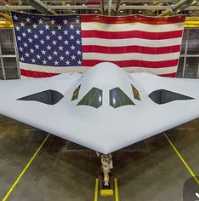
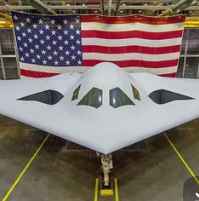
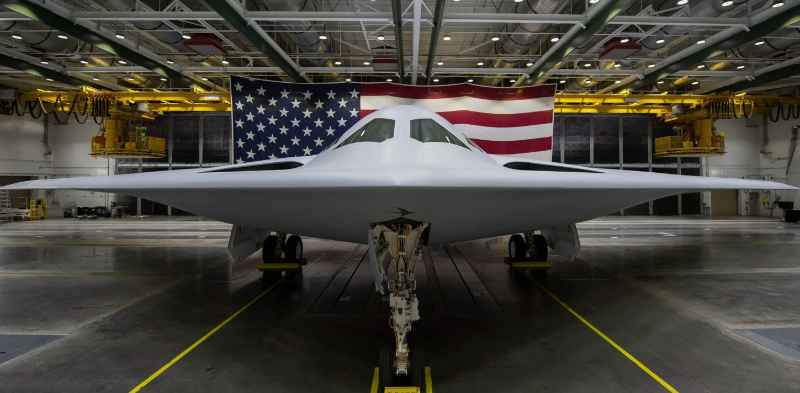
Compared with the imaginary picture, the air inlet is very low, which is confirmed, but the inward reverse sweep of the upper lip of the air inlet cannot be confirmed from the front view, and the longitudinal partition inside the air inlet is not seen in the imaginary picture. There may be two reasons for this analysis. This may be a necessity for the four-engine layout, or it may be to optimize the air inlet flow field.
The air inlet of the B-2 has serrations, but it is generally perpendicular to the direction of travel, and the problem of airflow side slip is relatively small. However, for the ultimate stealth, the air inlet of the B-21 is reversely swept and beveled, and the interaction with the leading edge and upper wing surface of the positively swept flying wing is very complicated. The low air inlet is not conducive to the high-flow uniform air intake for the efficient operation of the engine. It is reported that the air intake stability of the B-21 has always been a major problem for Northrop Grumman in its development. The longitudinal partition of the flat air inlet may be an effective way to solve this problem.
The longitudinal partition of the air intake is not the invention of the B-21. The Russian Su-75 "General" fighter also has a highly complex flat-bottomed V-shaped air intake, so the flow situation is very complicated and the longitudinal partition can only be used to help straighten it out and reduce the engine’s intake challenge.
The longitudinal partitions of the air intakes of the B-21 and "General" are most likely not to separate two independent air intakes and guide the intake to two different engines-like the MiG-19. In fact, the Su-75 is definitely a single-engine, as evidenced by the pictures at the rear angle. The longitudinal partition only serves as a guide vane, so it is only a short piece. And the guide vane has a clear sweep, which may be shaped for the shock wave of the lower lip of the air intake.
The details of the longitudinal partition of the B-21 cannot be finally confirmed now, because there are no photos of the nozzle details, and it is impossible to determine whether it is a twin-engine or a quad-engine. But judging from the landing gear, the weight of the aircraft should be a twin-engine. In other words, the longitudinal partition is just a guide vane, not a partition of the air intake, like the Su-75. Interestingly, the upper lip of the B-21’s air intake is not only reverse-swept, but the air intake cross-section is also asymmetrical, like the wing airfoil, in a horizontal teardrop shape. The longitudinal partition is not centered, but the capture area on both sides is nearly equal. I believe this is not the only basis for the design of the longitudinal partition, the flow field and pressure distribution are the most important.
Twin-engine medium bomber
Based on the relative scale of the ground crew and the tires in the relevant pictures, the tire size of the B-21 is not much different from that of the Boeing 737-800 or B-2. As a bomber, it is necessary to have a certain ability to take off and land at a field airport, that is, the tire pressure of the B-21’s landing gear should be at the same level as the B-2, or at least not much higher. In other words, the weight of the B-21 should be half to three-quarters of the B-2. The maximum take-off weight of the B-2 is 170.6 tons, while that of the Boeing 737-800 is 70.5 tons. It is reasonable to estimate that the B-21 is in the 100-120 ton level.
This determines that the legendary two non-afterburning F135 engines are credible as power. The non-afterburning thrust of the F135 is 125 kilonewtons. Compared with the LEAP series, the thrust is 100-156 kN, and the high-end is prepared for the extended A321XLR, with a maximum take-off weight of more than 100 tons. The C919 has increased to 125-133 kN because of the requirements for plateau take-off. The tailless flying wing has a high lift-to-drag ratio and low take-off power requirements. As a fighter engine, the F135 is limited in diameter. If it is used for bombers, it is not difficult to increase the fan diameter to increase the thrust. The F135 is also a military engine. The reliability and anti-electromagnetic interference capability (very important for nuclear attack missions) of both the non-afterburning and boosted models meet the requirements. Sharing the core engine with the F-35 fighter is also a consideration. The cost of twin engines is also lower than that of four engines. Not only are there two fewer engines, but the cost of the supporting systems is also reduced. The "twin-engine medium bomber" may reflect the new thinking of the US Air Force on bombers.
Historically, bombers are heavy hitters, with a larger payload and a longer range. The maximum take-off weight of the B-52 is as high as 221 tons, the bomb load is 31.5 tons, and the range without aerial refueling is 14,200 kilometers; the B-1 is 216.4 tons and 23 tons, and the range without aerial refueling is 12,000 kilometers; the B-2 is 170.6 tons and 23 tons, and the range without aerial refueling is 11,000 kilometers.
The reduced maximum take-off weight of the B-21 means a reduced range and bomb load, but considering the advanced flying wing configuration, the weight reduction of advanced composite materials and the more fuel-efficient advanced engines, the range without aerial refueling may still reach 8,000 to 10,000 kilometers, but the bomb load may be reduced to 15-18 tons.
As a heavy hitter, this does not seem to be very powerful, but as an ISR bomber, this still meets the needs. ISR bombers are the new thinking of the US Air Force.
ISR stands for intelligence, surveillance and reconnaissance. Intelligence focuses on the collection and analysis of information, while reconnaissance focuses on the acquisition of information. The two complement each other. Surveillance is a prominent requirement in modern warfare. Fast-in-fast-out reconnaissance is only effective for static targets, and is not very effective for time-sensitive or flickering targets. Continuous surveillance not only keeps track of the enemy at all times, but also tracks the entire process from emergence to elimination, which is conducive to target identification, target tracking, and confirmation of results, which are all indispensable links in the strike chain. Some people believe that the Russian army launched a powerful strike at the first time in the Ukrainian war, but lacked the link of confirming the results. "Strike and destroy" is a very arrogant assumption, and the Russian army has indeed suffered losses from this in subsequent operations.
Bombers are responsible for strategic strikes and deep penetration missions, and they have strong reconnaissance, surveillance and communication capabilities. Historically, this was used to serve penetration, and it was necessary to detect and monitor the weak points of the enemy’s air defense at any time to penetrate and retreat, and accurately judge and report the strike effects on important strategic targets. In today’s networked world, especially with the high stealth of bombers, these characteristics have also become natural advantages for battlefield ISR nodes. The long flight time of bombers is even more suitable for performing ISR missions deep behind enemy lines for a long time. B-21 is the first generation of new bombers that focus on both strike and ISR.
After the end of the Cold War, the biggest regret of the US Air Force was not the early discontinuation of the F-22, but the early discontinuation of the B-2. As an offensive air force, the US Air Force’s greatest combat power always comes from bombers, although fighter jets are often more eye-catching. In the new strategic environment of the Asia-Pacific axis and great power competition, what the United States needs most is 200 B-2s, not 2,000 F-35s. Fighting for air supremacy is a means, not an end. Only by exerting the power of air strikes at the strategic and campaign levels can we win the air war. No fighter can have the range and strike power of a bomber. This is the essential difference between the offensive air force and the national air defense air force.
B-21’s small size also ensures a low unit price. The US Air Force estimated the unit price to be US$550 million in 2010, which is approximately equivalent to US$753 million today. This is certainly much more expensive than a fighter, but much lower than the unit price of the B-2, which exceeds US$2 billion. The sky-high price of the B-2 is also the result of too low production, with only 21 aircraft. The B-21 is estimated to exceed 100, and the US Air Force hopes to reach 150. It is less than the ideal 200 or more, but much better than the current situation.
The range of the B-21 is reduced compared to the B-2, but its actual combat availability has increased. For the scenario of great power competition, it will rely on overseas bases, bases of allied countries outside the region, and aerial refueling, rather than simply relying on domestic bases in North America. For small and medium-sized countries, forward deployment is even less of a problem, and smaller, more, and lower costs also mean that they can be deployed more freely.
On the other hand, long-range strike means such as cruise missiles, hypersonic missiles, theater ballistic missiles, etc. have also made the bomb load of bombers no longer a decisive design consideration. With a system strike as a backing, why must we stick to being the first to drop bombs?
A simpler bat shape
The B-21 has a relatively thick central body compared to the B-2. The absolute thickness may not exceed that of the B-2, but it is an inverted trapezoid, not the "round bottom shallow V shape" of the B-2. The design of the B-2’s body is guided by the principle of stealth. Legend has it that Northrop Grumman’s chief electromagnetic scientist got the inspiration when he watched his children having fun in the "spinning teacup" in Disneyland: a round top, flat bottom, and sharp edges are the best shapes to make the incident electromagnetic energy "dissipate". This happens to be perfectly integrated with the tailless flying wing, so the basic shape of the B-2 is formed.
But the B-2 still needs a basic fuselage thickness to accommodate the engine and bomb bay, so the bottom surface cannot be completely flat and still has a shallow V. But the B-2’s actual use experience and further research on stealth have a deeper understanding of the real stealth effect of various shapes, or a higher level of fine control of stealth and aerodynamic and structural balance. The wide and flat bottom of the B-21 increases the relative volume inside the aircraft, providing a larger volume for the engine, internal bomb bay, and fuel tank, but does not affect stealth.
However, the B-21’s bomb bay still cannot accommodate too large missiles, such as hypersonic missiles. But this is not a loss. Stealth bombers are used for penetration bombing. Both penetration bombing and standoff long-range strike can attack long-range targets, but the former can attack with a large number of low-cost short-range ammunition, while the latter is limited by the cost of ammunition and cannot have a large tonnage of strike; the former has a short flight time and is more effective against sudden and time-sensitive targets, while the latter is limited by a longer flight time; the former has the conditions to attack after confirming the target, while the latter is no longer controlled after launch. Therefore, penetration bombing and standoff strike complement each other, rather than replace each other. Moreover, if it is a standoff long-range strike, it is more practical for non-stealth bombers to carry heavy missiles externally. Therefore, the US Air Force is replacing the engines for the B-52, and it will take another 40 years.
In terms of aerodynamics, the imaginary picture of the B-21 also shows a simpler "bat"-shaped aerodynamic shape, and the rear of the central body no longer has the complex "double W" of the B-2. The original design of the B-2 is also like this, which is optimized for high-altitude flight. If the stealth is powerful, the resistance of high-altitude cruising will be smaller. For ground radars, height means distance, and distance is the best comrade of stealth. But in the middle of the design, the US Air Force added the requirement of low-altitude penetration, still worried that the stealth was not strong enough.
But low-altitude penetration must take into account the impact of gusts. The B-2 originally had a short longitudinal distance and weak pitch control ability, so its gust suppression ability for low-altitude penetration was insufficient. Because low-altitude gusts exert a large torsional moment on the wing, the originally designed slender outer wing section not only had doubts about its strength, but also had the problem of "aeroelastic divergence". This was a common problem in the early days of swept wings. Due to the insufficient wing root strength and wing stiffness, when the flaperons were lowered, the aerodynamic pressure "lifted" the wing structure, causing the wing to twist around its own long axis, which not only offset the effect of the flaperons, but also may cause the control effect to reverse due to the larger wing area, resulting in loss of control.
B-2 also added a "double W" trailing edge to alleviate the problems of low-altitude gust resistance and aeroelastic divergence. The B-21’s return to the "fundamentalist" single W trailing edge shows two problems: first, low-altitude penetration is no longer the focus; second, aeroelastic divergence has been solved due to advanced composite materials and structural design.
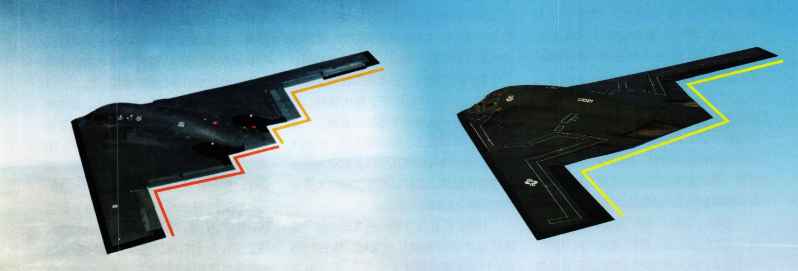
B-21 has a more flattened and sharp nose shape compared to B-2, a bit like Northrop Grumman’s X-47B. The cockpit glass has also been changed. It is said that these measures help improve the pilot’s vision.
B-21 is about to enter flight test, and more details will be circulated at that time.