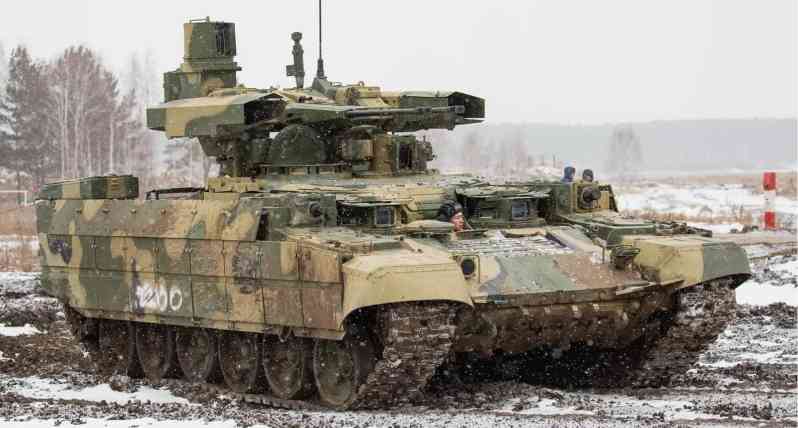

In December 2020, the first batch of 8 BMPT "Terminator" 3 tank support vehicles of the Russian Army were officially equipped with the 90th Guards Tank Division. This special vehicle, which is said to have performed well on the Syrian battlefield, was once promoted by the Russian side as a "street fighting weapon". In February 2022, the Russian army also announced in a high-profile manner that this "street fighting weapon" was put into the battle for towns in the new battlefield. However, there have been few reports about this "street fighting weapon" since then. How does the BMPT "Terminator" 3 tank support vehicle perform on the battlefield? Is this "street fighting weapon" out of order or is there something else going on? This article attempts to make a specific analysis of the "Terminator" 3 tank support vehicle.
Dead in the womb
In the 1980s, the Soviet invasion of Afghanistan was in full swing. In this protracted conflict known as the "War of Motorized Infantry Battalion Commanders", Soviet motorized infantry battalion commanders found that in the anti-ambush battles in the mountains of Afghanistan, the BMP infantry fighting vehicles that charged into battle needed more powerful close-range firepower support. The main guns of the T-72, T-55 and other models of tanks equipped for motorized infantry had an elevation angle of only more than 10 degrees, which was often not enough to deal with high-altitude firepower points "close to" tanks in mountainous environments. The self-propelled mortars with high firing angles have poor protection levels, unsatisfactory firing rates, and lack direct aiming and shooting capabilities. Therefore, in the mid-1980s, the Soviet Union launched Project 781 and Project 782, which were designed to provide motorized infantry with a powerful close-range tank support vehicle.
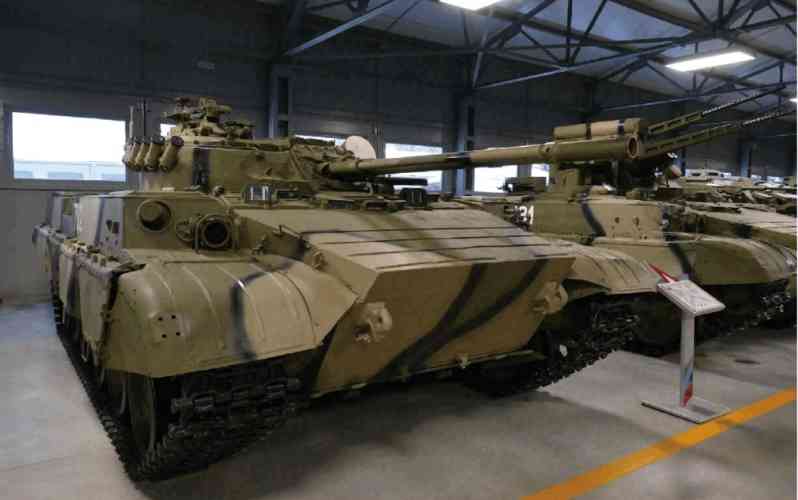
However, with the disintegration of the Soviet Union, Project 781 and Project 782 came to a standstill. In December 1994, the first Chechen War broke out. When the Russian army, whose strength was greatly weakened and whose military equipment was abandoned, attacked Grozny, the capital of Chechnya, the Chechen illegal armed forces not only took advantage of the fatal weakness of the Russian army’s infantry-tank coordination, approached from the blind spot of Russian tanks and armored vehicles, but also occupied the top floors of high-rise buildings in the city and used various anti-tank weapons to attack the tops of Russian tanks and armored vehicles with weak defenses, causing heavy losses to the Russian army.
At that time, the maximum elevation angle of the main gun of the BMP-1 infantry fighting vehicle equipped by the Russian army was only 33 degrees, which was obviously inadequate in urban combat. The maximum elevation angle of the main gun of the BMP-3 infantry fighting vehicle was only 60 degrees, which was not satisfactory. The elevation angle of the main gun of the BMP-2 infantry fighting vehicle reached 74 degrees, which was basically enough, but the firepower density was still insufficient, and the level of its own protection was poor.
It was the ZSU-23-4 "Shilka" self-propelled anti-aircraft gun that shined in the street fighting in Grozny. Because its 4-barrel 23mm machine gun can reach an elevation angle of 85 degrees, with 2,000 rounds of ammunition, and a maximum rate of fire of 850 to 1,000 rounds per barrel. The 4-barrel burst can fire a large number of shells at the enemy’s firepower launch point located high above the building in a very short time. When dealing with living targets, it can be said that "once the iron broom is out, no gods or ghosts will stay." However, the caliber of the ZSU-23-4 "Shilka" self-propelled anti-aircraft gun is only 23 mm. This type of ammunition is actually expanded on the basis of the 14.5x114 mm large-caliber bullet. Its tracer incendiary grenade warhead is only filled with a mere 13 grams of explosives, which is seriously insufficient to deal with reinforced concrete buildings. What’s more, the ZSU-23-4 "Shilka" was designed as an anti-aircraft gun accompanying mechanized troops after all. The air radar fire control system installed on it is useless in street fighting, and its own defense capability is obviously weak in the street fighting environment.
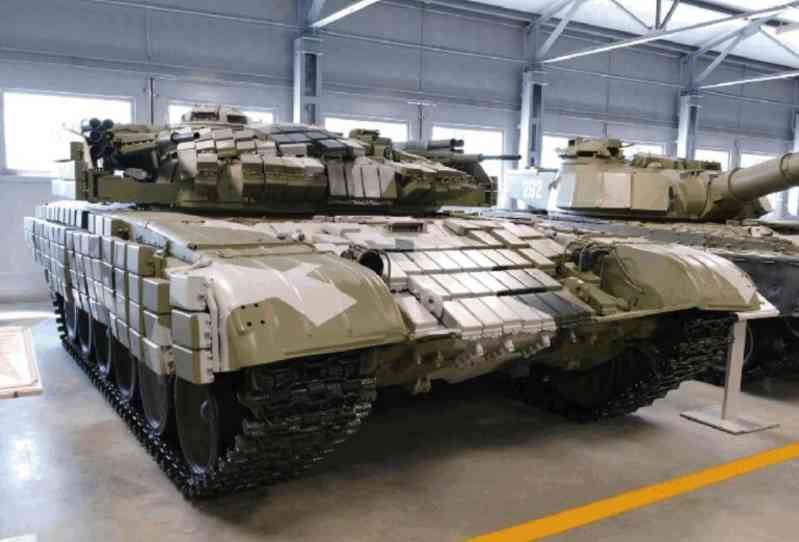
In view of this, the Russian army launched the 787 tank support vehicle project, which was developed by the Chelyabinsk Tank Plant. The initial 787 project prototype was unveiled in 1996. It is essentially a T-72B turret grafted onto the T-72AV tank chassis, with the main gun replaced by two 2A72 30mm machine guns, one PKT 7.62mm coaxial machine gun, two NSVT 12.7mm large-caliber heavy machine guns and two six-mounted B8V20/NURS-8 inertial guided rockets.
This prototype has been tested for nearly a year, and it was found that its protection is nothing to say. However, due to Russia’s backward observation and fire control system level, its ability to detect, identify and lock targets in complex weather is not satisfactory. The choice of its onboard support weapons has also caused controversy. As a lightweight version of the 2A42, the 2A72 30mm machine gun has a reduced number of parts from 578 to 349, and a weight from 115 kg to 84 kg. Since the specifications of the shells remain unchanged, the sharply reduced system weight has a significant negative impact on the accuracy of the machine gun’s continuous firing. The Chelyabinsk Tank Plant insists that as a close-range tank support vehicle, the increased dispersion of the 2A72 continuous firing is not a disadvantage, because the operator can shoot with only rough aiming, and rely on the dispersion of projectiles to cover the target to make up for the lack of aiming accuracy, which is conducive to timely seizing fleeting opportunities to annihilate the enemy in street fighting. In terms of the division of firepower strikes, the Chelyabinsk Tank Plant believes that the 7.62mm PKT machine gun is sufficient to deal with living targets. The NSVT12.7mm large-caliber heavy machine gun can destroy various earth and wood firepower points. The 30mm machine gun shells can deal with various light armored targets. When it comes to reinforced targets, the B8V20/NUR S-8 inertial guided rockets will be able to show their power.
Although the 781 project prototype has many supporters within the Russian army, the mainstream view within the army is that this specialized design only for street fighting is very useless in other occasions. In addition, the Russian economy fell off a cliff in the late 1990s, and the Russian army could not even feed the soldiers, so how could it have spare money to purchase specialized equipment with extremely narrow application range? Therefore, the 781 project was eventually discontinued. The Chelyaksk Tank Plant, which could not receive military orders, had to transform to produce tractors.
Twists and turns
In 1999, Yeltsin, then President of Russia, appointed Putin as Prime Minister. When Putin first came to the center of the Russian political stage, he used a strong iron fist to command the Russian army to quickly win the Second Chechen War, which boosted the morale of the Russian people, who had been depressed for a long time. Subsequently, Putin launched a heavy blow against domestic oligarchs. At the same time, the international energy market dominated by oil and natural gas entered an upward channel. The Russian economy began to stabilize and some previously shelved military research projects were restarted. The new tank support vehicle was one of them. However, after the project was restarted, it was handed over to the Uralvagonzavod Design Bureau for research and development, and the project code was changed to Project 199.
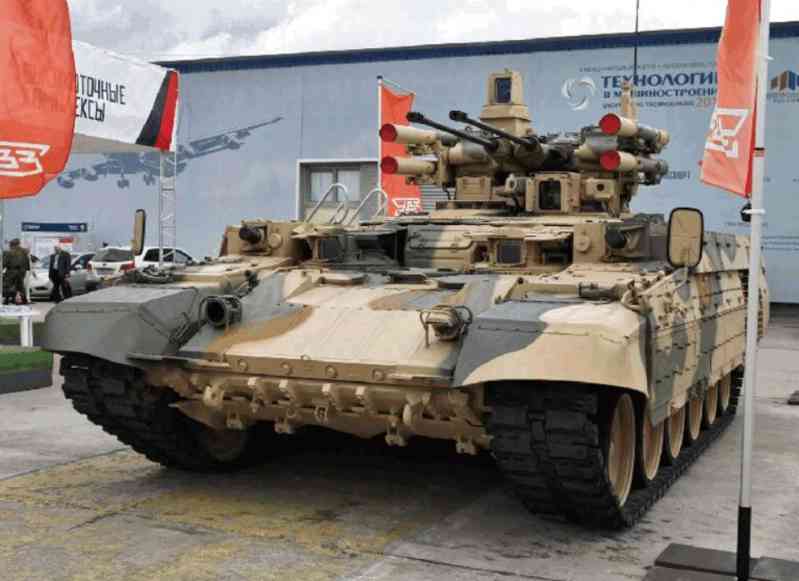
Since the tank support vehicle project is essentially a reintegration of various existing mature subsystems, the research and development difficulty is not great, so the Ural Vehicle Factory quickly launched the first prototype of the 199 project, the BMPT "Terminator" 1. It uses the T-90 tank chassis, and is equipped with a BO7-KA commander’s sight and a BO7-K2 gunner’s sight on the top of the redesigned low-profile unmanned turret. The integrated fire control system is code-named "frame". The main weapons include two 2A42 30mm machine guns installed in parallel and one PKMT7.62mm machine gun. Four 9M120 "Whirlwind" laser semi-active guided anti-tank missile storage and transportation/launch tubes are installed in groups of two, respectively, on the outside of the two 2A42 30mm machine guns. An AGS-17D 30mm automatic grenade launcher is installed on each side of the cockpit. Its combat weight is 47 tons, and the crew consists of 5 people, including the commander, the gunner, the driver and mechanic, and 2 grenade launcher operators.
The firepower configuration of this plan is much more complete than the previous 781 project. The Russian side claims that the maximum effective range of its upper "frame" fire control system can reach 10 kilometers, which is enough to support the 9M120 "Tornado" anti-tank missile with a maximum effective range of 8 kilometers to exert long-range strike power. The anti-tank missile uses laser semi-active guidance, so it can not only attack tanks and armored vehicles moving on the battlefield, but also easily destroy various enemy fixed fortresses or temporary firepower points. The 2A42 30mm machine gun has a barrel length of 2416mm, adopts a gas-guided working principle, a breech-rotating locking method, and is equipped with a muzzle brake and a two-way stabilization device, which can fire while moving. It adopts a two-way single-channel ammunition feeding system, and the theoretical firing rate has two gears to choose from: 200~300 rounds per minute and 550~800 rounds per minute, which are used for ground and air shooting respectively. The muzzle velocity is about 960~980 meters per second. When dealing with ground targets, the direct firing distance is about 1,000 meters. The armor-piercing shells used can penetrate 25 mm thick armor plates with a 60-degree inclination angle at a distance of 1,500 meters. The role of the PKMT7.62 mm machine gun is to eliminate unprotected living targets and save ammunition for the 2A42 30 mm machine gun. The main function of the two AGS-17D 30 mm automatic grenade launchers is to launch VOG-17M and VOG-30 grenades at high firing angles: to strike enemies hidden behind obstacles at various distances, and to eliminate the shooting blind spots of vehicle-mounted direct-fire weapons as much as possible.
According to Russian media reports, the performance of the BMPT "Terminator" 1 prototype in actual tests far exceeded that of its predecessor, the 787 Project prototype, and was sufficient to deal with enemy anti-tank teams, firepower points located in high-rise buildings in cities, tanks and armored vehicles that suddenly appeared in the streets, and low-flying helicopters. However, there is still controversy within the Russian army as to whether this type of tank support vehicle should be equipped. Therefore, the Ural Vehicle Plant launched the export version of the BMPT "Terminator" 2 tank support vehicle for the overseas market in 2013. Compared with the self-use version, it uses the old T-72 tank chassis and cancels the two AGS-17D 30mm automatic grenade launchers installed on the vehicle body. The effective range of the fire control system is also reduced to about 5 kilometers. However, in order to enhance the damage resistance of the exposed anti-tank missile storage and transportation/launch tube, the BMPT "Terminator" 2 is equipped with an armored sheath that can prevent shrapnel.
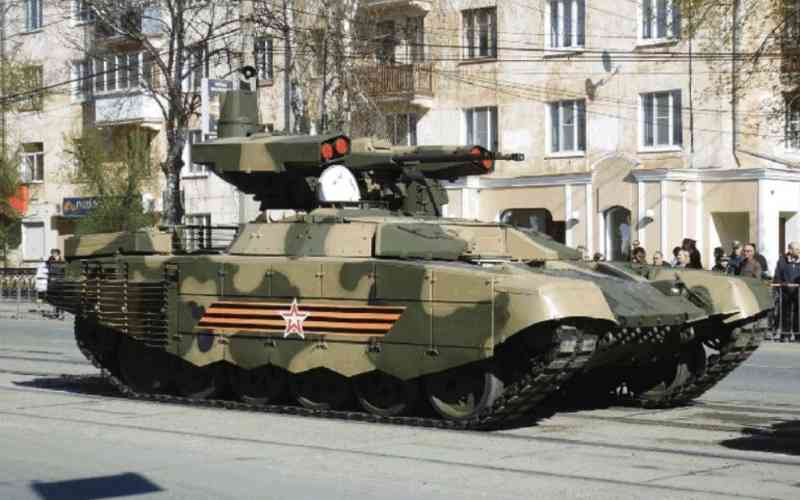
This "monkey version" (the "monkey version" on this website refers to the version with reduced configuration) BMPT is also known as the BMPT-72, and there is an upgrade kit for overseas customers to modify it by themselves. However, it has not received any overseas orders so far. If things continue to develop like this, Project 199 is likely to end in vain. Fortunately, at the end of September 2015, the Russian army openly intervened in the Syrian war, which brought a turning point to Project 199.
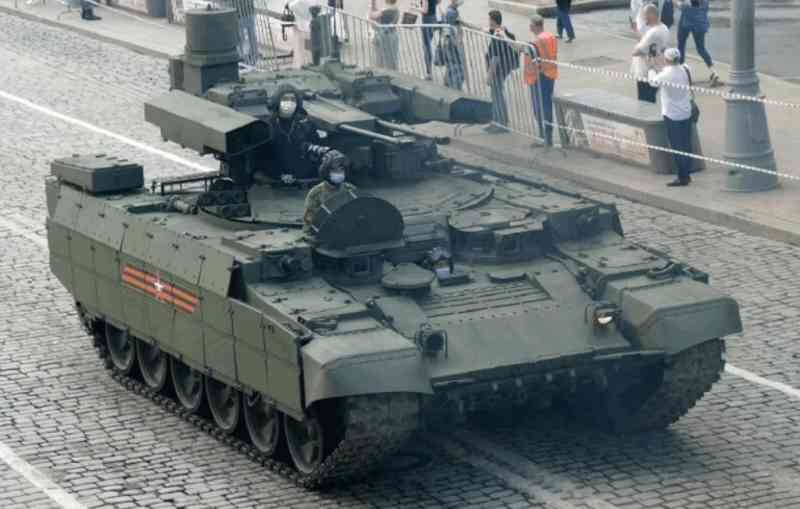
In 2017, 10 improved BMPT "Terminator" 3 prototypes were secretly transported to the Syrian battlefield for actual combat testing. It was equipped with explosive reactive armor on the basis of "Terminator" 1, which improved the protection performance of the whole vehicle. The layout of the on-board sighting system was fine-tuned, and the anti-tank missile storage and transportation/launch tube was also equipped with an armored sheath like "Terminator" 2. According to information disclosed by Russian media, these 10 BMPT "Terminator" 3 prototypes have performed well in the offensive and defensive battles in some towns in Deir ez-Zor and Hama provinces in Syria, so they were finally recognized by the Russian army.
According to the data released by the Russian side, the BMPT "Terminator" 3 uses the chassis of the T-72 main battle tank, with a body length of 7.2 meters, a bare body width of 3.37 meters, and a width of 3.7 meters after the explosive reactive armor is installed on the side skirts. The top of the body is 1.94 meters above the ground, and the highest point of the vehicle is 3.44 meters above the ground. The combat weight is 48 tons, the maximum output power of the diesel engine is 1,000 horsepower, the fuel load is 1,200 liters, the maximum road speed is 60 kilometers per hour, and the maximum road range is 550 kilometers. In terms of ammunition base, 2 2A42 30mm machine guns have a total of 850 rounds of ammunition, 2 30mm AGS-17D or AGS-30 automatic grenade launchers have a total of 600 rounds of ammunition, 7.62mm coaxial machine guns have 2,000 rounds of ammunition, and 9M120 anti-tank missiles have 4 rounds of ammunition.
The strength is not as strong as rumored
From the birth process and testing environment of BMPT "Terminator" 3, it is undoubtedly a specialized equipment designed for urban siege. If it is placed in a field environment, BMPT "Terminator" 3 will become a useless equipment that can’t do anything well and can’t provide effective fire support for other units. Because even in plain areas, limited by the battlefield situation awareness ability, the engagement distance cannot exceed 4 kilometers, and its standard engagement distance is usually around 2 kilometers. The sighting and observation system and information level of the BMPT "Terminator" 3 are not more advanced than those of main battle tanks, and there is no lifting observation platform or portable reconnaissance drone. Therefore, it is impossible to provide long-range fire support for its own tanks outside the control range of enemy tank fire. Although the four 9M120 "Tornado" anti-tank missiles it carries are said to have a maximum effective range of more than 8 kilometers, the flight speed of anti-tank missiles is much lower than that of tank shells. When both sides discover each other on the battlefield at the same time, it is impossible to destroy the enemy first. Therefore, anti-tank missiles have never been the mainstay of anti-tank firepower, but just a "rabbit kicking eagle"-style life-and-death means.
From World War II to the present, countless battles have proved that urban warfare is a complex combat style that requires close coordination between tanks, infantry fighting vehicles, dismounted infantry, engineers and artillery. Its combat organization is very complicated and cumbersome. No matter which army, if it simply and crudely directly puts troops into urban combat for the sake of saving trouble by omitting the coordination organization, even if this army has advantages in equipment, numbers and morale, it will pay a heavy price far beyond expectations.
As far as tanks and infantry fighting vehicles are concerned, the so-called main gun elevation angle is not enough in urban warfare. The argument that high-elevation urban assault tank support vehicles must be customized is very questionable. Even the T-72, whose main gun elevation angle is significantly lower than that of Western tanks of the same generation, has a main gun elevation angle of 14.5 degrees. Through simple geometric calculations, we can know that even if we want to bombard a target on the top of a 10-story building 30 meters high, the T-72 tank can reach it at an elevation of 13 degrees at a distance of 130 meters from the building. Of course, tanks and infantry fighting vehicles are powerless against high-rise targets that are very close to them. However, countless lessons learned from urban offensive and defensive battles have shown that in such combat environments, mechanized infantry must dismount and move forward, and tanks and infantry fighting vehicles should follow closely as supporting firepower, and dismounted infantry should protect their flanks. Self-propelled artillery is responsible for providing indirect fire support, and engineers are assigned to dismounted infantry in groups to clear obstacles on the way forward.
In the Iraq War, there was an example of two M2 Bradley infantry fighting vehicles firing all the onboard shells before they could barely clear anti-US armed forces hiding in a building. In other cases, the MIA2 tank only needs to fire one 120mm multi-purpose bomb to wipe out the resistance on a whole floor. Both positive and negative examples show that the larger the caliber and the more powerful the supporting firepower in urban warfare, the better.
Previously, there were not only one-sided praises about the actual combat performance of the BMPT "Terminator" 3 in Syria. Russian media also revealed that in the Aleppo city attack and defense, the 30x165mm high-explosive incendiary bomb used by the 2A42 machine gun, the main weapon of this tank support vehicle, had a charge of 49 grams, but it was still incapable of dealing with solid buildings. In many cases, it still had to rely on the tank to fire 125mm high-explosive bombs to destroy the target. Because of this, there is a call within the Russian army to replace the existing two 30mm machine guns of the BMPT "Terminator" 3 with a new 57mm machine gun. Because even the old 57mm tracer grenade has an explosive charge of 168 grams, which is 3.43 times more powerful than the 30mm caliber ammunition. If equipped with the newly developed composite armor-piercing projectile and high-explosive grenade, it will theoretically be able to destroy light armored targets within 3,000 meters and destroy the side armor of main battle tanks within the common combat distance. Perhaps this is one of the main reasons why this weapon did not perform well in the Russian-Ukrainian conflict.
Not only that, from the design concept of BMPT "End Cold" 3, the Russian army seems to be counting on using this specialized equipment to replace the organization of various arms synthesis tactics, hoping that this equipment can be used to fight urban offensive and defensive battles. This is the simple and crude thinking that the Russian army has always had when solving problems. It is easy to fall into the dilemma of "adding more water to flour and more flour to water", which is obviously unrealistic.
In terms of firepower, the BMPT "Terminator" 3 uses a small-caliber machine gun to replace the large-caliber main gun, which is to increase the strike range at the cost of power loss. However, the 2A42 30mm machine gun is not equipped with a double-chain ammunition supply system, and it is difficult to quickly switch the type of ammunition to meet the requirements of striking different performance targets. Therefore, one gun can only be used to fire grenades and the other gun can only be used to fire armor-piercing shells. In addition, the Russian side hopes to use anti-tank missiles to make up for the lack of firepower of small-caliber machine guns. However, the reserve of only 4 ammunition is often insufficient in actual combat. It continues to use the tank chassis and add explosive reactive armor, which certainly improves the anti-strike capability of the vehicle body, but the large number of external weapons and equipment are not under the effective protection of the armor, and being hit by light weapons and ammunition may paralyze some of the strike functions. Moreover, because the vehicle weight has increased by several tons compared to the tank, its battlefield mobility has been significantly reduced. The most critical thing is that its battlefield situation awareness capability has not been improved compared to the existing main battle equipment, and its crew’s observation blind spots and vehicle-mounted weapon shooting blind spots remain the same.
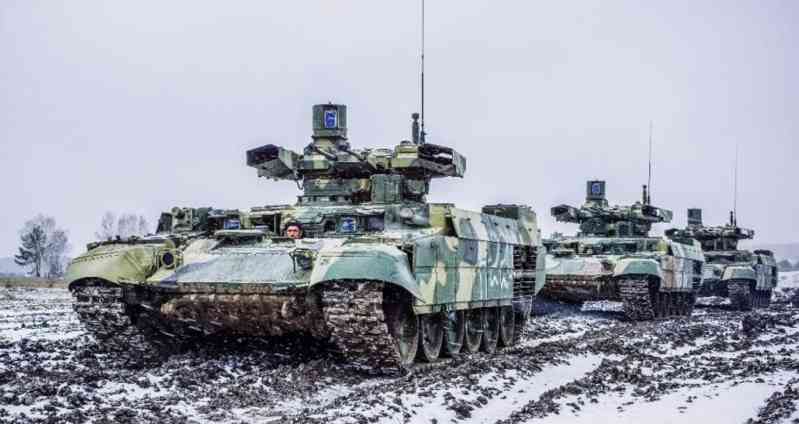
According to Russian media reports, the BMPT "Terminator" 3 does not have the ability to "attack three targets at the same time" as claimed by the manufacturer in actual combat, and the 30mm AGS-17D or AGS-30 automatic grenade launcher is fixed on both sides of the vehicle body, and the directional firing range is extremely narrow, which is far from enough to eliminate the firepower blind spot of the entire vehicle. It is still necessary for dismounted infantry to provide close-range cover for it to prevent the enemy from approaching using the shooting blind spot. In this case, for dismounted infantry, what is the difference between this and the previous close-range protection of tanks and infantry fighting vehicles? The Russian army did this, which is equivalent to adding an additional new equipment with a very narrow application range to the troops. And all the functions of this new equipment can be achieved by a combination of existing equipment.
For the Russian military logistics department, the BMPT "Terminator" 3, which is still a "niche equipment", has a complex system structure and is not easy to maintain, which directly limits its combat effectiveness. If you want to ask why the number of equipment of this "street fighting weapon" is still very small even though it has been officially equipped for more than two years, you can list a long list of reasons such as the actual equipment procurement costs of the Russian army in recent years are stretched, the unit price of the BMPT "Terminator" 3 has doubled compared to the T-72 series main battle tanks, and its narrow application range. The above-mentioned various defects, deficiencies and helplessness are superimposed, and it is natural that there is no relevant combat use report of the BMPT "Terminator" 3 in recent conflicts.