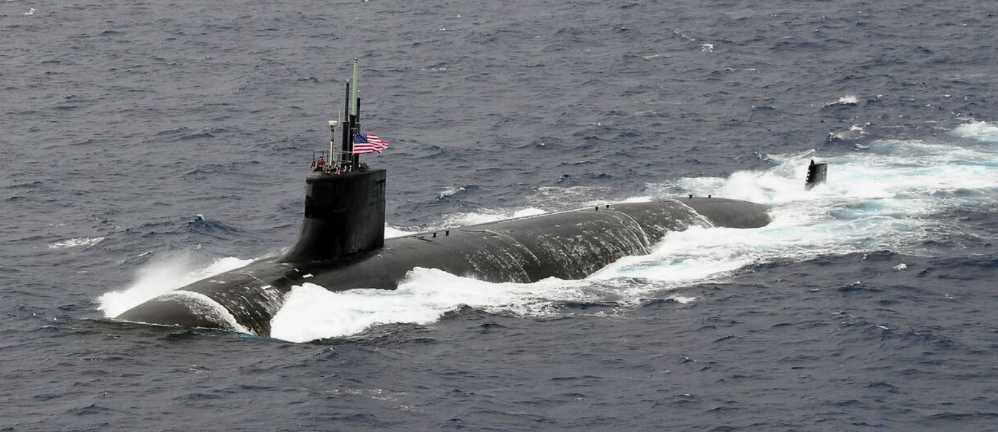

A cruise missile nuclear submarine refers to a large nuclear submarine that uses cruise missiles as its main combat weapon. It is equipped with an independent missile launch and control system. Its outstanding feature is that it is supported by a displacement of more than 10,000 tons and a multi-unit missile launcher. It can fire dozens or even hundreds of cruise missiles at a time to form a saturation attack on an aircraft carrier formation or carry out long-range precision strikes on dozens of military targets. It can be called the "ceiling" of campaign-tactical-class submarines. The "nuclear submarines with cruise missiles as their main combat weapons" emphasized here need to exclude some attack-type nuclear submarines or multi-purpose nuclear submarines that can only launch cruise missiles through torpedo tubes. Therefore, according to the above standards, there are not many such nuclear submarines in the world, only 4 Ohio-class submarines in the United States and 6 "Oscar" II-type and 4 "Yasen" M-type submarines in Russia, a total of 14.
Development status and prospects
United States
The United States’ cruise missile nuclear submarines and ballistic missile nuclear submarines have developed almost synchronously. As early as the 1950s, the United States developed the "Polaris submarine-launched ballistic missile" and the "Tiensing" cruise missile with a range of more than 1,000 kilometers to counter the Soviet Navy’s submarines and large surface ships. The two types of missiles are mainly used to attack enemy strategic targets and tactical targets such as surface ships, and the first generation of strategic missile nuclear submarines and cruise missile nuclear submarines were developed for this purpose.
The "Halibut" commissioned in 1960 was the first specially designed cruise missile nuclear submarine (the previous "Grayback" was a conventional submarine). The US Navy set up the "Tiens" I cruise missile library at the bow of the boat, which can store 5 missiles. However, since the launch and maintenance of the "Tiens" must be carried out on the surface, the launch and guidance systems are complex and easy to be intercepted, the submarine has low concealment and little combat value. Therefore, the United States soon gave up the construction of cruise missile nuclear submarines. However, the United States has not stopped its research on cruise missile nuclear submarines, and has attached great importance to the inclusive development strategy of nuclear submarines. After the successful development of the submarine-launched "Tomahawk", the number of nuclear submarines carrying cruise missiles in the US military began to increase, but no cruise missile nuclear submarines were specially developed. The launch was mainly achieved through Los Angeles-class torpedo tubes or a small number of cruise missile launch tubes. In the early 21st century, the US Navy converted four Ohio-class cruise missile nuclear submarines into cruise missile nuclear submarines, which finally made this type of submarine mature.
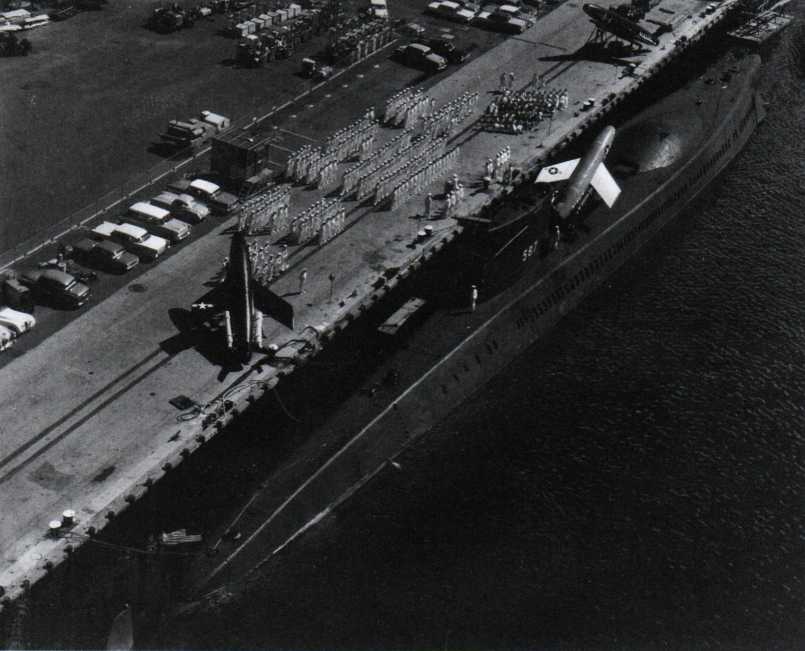
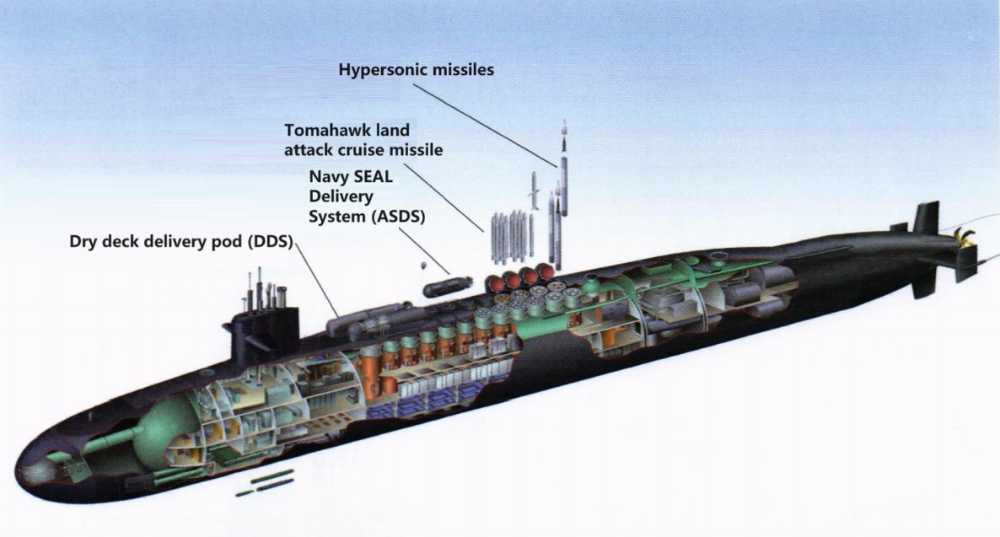
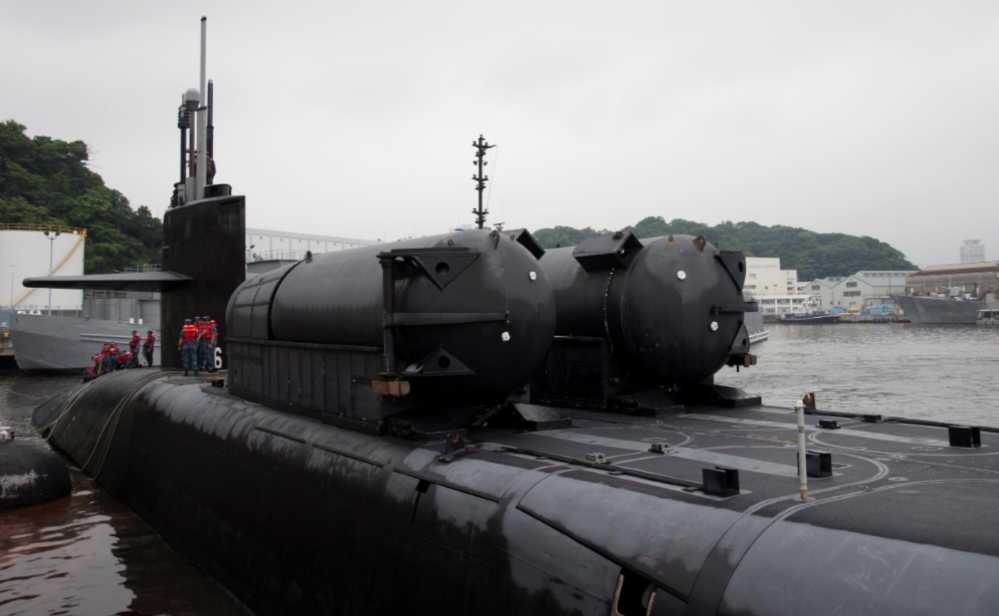
After the disintegration of the Soviet Union, according to the Treaty on the Reduction and Limitation of Offensive Strategic Arms reached by the United States and the Soviet Union, the number of US strategic missile nuclear submarines was limited to 14 from 2002. At that time, there were 18 Ohio-class ballistic missile nuclear submarines in service. The United States was reluctant to retire the extra 4. After comprehensive demonstration and optimized modification design, the first 4 submarines in service were converted into cruise missile nuclear submarines, thus realizing the optimized development of "one level and two types". 22 of the original 24 "Trident" missile launch tubes of the Ohio class were converted into launch devices that can accommodate "Tomahawk" cruise missiles. Each submarine can carry a total of 154 The remaining two launch tubes are connected to the mini-submarine of the "Seal Delivery System (ASDS)" or the dry deck delivery compartment (DDS) equipped with a "frogman" carrier. Each modified Ohio-class can carry 66 special operations personnel, and the ASDS can transport 9 "Seal" commandos at a time. This successful modification has made the Ohio-class the cruise missile nuclear submarine with the largest number of cruise missiles and the greatest assault power in the world. A single submarine can destroy 1 to 2 large aircraft carrier battle groups or dozens of important military targets on land by completing a full missile launch.
By 2027, the service time of the four Ohio-class ships will exceed 45 years, and finding their replacements has long been included in the development plan of the US cruise missile nuclear submarine. In 2019, the U.S. Navy signed an agreement with General Dynamics Electric Boat to order nine Virginia-class Block V nuclear submarines (the agreement for the tenth submarine was signed in 2021). This type of submarine will be equipped with a missile compartment module (VPM) at the rear of the command platform, increasing the length of the submarine from the original 114.9 meters to 140 meters. The compartment has a total of four large launch tubes, each of which can carry seven Tomahawks, increasing the number of cruise missiles carried from 12 to 40. In addition, the original four 533 mm torpedo tubes can launch a total of 26 Mk 48 torpedoes and Harpoon anti-ship missiles, with a total of 66 weapons per submarine. The first Block V submarine, the USS Oklahoma, is currently under construction and is expected to be commissioned in 2025, which is expected to once again realize the U.S. Navy’s "one level, two types" cruise missile nuclear submarine development path.
Even if the U.S. Navy tries its best to make up for the retirement of the Ohio-class by improving the Virginia-class, the assault power is still far behind the latter’s single-boat carrying 154 cruise missiles. Therefore, the future Columbia-class ballistic missile nuclear submarine of the U.S. Navy can completely copy the development strategy of "one class and two types". For the United States, which has already realized modular design and construction of nuclear submarines, there is basically no technical difficulty. The Columbia-class is planned to be equipped with 16 ballistic missile launch tubes. If it is still designed to carry 7 cruise missiles per tube, a single boat can carry up to 112 missiles, which is close to the carrying capacity of three Virginia-class Block V-type ships. In addition, it is not ruled out that it will increase the compartment and increase the missile carrying capacity to the level of 154 missiles of the Ohio-class to ensure the ability to carry out rapid, continuous and high-intensity strikes on targets in a high-intensity war environment. Judging from the development trend of the US Navy’s submarines and submarine-launched weapons, the "one class, two types" path of the Virginia-class improved version and the Columbia-class can be flexibly selected. It can also be foreseen that future cruise missile nuclear submarines will also focus on shallow water combat capabilities to expand the range of cruise missiles to strike land.
Soviet Union/Russia
Compared with the United States, the Soviet Union/Russia attaches more importance to the development of cruise missile nuclear submarines. During the Soviet period, cruise missile nuclear submarines developed four generations: the first generation was the E-1 class (Type 659); the second generation was the E-2 class (Type 675); the third generation was the C class (Type 670 and Type 670M); the fourth generation was the O class (Type 949 and Type 949A). The first three generations of cruise missile nuclear submarines were an important part of the Soviet Navy submarine force from the 1960s to the early 1990s, and were also the main force to deal with the US aircraft carrier formation at that time. However, after the disintegration of the Soviet Union, due to the significant reduction in military expenditures, the fate of the first three generations of submarines was also like many ballistic missile nuclear submarines, and they were quickly withdrawn from active service. The 0 class continued the development path of the "one generation and two types" of the C class. Its main combat mission is to launch missiles from submarine groups to carry out "saturation attacks" on US aircraft carrier formations.
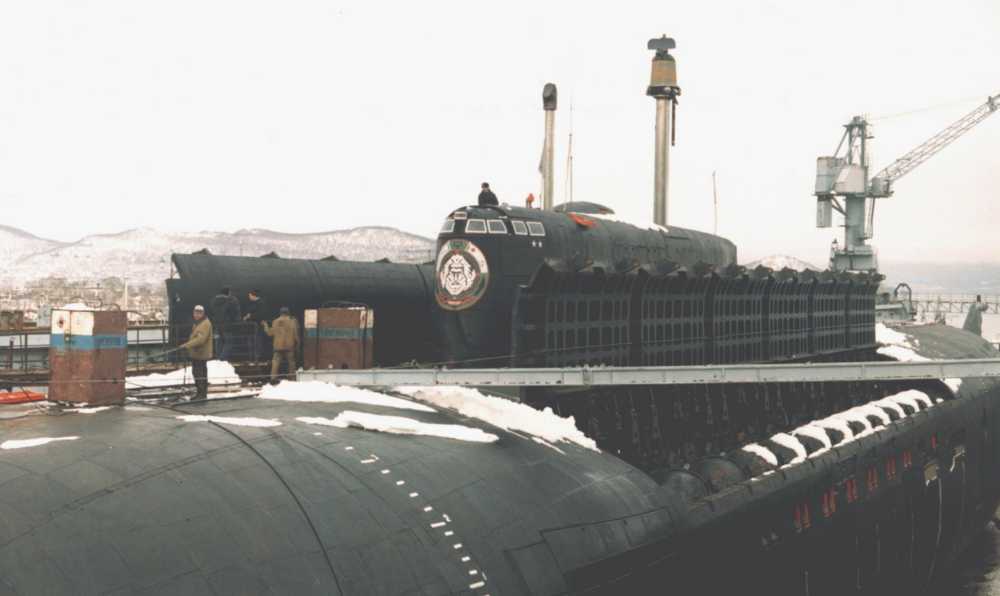
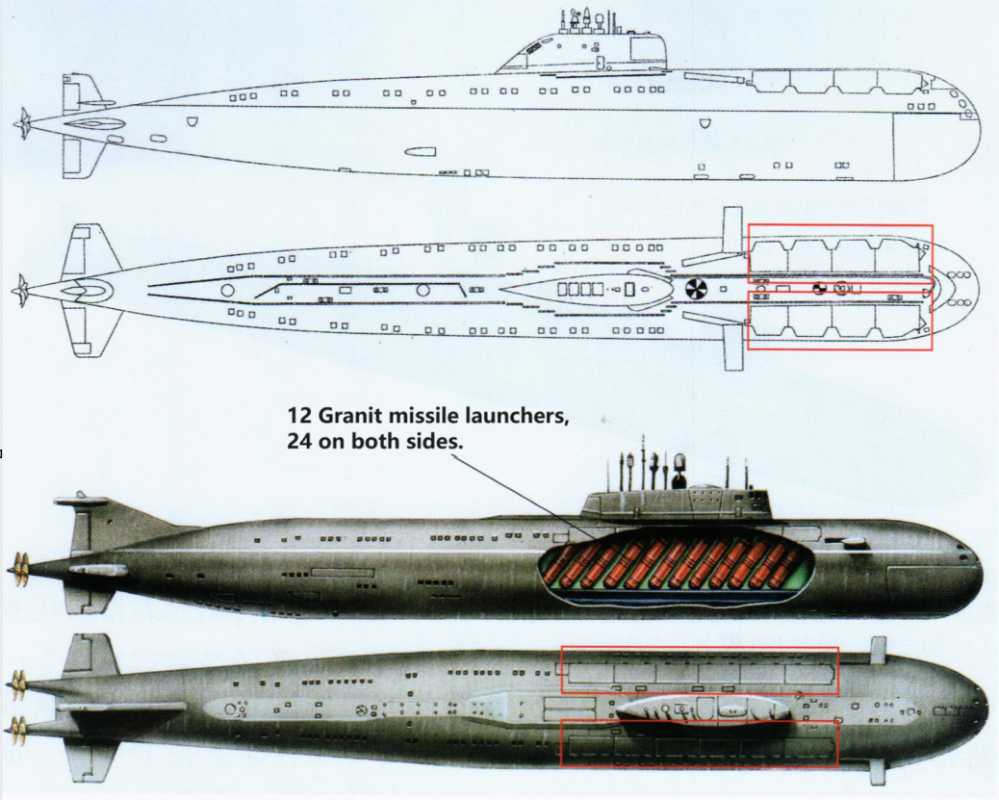
From the development of the Soviet/Russian four-generation cruise missile nuclear submarines, almost all of them have followed the technical iteration and upgrading from low to high, especially since the third-generation C-class, this trend is more obvious, and the 0-class is even more so. The O-class 949 type began to serve in 1982, and only 2 ships were built; the 949A type began to serve in 1986, and a total of 12 ships were built. It added an 11-meter-long auxiliary engine compartment section on the basis of the 949 type. The 949A type is equipped with 24 "Granite" missile launch tubes, arranged between the pressure hull and the non-pressure hull in the front middle of the boat. There are 6 rectangular covers on each side of the command platform enclosure, which contains 2 missile launchers, arranged at a 45-degree angle to the vertical line. According to the Soviet Union’s expectations, a 949A type can destroy a large aircraft carrier formation. If it is equipped with "caliber" series missiles, it can also achieve multi-target attacks on land.
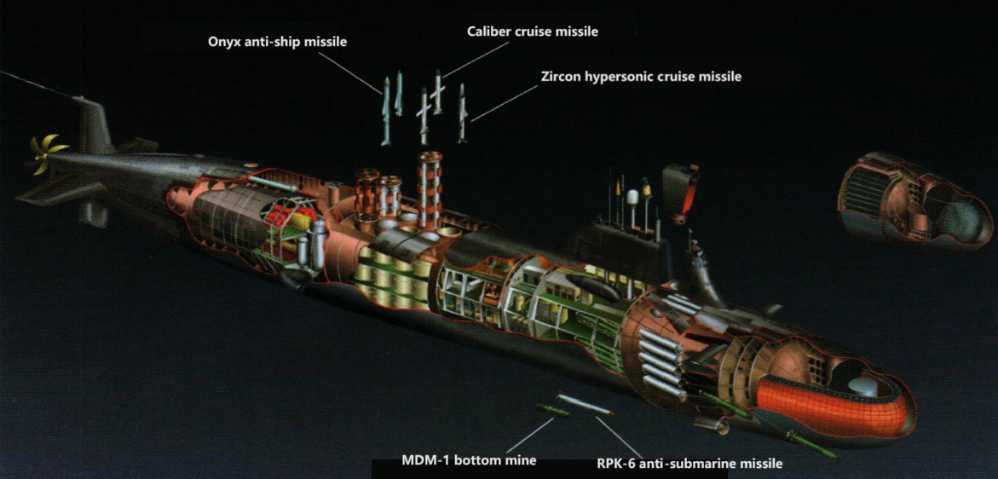
The Yasen class (Type 885 and Type 885M) is Russia’s fourth/fifth generation multipurpose nuclear submarine that can launch cruise missiles). Since it is the successor of the O-class and Akula-class, it must take into account the ability to launch cruise missiles underwater for anti-ship or land attack and anti-submarine operations. Judging from the number and displacement of cruise missile vertical launch devices and bow torpedo tubes, it is more inclined to the 0-class cruise missile nuclear submarine. Starting from the Yasen-class No. 2 boat, the Type 885 was upgraded to the Type 885M, and the iterative upgrade development goal of "one generation and two types" was achieved. The Type 885M is equipped with 8 modular multipurpose missile vertical launch devices behind the command platform, and each launch tube can be loaded with 4 "caliber" cruise missiles. The torpedo compartment is moved to the front and middle part, and 10 launch tubes are distributed on both sides of the hull, 5 on each side.
At present, Russia is developing the next generation of Husky-class nuclear submarines, which adopts a modular design of "one generation, multiple types" technical optimization plan, further integrating the technical advantages of Akula, Yasen and Borei. Each submarine may carry 88 to 110 cruise missiles, which is obviously a benchmark for the design of the new US cruise missile nuclear submarine. In particular, the use of the "Zircon" hypersonic missile will pose a great threat to the US missile defense system.
Technical features and advantages
Whether it is divided by weapon system and mission, or by power system and displacement, cruise missile nuclear submarines and multi-purpose attack nuclear submarines seem to have many similarities, and it is even difficult to strictly distinguish them. But a careful analysis shows that cruise missile nuclear submarines focus on achieving high-density saturation missile attacks on sea/land.
Large hull size and displacement
Due to the large missile load of cruise missile nuclear submarines, their hull size must be larger. For example, the Ohio class is 170 meters long, the 0 class is 154 meters long, and the Yasen class is 111 meters long, while the multi-purpose attack nuclear submarine is generally 85 to 100 meters long. With such a hull size, the displacement must be larger. The Ohio-class surface displacement is 16,764 tons, and the underwater displacement is 18,750 tons; the 0-class surface displacement is 14,700 tons, and the underwater displacement is 23,860 tons; the Yasen-class surface displacement is 8,600 tons, and the underwater displacement is 13,800 tons. The displacement of multi-purpose attack nuclear submarines is generally between 5,000 and 9,000 tons.
Good concealment and internal environment
Although the construction time of cruise missile nuclear submarines of the United States and Russia spans decades, they attach great importance to low hydrodynamic noise in the hull shape: there is no obvious "turtle back" deck due to the vertical launch device, and the hull surface is well streamlined. Most of the mechanical equipment such as the main/auxiliary engines in the cabin are equipped with elastic vibration reduction bases or vibration reduction float valves, and new integrated self-circulating reactors, low-noise propellers or new pump-jet propulsion are used. Noise monitoring equipment is also installed in many parts to monitor the noise of the submarine at all times, and the latest demagnetization technology is used. These new technologies, new processes and new measures have greatly improved the acoustic stealth of the submarine.
In order to maintain and improve the combat effectiveness of the crew, these large nuclear submarines mostly adopt optimized modular design and construction technology, with large living and working cabins, and high automation levels in the reactor cabin and main and auxiliary engine cabins; by setting up gyms, swimming pools, solariums, saunas and entertainment areas, the working and living conditions of the crew are improved. These technical applications and measures have greatly simplified the difficulty and pressure of the crew’s operation, greatly enriched the crew’s spare time, and greatly improved the combat effectiveness of the submarine.
Underwater maneuvering/command and communication/anti-ship or land assault/special operations
In order to maintain the continuous maneuvering of submarines in the deep sea, it must have a stronger propulsion capability. The Ohio-class submarine has a maximum underwater speed of 32 knots, while the Virginia-class submarine can reach 34 knots. The Soviet Union and Russia are not far behind, with the 0-class submarine having a maximum underwater speed of 33.5 knots and the Yasen-class submarine having a maximum underwater speed of 33 knots. The maximum speeds of the above submarines are almost the same. Cruise missile nuclear submarines must rely on integrated anti-submarine command systems and satellites, early warning aircraft, etc. to provide target indication information to strike long-range targets, rather than relying on the submarine’s own sonar, radar and other detection equipment to find targets. This places high demands on the timeliness and reliability of underwater information received by cruise missile nuclear submarines. Both the Ohio-class and Virginia-class submarines are equipped with the most advanced fleet anti-submarine command and communication systems, as well as multi-band communication equipment. They can implement integrated network-centric tactical coordination with the theater anti-submarine command satellite, early warning aircraft, other submarines, surface ships and shore-based radars. Submarines receive instructions or target indication information through various means such as radio and laser and tactical data links, thereby achieving high-density missile strikes. In order to effectively command and control the maritime operations of cruise missile nuclear submarines, the Russian Navy has built a number of shore-based low-frequency, very low-frequency, and extremely low-frequency wireless communications and low-frequency hydroacoustic communication base stations on the northern and eastern coasts. At the same time, submarine command can also be carried out through space-based communication satellites and airborne command aircraft. The command process is as follows: the theater commander directly commands the nuclear submarines waiting for battle at sea through the theater submarine command system; after receiving the order, the nuclear submarines waiting for battle will float to the predetermined missile launch depth, and then receive information such as the target location provided by satellites, reconnaissance aircraft or surface ships through radio towed antennas and tactical data links, and launch missiles at the right time.
The Ohio-class and Virginia-class can carry 154 and 40 missiles respectively. "Tomahawk has the ability to launch missiles in salvos and continuously, and has strong anti-ship or land assault capabilities. "Tomahawk’ has a variety of models, including submarine-to-ship type and submarine-to-land type, and the maximum range of the land type can reach more than 1,600 kilometers. The 949A is equipped with 24 Granite anti-ship missiles; the Yasen M class is equipped with 32 anti-ship or anti-land cruise missiles, plus 10 torpedo tubes that can be equipped with anti-ship or anti-land missiles, which are devastating to any surface ship formation or land military target.
Although special operations are not the main task of cruise missile nuclear submarines, in order to enable this type of nuclear submarine to have the ability to perform a variety of combat missions, the United States and Russia have specially equipped them with special operations equipment. The Ohio-class rear deck can be equipped with a miniature submarine or a transport cabin, which can be docked with the sealed hatch of the hull. Special forces can directly enter the miniature submarine or sail to the target area through the transport cabin to land secretly. The Virginia-class is equipped with a recoverable autonomous unmanned submarine for underwater reconnaissance, minesweeping, anti-submarine or transporting "Navy SEAL" commandos. The Yasen class also adopts a modular design, which can be equipped with different mission modules to perform different special operations tasks, such as carrying small submarines, etc.
The choice of precision and saturation strikes
The United States attaches importance to precision strikes against land
The main purpose of the United States to develop cruise missile nuclear submarines is to enhance its land strike capability. The US military attaches great importance to the long-range precision strike capability of the "Tomahawk" against land. It has become the "vanguard" of the US military’s external war. Once the war starts, a large number of "Tomahawks" will be launched to the war zone at the first time to strike the enemy’s high-value targets. With cruise missile nuclear submarines, this strike capability is even more amplified. On March 19, 2011, the United States, Britain, France and other countries launched the "Odyssey Dawn" operation against Libya in the name of implementing UN Security Council Resolution 1973. The "Florida" cruise missile nuclear submarine participated in the war for the first time and fired 93 "Tomahawks" at Libya’s military targets in succession, almost destroying Libya’s air defense system. At that time, U.S. Navy Rear Admiral Rick Breckenridge praised this: "In the history of the United States, no ship has ever carried out so many attacks on land in a short period of time, and we did it with underwater forces."
On April 13, 2018, the United States, together with Britain, France, Israel and other countries, launched a missile attack on Syrian land military targets. The "Ohio" launched a series of 90 Tomahawks, the US said all missiles hit the target. Two combat tests of the Ohio class have demonstrated the powerful long-range missile strike capability against land, and accumulated experience for the development and application of cruise missile nuclear submarines.
Russia attaches importance to saturation attacks on aircraft carrier formations
Compared with the United States, Russia attaches more importance to using cruise missile nuclear submarines to saturate attack aircraft carrier formations, which is also the consistent proposition of the Russian Navy. The Russian Navy’s Northern Fleet and Pacific Fleet have repeatedly practiced the use of two Type 949A submarines to attack aircraft carrier formations. The operational concept is to deploy two boats in advance to wait underwater in an area 500 to 600 kilometers in front of the enemy aircraft carrier formation; after reconnaissance platforms such as reconnaissance satellites and long-range early warning aircraft discover the enemy aircraft carrier formation, the fleet’s submarine command post calls on each submarine to float to the long-wave receiving depth, release the satellite receiving antenna, and receive information such as the position, heading, speed, and number of formations of the enemy aircraft carrier formation through data links, and mark the missile strike position area; each submarine determines the number of missiles to be launched, sets the missile strike parameters, and completes the missile launch preparation; when the distance from the aircraft carrier formation is 470 to 480 kilometers, a missile coverage overlap area is formed, and each boat launches missiles at the location of the enemy aircraft carrier formation. In this way, two submarines launch 48 missiles at a time to attack an aircraft carrier formation composed of 6 to 8 surface ships, with a penetration probability of 0. 50% calculation, that is, 24 missiles hit, can also give the formation a devastating blow.
In addition, the Russian Navy has gradually attached importance to the actual combat test of using submarine-launched cruise missiles to attack land targets. On September 14, 2017, the Black Sea Fleet’s "Very Novgorod" and "Kolpino" submarines launched 7 "Caliber" cruise missiles from the eastern Mediterranean, destroying a communication center and an ammunition depot of the "Islamic State" in Syria; on October 31, the "Very Novgorod" launched another 3 "Caliber" from the eastern Mediterranean, destroying a headquarters and a large arsenal of the "Islamic State" in eastern Syria, verifying the long-range precision strike capability of the submarine-launched "Caliber" against land.
The development and combat application practices of cruise missile nuclear submarines in the United States and Russia will surely play an important reference and reference role in the development of cruise missile nuclear submarines in various naval powers. However, like any equipment, cruise missile nuclear submarines have both strengths and weaknesses. Their large hull size and limited maneuverability make them unsuitable for accompanying and escorting ballistic missile nuclear submarines or aircraft carrier formations; their large displacement and deep draft make them unsuitable for anti-submarine combat missions in shallow waters near the coast. Therefore, only by using their strengths and avoiding their weaknesses can we give full play to their advantages in continuous assault capabilities.