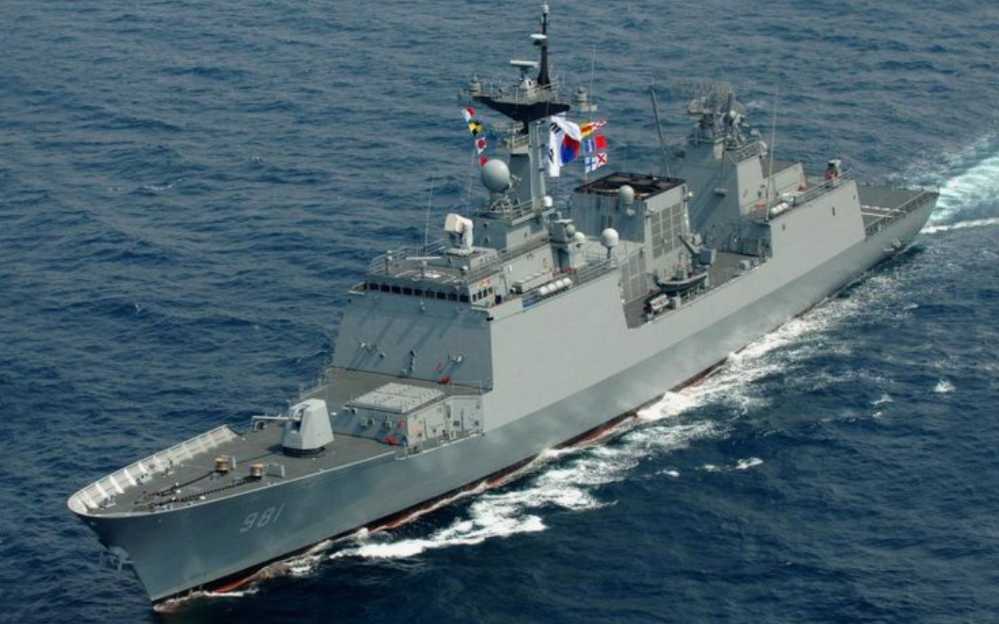

The South Korean Navy was reorganized from the South Korean Coast Guard during the U.S. Military Administration in Korea in 1948. Compared with the Army, Air Force and the semi-independent Marine Corps, the South Korean Navy started late, was greatly affected by the domestic economy, and has long relied on the U.S. Navy in Korea to assist in maritime defense.
In 1963, the United States provided South Korea with three Fletcher-class destroyers. This was the first time that South Korea had medium-sized surface ships since its founding. They were named "Chungmu" (DD 911), "Seoul" (DD 912) and "Pusan" (DD 913). In December 1973, South Korea obtained two Allen M. Sumner-class destroyers from the United States, named "Daegu" (DD 917) and "Incheon" (DD 918). From 1972 to 1981, South Korea successively obtained seven Gearing-class destroyers from the United States, named "Chungbuk" (DD 915), "Jeonbuk" (DD 916), "Daejeon" (DD 919), "Gwangju" (DD 921), "Gangwon" (DD 922), "Gyeonggi" (DD 923) and "Jeonju" (DD 925). These 12 destroyers were all built during World War II. Compared with today’s missile destroyers, they are relatively backward, but they still have a very obvious advantage over their main rival, North Korea.
The origin of the KDX-2 type
In the 1980s, North Korea’s underwater forces became increasingly powerful with external assistance, and the South Korean Navy’s artillery/torpedo destroyers were seriously outdated, so it began to launch a surface ship replacement plan. In November 1983, the South Korean Navy proposed the "Korean Destroyer Experimental" (KDX) plan, intending to build a destroyer with a displacement of 3,500 tons. The KDX plan was officially launched in 1986. Soon after South Korea launched the KDX plan, the Cold War ended, and the international political and military environment changed dramatically. The mission of the US military stationed in South Korea also changed from simply assisting the South Korean military in dealing with North Korea to responding to this new challenge in the Asia-Pacific region. In 1995, then-Navy Chief of Staff Ahn Byung-tae suggested to then-President Kim Young-sam that a blue-water navy should be built for the ocean, and the Kim Young-sam government accepted the suggestion. In 1997, Ahn Byung-tae proposed to build a large destroyer, and on this basis, the KDX plan was revised and adjusted to three stages. The previous KDX plan became the first stage, and the destroyer built was the KDX-1 type, also known as the Guangkai Seven Kings class.
It is worth mentioning that in 2001, when the then South Korean President Kim Dae-jung gave a speech at the Korean Naval Academy, he said that South Korea should build a strategic mobile fleet to defend South Korea’s interests in the ocean and contribute to world peace. At that time, he promised to spare no effort to build a real blue-water navy. Against this background, the South Korean Ministry of Defense further clarified the details of the South Korean Navy’s construction in "National Defense Reform 2020". In addition to planning the expansion of the navy, the construction of facilities and equipment related to naval strategy has attracted much attention.
Since the KDX-1 was the first ship designed and built independently by South Korea, and there was no experience in the development of medium-sized destroyers before, the South Korean Navy found that there were many problems with this class of ships after it was commissioned, including the extremely poor ocean-going capability due to its shallow draft, and the limited hull made it almost impossible to upgrade in the future. There were also quite a lot of failures after it was put into service, with an average of 4 repairs per year, forcing the KDX-1 to be unable to perform combat readiness tasks for a minimum of 3 months and a maximum of 6 months each year, resulting in a certain degree of "vacuum" in South Korea’s territorial waters defense. The South Korean Navy was quite dissatisfied with this class of ships and only built 3 ships before the project was hastily completed.
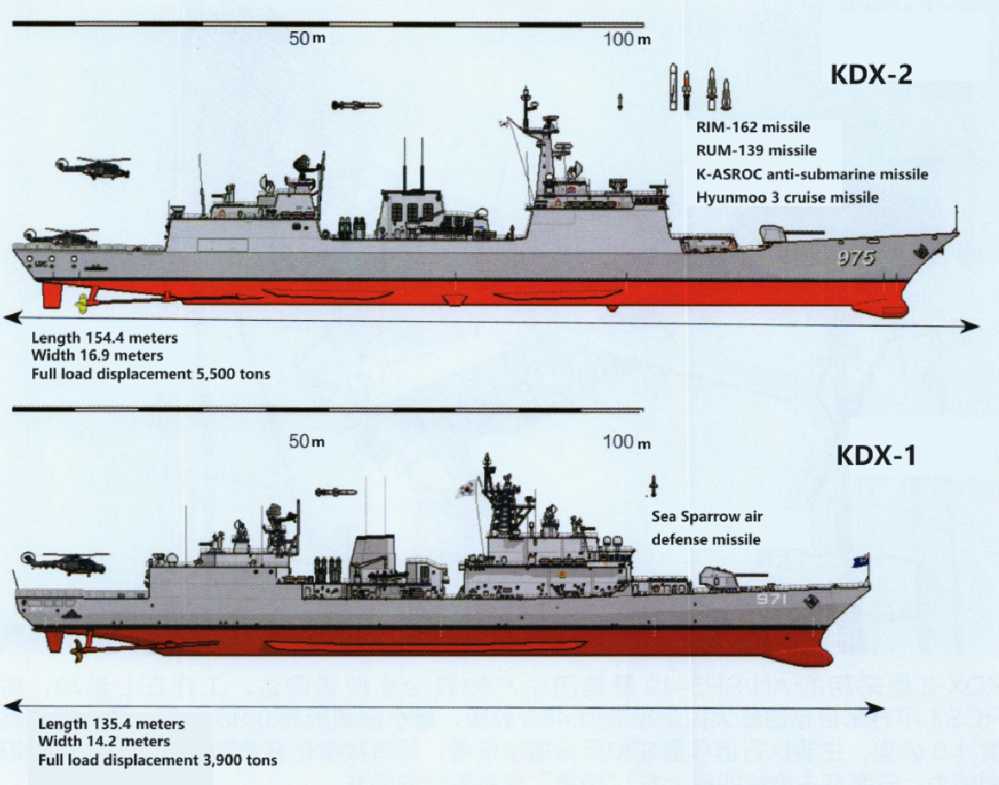
Afterwards, the South Korean Navy quickly launched the design work of the next generation of destroyers, namely the KDX-2, also known as the Chungmugong Yi Sun-sin class. With the experience and lessons of the KDX-1, the design of the KDX-2 was relatively smooth. The South Korean Navy did not "start from scratch" in the design of this type of ship. Instead, it enlarged the hull based on the KDX-1 type, carried out stealth modification, and comprehensively strengthened the armament, so that the combat capability of the KDX-2 type has been comprehensively improved. The South Korean Navy initially planned to build 3 ships, and then increased it to 6 ships, which were completed in 2 batches and jointly undertaken by Hyundai Heavy Industries Group and Daewoo Group.
Design and performance
Basic data and hull design
KDX-2 is 154.4 meters long, 16.9 meters wide, 4.3 meters draft, standard displacement of 4,800 tons, full load displacement of 5,500 tons, 185 people, maximum speed of 30 knots, and endurance of 4,500 nautical miles/18 knots.
The bow of the KDX-2 is equipped with bulwarks and wave-breaking plates. The ship’s hull is at a large angle, and the main deck is changed from outward to inward, forming an obvious angle line, which is conducive to reducing radar reflection signals and playing a certain role in stealth.
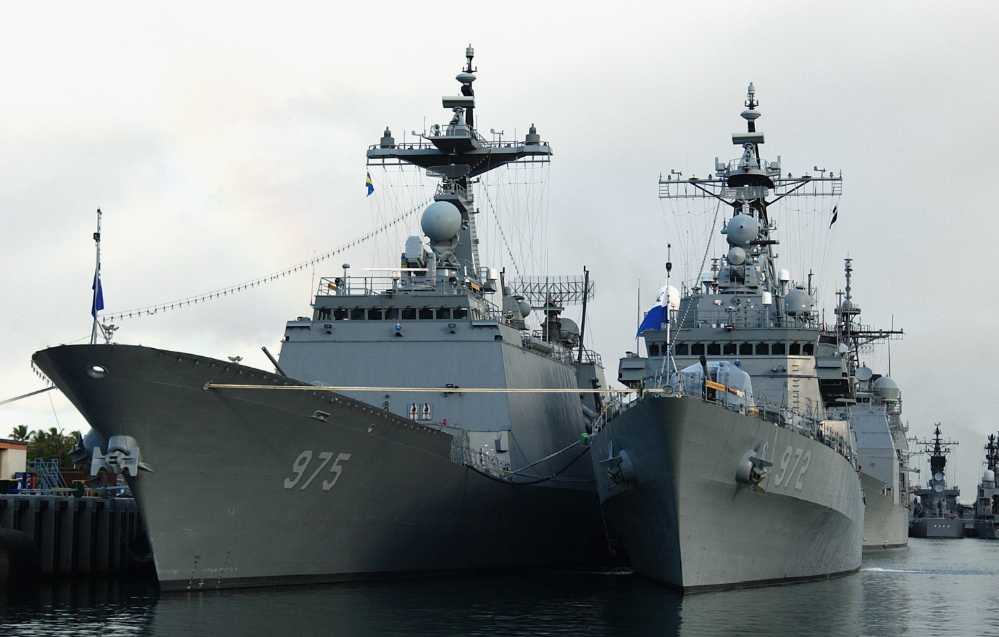
The deck of the KDX-2 is divided into two independent parts, front and back, with the middle as the boundary. The front half is the bridge and main mast, and the back half is the chimney and hangar. The superstructure of the KDX-2 is simpler than that of the KDX-1, and it is tilted inward at a certain angle to reduce RCS (radar cross-sectional area). At the same time, the lattice mast of the KDX-1 is abandoned, and replaced by a tower-shaped alloy main mast with better stealth, and the closure is stronger than that of the KDX-1, with certain resistance to war damage and NBC (nuclear, biological and chemical) capabilities. The combat information center is set on the main deck inside the bridge structure, and is specially reinforced with Kevlar bulletproof plates to reduce the probability of the combat information center being disabled in the event of war damage.
Power
KDX-2 adopts diesel-gas alternating (CODOG) power. The power system consists of 2 LM 2500 gas turbines and 2 MTU 20V 956-TB92 diesel engines, driving 2 propulsion shafts. The diesel engine is responsible for cruising at low speed (the gas turbine is turned off at this time), and the gas turbine works at high speed (the diesel is turned off at this time). 2 gas turbines with a single power of about 40,000 kilowatts and 2 diesel engines with a single power of about 5,965 kilowatts can ensure the maximum speed of 30 knots for KDX-2, and the endurance reaches 4,500 nautical miles at a speed of 18 knots.
Radar
KDX-2 uses almost the same radar configuration as KDX-1, including 1 AN/SPS-49 long-range air search radar and 1 MW-08 three-coordinate C-band sea search radar. The fire control radar is replaced with a larger and better-performing STIR-240 antenna (STIR-180 antenna diameter is 1.8 meters and STIR-240 is 2.4 meters) to match the longer-range "Standard" 2 air defense missile.
MW-08 radar is a lightweight model derived from the SMART series. The radar operates in the shorter G band and can track up to 160 (air)/60 (surface) targets at the same time. The effective detection distance for RCS targets of 1 square meter is about 27 kilometers, and the maximum detection distance is 32 kilometers. It is installed below the AN/SPS-49 radar.
The KDX-2 is equipped with two STIR-240 fire control radars, one in front of the mast on top of the bridge and the other above the hangar. The STIR-240 antenna size reaches 2.4 meters, which can track targets more accurately and continuously, providing accurate, high-data-rate data for shipborne weapons. The STIR-240 weighs about 2.2 tons and has a maximum effective illumination distance of 180 kilometers. It can provide fire control guidance for weapons such as the Standard 2 missile and the RIM-162 Improved Sea Sparrow missile, the Mk 45 naval gun, the RAM close-in defense missile and the Goalkeeper close-in defense gun.
Electronic warfare system
KDX-2 and KDX-1 are both equipped with the SLQ-200(V)5K SONATA electronic warfare system, which includes not only the US-made AR-700 electronic support/countermeasures system and the APECS-2 electronic support system, but also integrates the French "Da Gai" Mk2 jamming system. The "Da Gai" system includes four 6-tube 130mm launchers, which are automatically activated by radar, electronic support system or optoelectronic system, and can quickly launch jamming foil strips with an average reaction time of < 4 seconds.
Combat system
The KDX-2 adopts the KDCOM-2 combat system, which is based on the KDCOM-1 of the KDX-1. Its architecture is basically the same, mainly expanding the command and control capabilities of the "Standard" 2 missile and the RIM-162 missile.
Naval gun
The KDX-2 bow A gun position uses the American Mk 45 Mod 4 (127 mm 62 caliber) stealth naval gun, which is the latest improved version of the Mk 45 family. Compared with the previous models, Mod4 has modified the turret to improve stealth, and the range has also been increased from the early 23 kilometers to 39 kilometers: it can fire 117 The KDX-2 is also the first non-US Navy ship equipped with the Mk 45 Mod 4.
Vertical Launch System
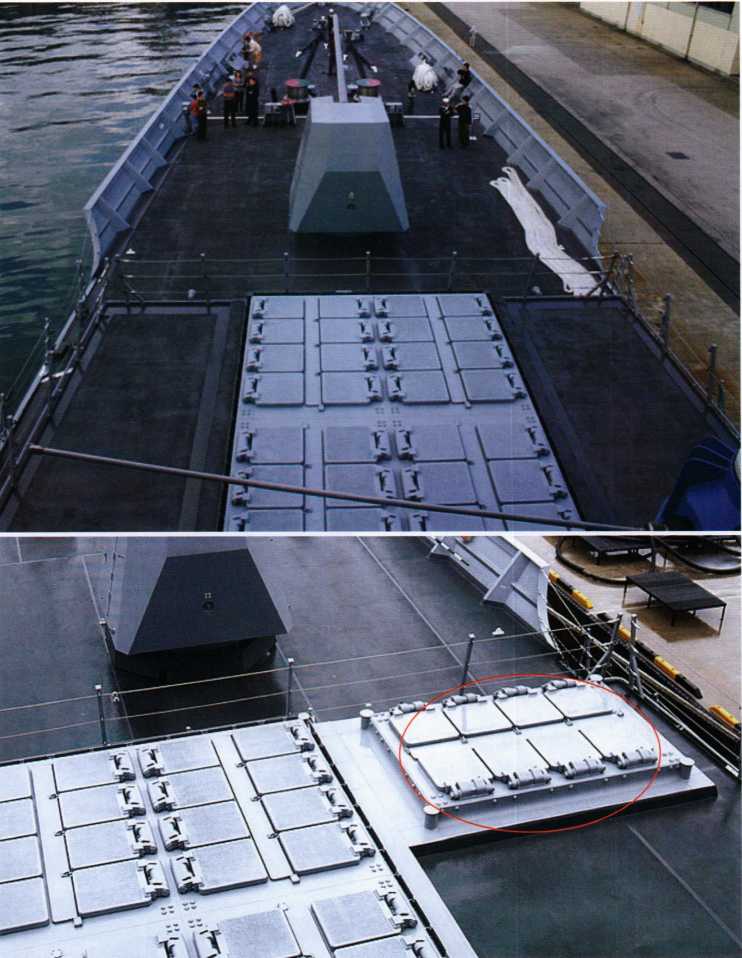
Since the US military refused to upgrade the Mk41 vertical launch system of the KDX-2 to be compatible with the Tomahawk cruise missile, and the South Korean Navy urgently needed the ability to strike at sea, it could only develop its own vertical launch system (KVLS). In order to adapt to the domestically produced KVLS, the last three KDX-2s moved the Mk 41 system slightly to the left, and set up three groups of 8-unit KVLS in the empty space on the right to launch K-ASROC anti-submarine missiles and Tianlong cruise missiles (i.e. "Hyunmoo" 3). However, after the KVLS was developed, only one group was installed on the KDX-2. From 2012 to 2016, the South Korean Navy spent $900 million on the KVLS. 100 million won (about 73 million US dollars) to fill the two empty groups.
K-ASROC is the "Red Shark" anti-submarine missile, which was developed by South Korea based on the "Blue Shark" torpedo. It is about 5.7 meters long, 0.38 meters in diameter, weighs 820 kilograms, and has a maximum range of 20 kilometers.
"Tianlong" missile is the "Hyunmoo" 3 cruise missile. "Tianlong" is an early camouflage code. "Hyunmoo" 3 and "Hyunmoo" 1/2 have no direct technical inheritance relationship. The reason why the "Hyunmoo" code is still used is only to represent the inheritance of long-range attack weapons. Among them, the "Hyunmoo" 3A weighs 1.3 tons, is 12 meters long, has a diameter of 0.8 meters, and a warhead of 500 kilograms (restricted by the "South Korea-US Missile Agreement" and "Missile Technology Control" and other treaties), adopts GPS/INS composite guidance mode, and has a maximum range of 500 kilometers.
After World War II, South Korea was unable to develop long-range attack weapons with a range of more than 180 kilometers under pressure from the United States. In 2001, after negotiations between the Kim Dae-jung government of South Korea and the United States, the United States agreed to restrict South Korea in accordance with the Missile Technology Control Regime. At the same time, a backdoor was opened for South Korea: if the warhead of the cruise missile developed by South Korea is below 500 kilograms, the range will not be restricted; in 2012, the Lee Myung-bak government and the United States conducted the second negotiation of the South Korea-US Missile Agreement, and the restrictions were reduced to 800 kilometers and 500 kilograms of warheads; in 2017, the Trump administration and South Korea reached a consensus that no technical cap would be set on South Korea’s missile development.
Close-in defense system
The South Korean Navy installed a 21-unit "RAM" missile launcher behind the top of the KDX-2 bridge. The missile is about 2.82 meters long, 0.127 meters in diameter, weighs 73.5 kilograms, has a range of about 10 kilometers, and the purchase price of a single missile is about 1.04 million US dollars. It uses infrared/passive radar composite guidance.
A "Goalkeeper" close-in weapon system is installed above the hangar at the stern of the ship. It is a 7-barrel 30mm close-in weapon system jointly developed by the Netherlands and the United States. It consists of a fully automatic 7-barrel 30mm "Avenger" machine gun and a STIR-240 fire control radar. It is arranged in a stepped manner above the hangar. The position of the STIR-240 radar is slightly higher, which is convenient for omnidirectional tracking of targets. The shooting elevation angle of the "Goalkeeper" system is between -24°~ +84°, the horizontal firing range is between ±180°, the firing rate is 4200 rounds/minute, and the maximum range can reach 2 kilometers. Compared with the Mk 15 adopted by NATO, the advantage of the "Goalkeeper" system is that it uses a 30mm caliber, the kinetic energy of the ammunition is higher, the damage effect on the interception target is better, and the multi-target engagement capability is stronger. It can track and attack 10~20 targets at the same time. The disadvantage is that it is more expensive, with a unit price of about 2 to 4 times that of Mk15. The system needs to penetrate the deck for installation, and its adaptability is not strong enough, while Mk 15 can be directly installed in almost any empty space on the deck.
Anti-ship missiles The two 4-unit anti-ship missile launchers of the KDX-2 type are arranged in a cross-opposite tilted manner behind the chimney, used to launch the US-made "Harpoon" anti-ship missiles, and are also compatible with the "Starfish" anti-ship missiles. The KDX-2 is the first ship of the Korean Navy to be equipped with the "Starfish" missile. The "Starfish" is a Korean domestic derivative of the "Harpoon" and was jointly developed by the Korean Defense Development Agency, LIG NEX1 Company and Hanwha Systems Company. Although it was developed on the basis of the "Harpoon", the two are quite different in details such as the shape of the missile body and the aerodynamic wing surface. The size of the "Starfish" is also much larger, so it is easy to distinguish them.
The "Starfish" is about 5.7 meters long, weighs about 660 kilograms, and has a warhead of about 120 kilograms. The main power is a Samsung SS-760K turbojet engine. It uses GPS/INS+terminal active radar guidance, with a maximum range of 150 kilometers, which exceeds the range of the later models of the "Harpoon". At the same time, the terminal can penetrate at a speed of 0.95 Mach and perform S-shaped maneuvers. However, due to the high cost of the "Starfish", a single missile can reach 2 million US dollars, which is almost twice that of the "Harpoon", so the South Korean Navy did not choose to completely replace the "Harpoon" with the "Starfish", but equipped these two types of anti-ship weapons at the same time.
Although the cost of the "Starfish" is high, the benefits are also obvious. On its basis, the South Korean Navy further developed the "Sea Dragon" land attack cruise missile with a range of 310 kilometers, and exported the whole missile to Colombia, and the missile’s rocket booster engine was exported to Vietnam.
Anti-submarine system
The KDX-2 has an ATLAS DSQ-21BZ active/passive sonar and a SOR-220K towed array sonar (a Korean derivative of the US-made AN/SQR-19), paired with two triple-mounted Mk 32 torpedo tubes (capable of launching Mk46 light anti-submarine torpedoes) and SLQ-261K towed torpedo decoys (a Korean licensed production model of the US-made AN/SLQ-25 anti-torpedo decoys), plus the "Super Lynx" helicopter at the stern, forming the KDX-2’s anti-submarine system.
Carrier-based aircraft
The "Super Lynx" is a carrier-based aircraft derived from the "Lynx" helicopter. It is equipped with two LHTEC CTS800-4N engines jointly developed by Honeywell and Rolls-Royce, which has a huge leap in power output. The fuselage uses a large amount of composite materials, and the avionics use digital avionics of fly-by-wire flight control and 1553 data bus. At the same time, it is equipped with radar and optoelectronic pods with better performance.
The KDX-2 type has a hangar, which is slightly to the right. The space inside the hangar is very spacious, and it uses a landing aid system similar to the Japanese Maritime Self-Defense Force’s high-wave class, which means that the KDX-2 type has the ability to carry two helicopters at the same time, which greatly enhances the anti-submarine capability of the ship.
Service status and actions
The KDX-2 type was built during the Korean economic crisis, so the Korean government strictly controlled its costs. On December 2, 2003, the first KDX-2 entered service in the South Korean Navy. Daewoo Shipbuilding and Hyundai Heavy Industries Group subsequently maintained a delivery rate of one ship per year. All six ships were put into service before 2009, and were named after monarchs or famous generals in the history of the Korean Peninsula.
On March 3, 2009, the South Korean National Assembly passed the "Agreement on the South Korean Army’s Dispatch of Troops to the Somali Waters". The South Korean Navy dispatched the first escort warship KDX-2 "Wunmu Daewang" to the Gulf of Aden, accompanied by a "Super Lynx" helicopter and a speedboat. The formation was named the Cheonghae Force. On March 13, the Cheonghae Force set off from the Naval Operations Command in Busan and arrived in the Gulf of Oman on April 14, joining the 151st Joint Task Force led by the US Navy to perform escort and anti-piracy tasks together.
On January 15, 2011, the South Korean merchant ship "Samho Treasure" was hijacked by 13 pirates in the waters of Somalia. Since the South Korean "Samho Dream" set the record for the longest hijacking time (217 days) and the highest ransom (US$9.5 million) in 2010, the South Korean government decided not to negotiate or pay the ransom and directly use force to rescue the ship and hostages for the sake of its international reputation. The then President Lee Myung-bak issued an order to rescue the hostages. The Cheonghae Unit launched the first assault, but failed and three special forces were injured.
The South Korean Navy then adjusted its plan. In the early morning of January 22, the South Korean Navy Special Warfare Group on the Cheonghae Unit "Choi Young" launched a rescue operation code-named "Dawn of the Gulf of Aden" with the intelligence support of the US Navy. The "Super Lynx" helicopter first used a 12.7mm machine gun to strafe the bridge and deck of the merchant ship to attract the attention of the pirates. After that, the South Korean Navy special forces boarded the merchant ship in an inflatable speedboat and successfully killed 8 pirates and captured 5 alive. Five special forces were injured in the assault and 21 hostages were safely rescued. The entire operation took 5 hours. This was the first time that the South Korean military independently carried out actual combat missions overseas.
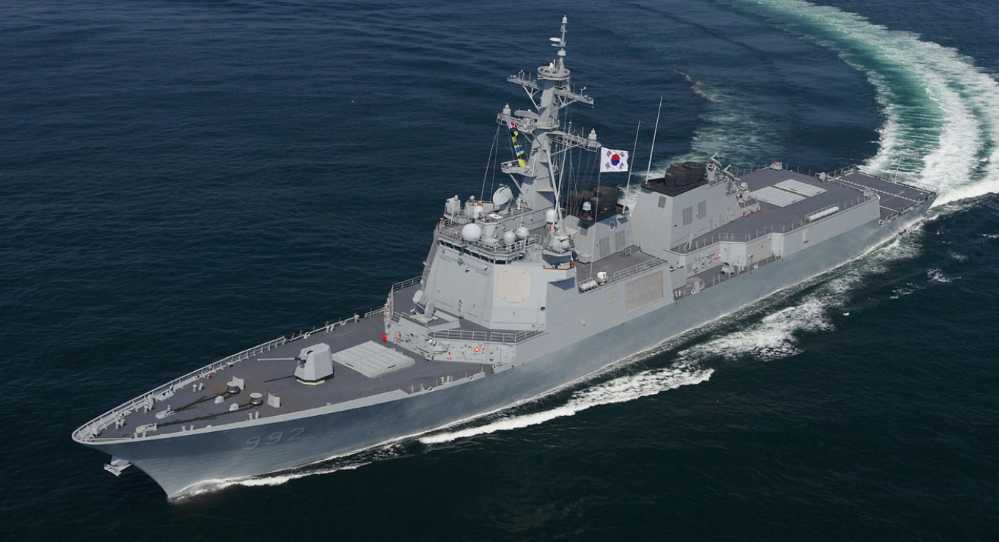
Existing problems and subsequent upgrades
The KDX-2 has 56 vertical launch units, including 24 KVLS units and 32 Mk41 units. Since they are not dispersed, they are all installed at the B gun position. Therefore, the deck opening of this gun position is particularly large, almost occupying the entire gun position. It is inevitable that problems will occur if too much equipment is stuffed into a limited space.
In 2019, an article published in the professional journal of the Korean Quality Association revealed that the two KDX-2s currently in service in the Korean Navy have successively experienced deck cracking and metal fatigue in the vertical launch area. After the incident was exposed, the Korean Navy conducted a comprehensive inspection of the problematic B gun position and strengthened the structural treatment to prevent similar situations from happening again.
Although the KDX-2 has a certain degree of regional air defense capability, it is not equipped with an active phased array radar. Compared with the Kongo-class and Atago-class of the Japanese Maritime Self-Defense Force and the 052C of the Chinese Navy, as the backbone of the Korean Navy’s ocean-going fleet at the time, its long-range air defense and multi-target engagement capabilities are still slightly insufficient.
In 2012, all three KDX-3s were in service, and the prototype of the Korean Navy’s ocean-going fleet began to emerge. But at this time, South Korea was facing considerable military pressure. Although Japan did not have a new "Aegis" destroyer in service, its new generation of multi-purpose destroyers, the Akizuki class, had begun to serve; although the Chinese Navy did not have a new missile destroyer in service, the four 052Cs on the slipway had been basically completed; North Korea began to strengthen the development and deployment of ballistic missiles since the late 1990s. South Korea’s anti-missile pressure was huge, and the number of KDX-3s was insufficient. There were only two options left for the Korean Navy: either to further upgrade the KDX-2 or to build a new KDX-2.
In 2009, the South Korean Navy announced the construction plan for the second batch of KDX-2, codenamed KDX-2A. It is planned to equip it with the "Aegis" system with AN/SPY-1F phased array radar as the core, and SMART-L search radar, which can greatly enhance the air defense capability of KDX-2A. However, due to multiple factors, the construction of KDX-2A was eventually abandoned.
In 2013, Lockheed Martin proposed an upgrade plan for KDX-2. The upgraded KDX-2 is equipped with the AN/SPY-1F four-sided phased array radar in the KDX-2A plan. However, this plan has only remained in the model stage due to funding and cost-effectiveness issues. The South Korean Navy believes that the funds required for the upgrade are huge. Instead of spending $1 billion to upgrade the old ship, it is better to add and repair it and build a new ship.
In 2021, South Korea decided to upgrade the KDX-2 again. It is planned to upgrade the overall combat capability of 6 KDX-2s in batches from 2022 to 2031, taking 9 years and spending about 420 million US dollars. The upgrade projects include replacing the MW-08 radar with the domestic SPS-550K radar and replacing the domestic towed array sonar. However, with the launch of the first ship of the KDX-3 BatchⅡ "King Jeongjo" and the commissioning of the new generation of Daegu-class frigates, the possibility of large-scale upgrades of the KDX-2 is gradually decreasing. In the future, the South Korean Navy may carry out small-scale upgrades and enhancements to the KDX-2. After all, it won’t cost too much to repair it.
Summary
Overall, the air defense combat capability of the KDX-2 is somewhat behind that of the new generation of surface ships in Europe and the United States. However, through the construction of this class of ships, the Korean shipbuilding industry has accumulated experience in the development of medium-sized ships, laying the foundation for the future development of large "Aegis" destroyers in South Korea.
As the backbone of South Korea’s new generation of ocean-going fleet, although the KDX-2 is not equipped with a phased array radar, it has improved the problems of the previous ship and has a good sailing rate and technical and tactical level. Compared with the KDX-1, the KDX-2 has modified the design defects and strengthened the armament; compared with the expensive KDX-3, the KDX-2 has the advantages of low price and large quantity. The ship body of about 5,000 tons, equipped with a 56-unit vertical launch system, electronic system and combat management system, can be called "luxury". The KDX-2 is the most solid generation in the entire KDX program and will remain active for a considerable period of time in the future. It is a force that cannot be underestimated in the waters of the Asia-Pacific region.