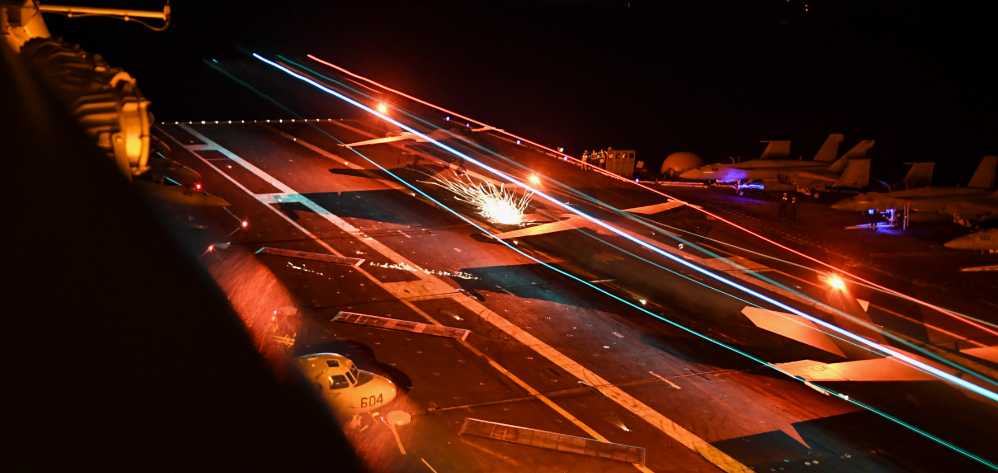
Landing is the riskiest phase of an aircraft flight, and landing on an aircraft carrier, especially on a small or medium-sized aircraft carrier, is more challenging due to the limited length of the flight deck, the motion characteristics in complex sea conditions, and aerodynamic effects. To meet this challenge, the landing guidance system came into being.
From the 1920s when aircraft began to land on ships to the 1950s, pilots had to rely entirely on their visual perception of the aircraft carrier deck and the assistance of the carrier landing officer (LSO) to land. Before the introduction of the optical landing guidance system (OLS), the early LSO mainly used colored flags, short paddle-shaped command signs, and illuminated batons to guide landings.
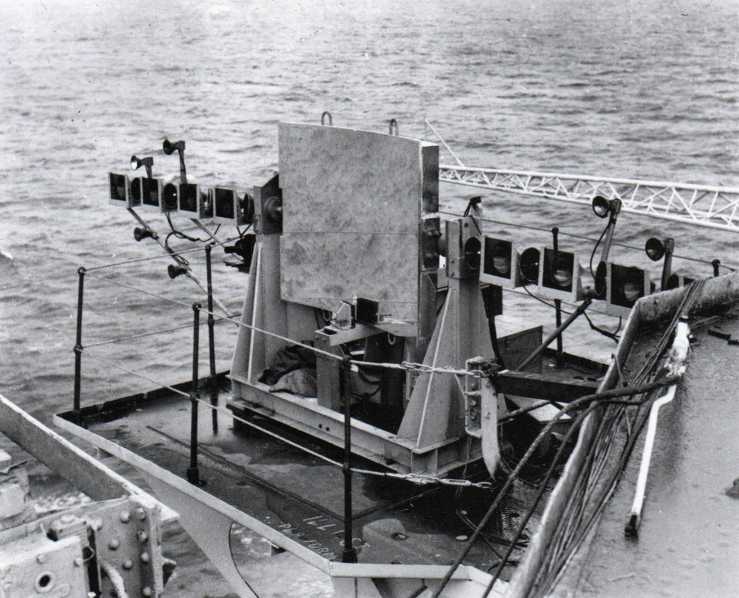
The original OLS was a mirror landing aid system, one of several inventions that revolutionized aircraft carrier design after World War II. The core of the device is a concave mirror controlled by a gyroscope, generally located on the port side of the flight deck. On both sides of the mirror are a row of green reference lights. A bright orange light source enters the mirror to form a light ball, and the pilot lands visually. According to the relative position of the light ball and the reference light, the correct glide path position of the aircraft is indicated: if the light ball is higher than the reference light, the glide path is judged to be too high; if the light ball is below the reference light, the glide path is judged to be too low; if the light ball is between the reference lights, the aircraft is on the correct glide path. Since the gyro stabilization compensates for most of the movement of the flight deck caused by waves, it can provide a constant glide path.
Initially, the system was highly anticipated, and experts believed that it could help pilots land without LSO instructions. However, when OLS was first introduced, the accident rate increased, so a landing guidance system with the participation of LSO had to be studied, and the pilot still needed the assistance of LSO when landing. LSO provides additional data to the pilot via radio, including key data such as engine thrust, glide path position and landing heading. The OLS system can also manually send out light signals, such as a flashing red light to indicate "leave", and other light signals can convey information including "landing allowed", "increase thrust" or "reject landing". This development reduced the US carrier landing accident rate by about 80% in the 1950s. Another well-known carrier landing guidance system is the Fresnel Lens Optical Landing System (FLOLS). The subsequent development of the system basically retains the same landing mirror assist function, but improves the components and other functions. The combination of four mirrors and light sources in the original OLS was replaced by the Fresnel lens series.
The development of the US autonomous landing guidance system
After the Fresnel system appeared, engineers at the Lakehurst base in New Jersey, USA, made technical improvements to it. The new system is called IFLOLS. On the basis of retaining the basic functions of FLOLS, the improvements include: integrated stabilization mechanism and the use of gyroscopes and radar signals to better compensate for deck movement, providing more accurate glide path position indication; using fiber optic light sources, which can present clearer light through lens projection, so that pilots can identify signals farther away from the aircraft carrier, making the transition from instrument flight to visual flight smoother. In some cases, the manual landing visual aid system (MOVLAS) can be used. This is a visual aid landing backup system, usually used in the case of IFLOLS failure or pilot landing guidance training, designed to present glide path information in the same visual form as IFLOLS.
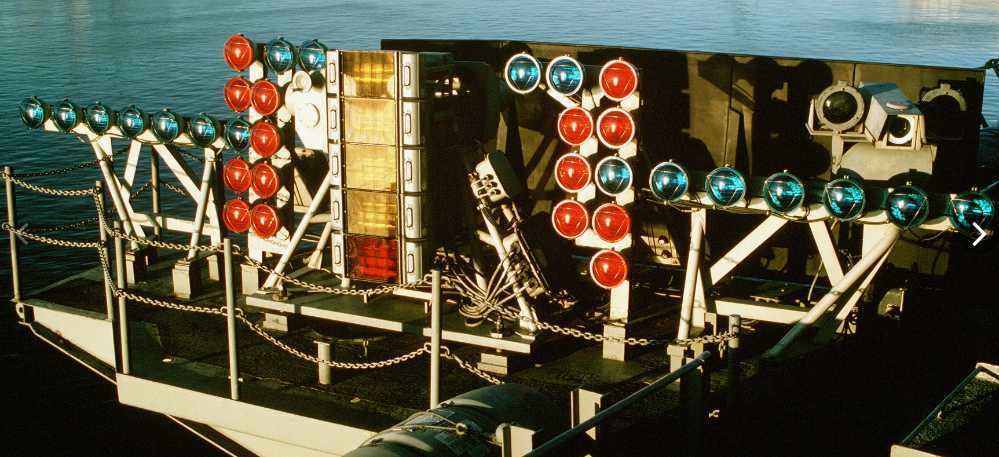
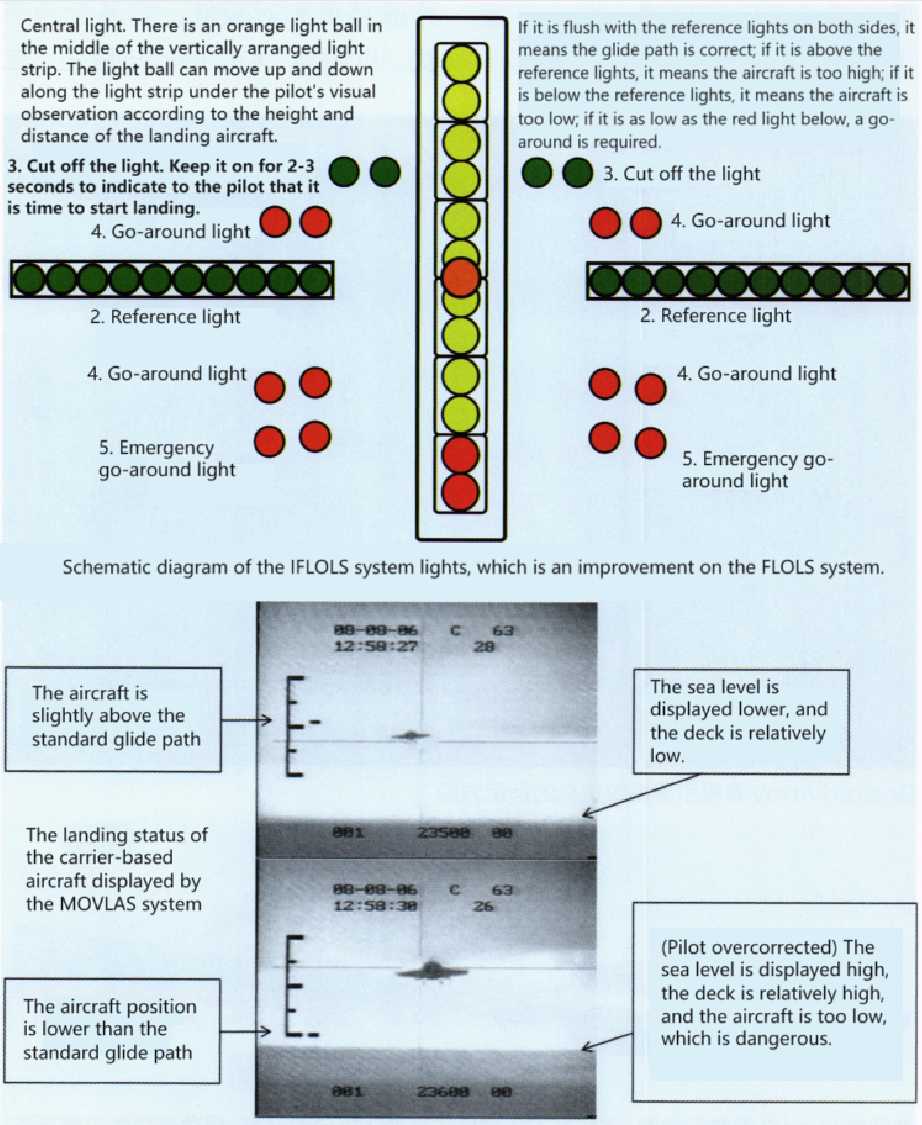
The optical landing aid system produces a light ball indicating the relative position of the aircraft relative to the glide path, similar to the OLS.
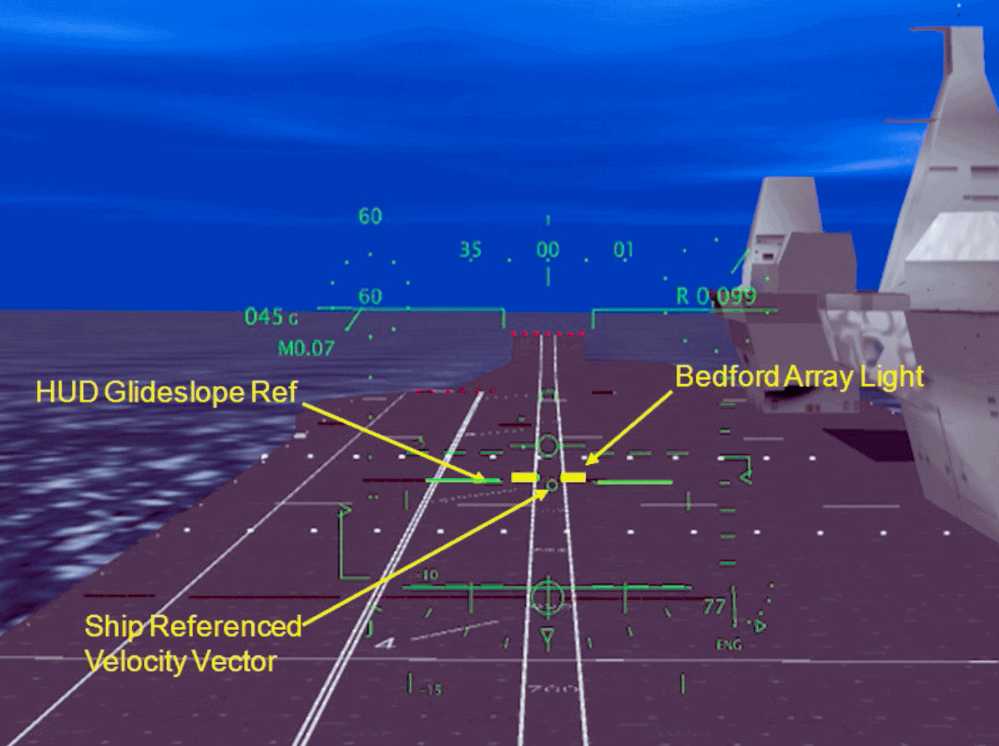
In 2012, the U.S. Navy announced the development of a new aircraft carrier landing guidance system. The pilot’s glide path indication is determined by comparing the light mark on the deck with the indicator light on the cockpit windshield, just like in a computer game. The new system is called Bedford Array, which cancels the searchlight unit in the optical landing aid system and changes it to a horizontal light mark formed on the deck, and displays relevant information on the aircraft instrument. Tests have shown that the Bedford Array system can significantly improve the accuracy and safety of aircraft landing on the deck.
In addition, the United States has also developed a precision landing aid system (JPALS). JPALS enables the vast majority of aircraft to land on the deck, including many aircraft without digital systems, and can also exchange information with the onboard equipment of F-35C fighters and MQ-25 series drones. JPALS consists of a GPS system, local precision positioning, and an information exchange system with aircraft. The information required for landing can be automatically shared with manned and unmanned aircraft with compatible electronic systems. Since there is no need to coordinate landings with dispatchers, JPALS will reduce the landing interval of aircraft. On aircraft carriers carrying new aircraft, JPALS can eliminate the radar required to monitor the airspace, thereby freeing up some resources for other electronic systems of the aircraft carrier.
Currently, when the F/A-18EF lands on an aircraft carrier, the pilot must control and adjust the aircraft’s angle of attack, pitch, and tilt according to the landing conditions. Since 2019, fighters such as the F/A-18E/F, F-35B/C, and EA-18G on US aircraft carriers have begun to receive new "carpet aircraft" software, which allows aircraft to turn on autopilot when landing, eliminating the impact of "cross-connection" in control. The "carpet plane" software can independently assume the task of adjusting the glide position, and the pilot hardly needs to make additional controls. Tests have shown that under the control of the "carpet plane", the deviation of the flight deck contact point is reduced by about 50% compared with a fully manual landing.
The development of the Soviet/Russian autonomous landing guidance system
The landing guidance system Luna-3 of the Soviet/Russian aircraft carrier cruiser began with the 1143.5 project. Its first prototype system was developed based on the FLOLS system, which uses the principle design of forming a light beam in a vertical plane. Unlike known similar systems, a series of plane lights are similar to traffic lights, yellow, green and red from top to bottom.
When flying in the green area, the aircraft position corresponds to the normal glide path and can land on the third of the four arresting cables; when flying in the yellow area, the aircraft is likely to hook the fourth arresting cable, and if it is at the top of the yellow area, it needs to go around; if the flight altitude is lower than the glide path, the pilot will see a red beam and receive corresponding instructions to correct the position. If there is a serious deviation, a flashing red light will appear, indicating that it is necessary to immediately deflect to the left and make an emergency go-around.
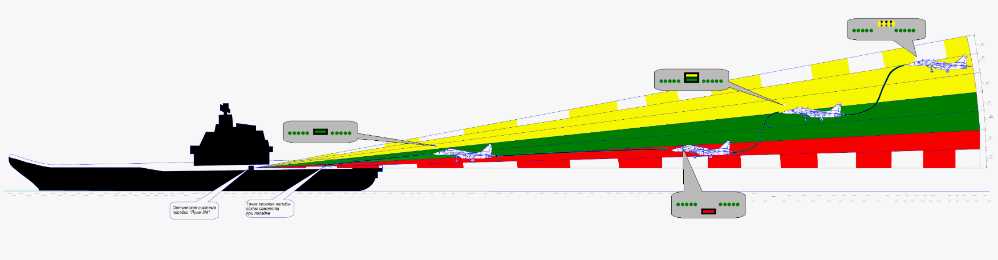
Another invention of the Soviet Union in this field is the "resistor" K42 system, which allows the aircraft to land on the deck in guidance mode. The system automatically calculates and transmits command signals, and the pilot only needs to follow the instructions. The system allows the aircraft to automatically enter the guided landing process, but when landing, the pilot must switch to manual control. The "Resistor" K42 system was developed in the late 1980s, but due to the disintegration of the Soviet Union, it failed to pass the test and improvement results. Only the analog data transmission line was put into use on the "Kuznetsov", which has a relatively low accuracy and is easily interfered. The improved version of the "Resistor" K42 is the "Resistor" E, which has a digital channel for exchanging data with carrier-based aircraft, which is specially used to control the close-range flight and landing of the MiG-29K/KUB carrier-based fighter. The Indian "Vikramaditya" aircraft carrier has installed this system.
In order to further reduce the landing risk of carrier-based aircraft, Russia has developed a satellite wireless navigation system designed specifically for carrier-based aircraft. The system was developed by the FGUP Experimental Research Center. The computer on the aircraft carrier cruiser constantly calculates its coordinate position, compares it with the coordinate position of the aircraft, and transmits this data to the carrier-based aircraft in real time. At the same time, the carrier-based aircraft also receives data directly from the satellite. This double or even triple positioning technology enables the carrier-based aircraft’s computer to determine its position and altitude (including the altitude relative to the flight deck) multiple times in a short period of time, with an accuracy error of no more than 10 centimeters. All information on the carrier-based aircraft’s instruments is displayed on the same screen, and the pilot does not need to divide his attention between the aviation horizon, speed indicator, and engine speed indicator. With the blessing of this technology, the pilot only needs to monitor the flight situation by controlling the speed and altitude, and the carrier-based aircraft will land accurately on the deck. "The Su-33 on the Kuznetsov is expected to be the first aircraft equipped with this system. Even if the pilot does not have much experience in shipboard takeoff and landing, he can land on the carrier in all weather conditions with the help of this system.
At present, the automatic landing guidance system has been well developed in both civil and military carrier-based aircraft. The current technical level has allowed drones to land completely automatically, as confirmed by the X-47B drone project that has been discontinued in the United States. The development of these systems will provide new directions for breakthroughs in carrier-based aviation technology to reduce the burden on pilots during the landing phase and effectively expand the air force on the aircraft carrier deck, enabling them to land accurately and safely in any weather conditions.